What does an intelligence agency do with its fuck-ups? Not the operational mistakes, or even the policy disasters, but the people who, for one reason or another, cannot be kept as part of the active service but cannot just be let go. Maybe they embarrassed the agency in some way, and giving them the boot would just compound the embarrassment. Maybe they were close to someone caught working for the other side, not close enough to charge with a crime but too close to be trusted anymore. Maybe they were too traumatized in the line of duty to do good work anymore, but getting rid of them would show others that the reward for sticking one’s neck out—perhaps literally—is getting the sack. Unless the agency in question is the Stalin-era NKVD, such people cannot be shot out of hand.
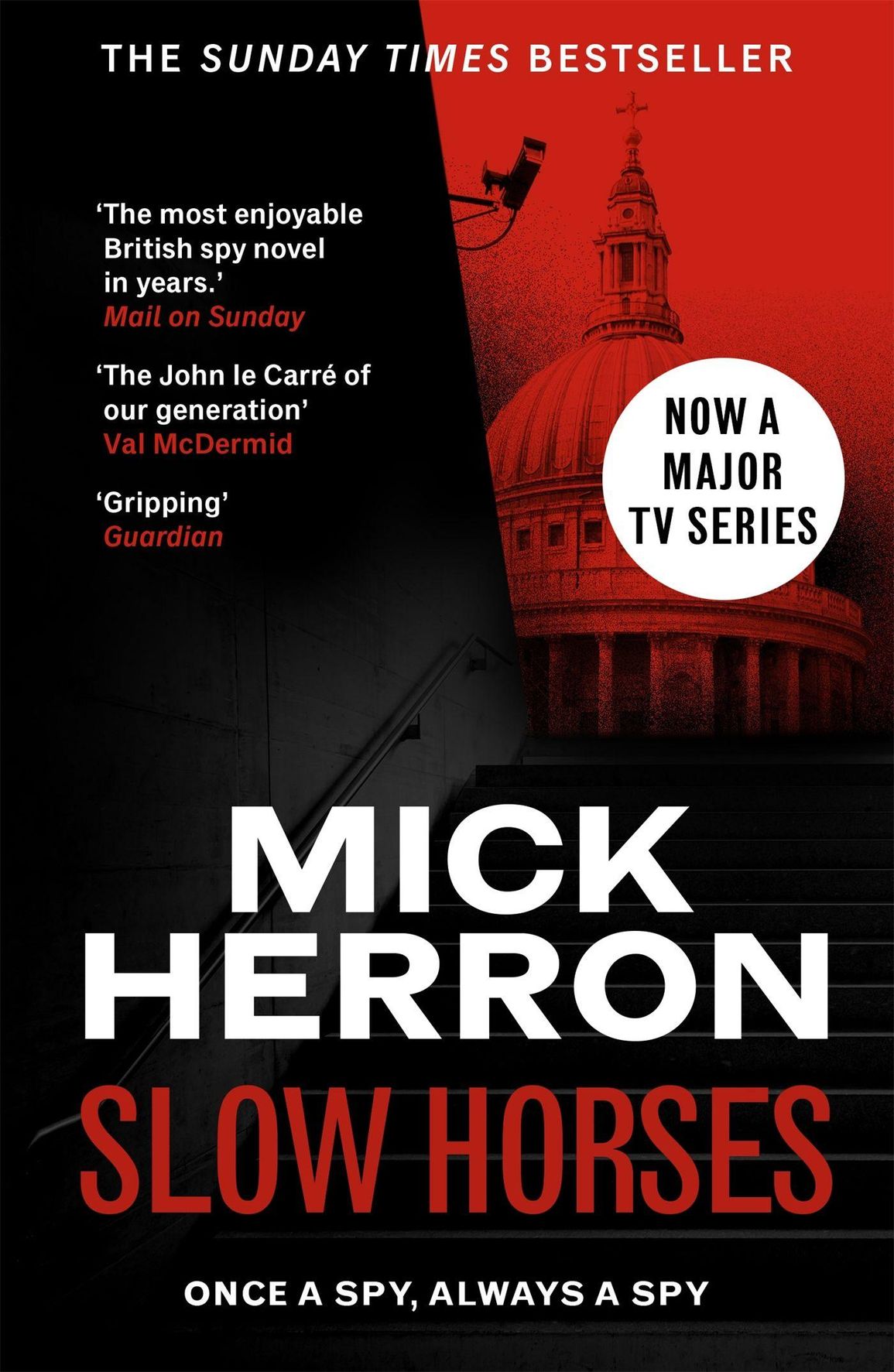
In Mick Herron’s Slow Horses—the first novel in a series that now runs to nine novels and five novellas, and which has spawned a television adaptation that is presently making its sixth season—the solution that MI-6 has chosen is to put them out to pasture in a place called Slough House, give them tiresome, repetitive, meaningless work, and hope they take the hint to quit or retire of their own accord. Slow Horses introduces the current denizens of Slough House. The name is pronounced with one of those ineffable British vowels that render the first word somewhere between “slow” and “slaw.” Any resemblance between Slough House and the Slough of Despond from Pilgrim’s Progress is surely intentional on the part of the service’s upper mandarins. Said denizens occasionally refer to themselves as the Slow Horses, sometimes with dark humor, sometimes with not quite enough despair to quit.
There is River Cartwright, whose final training exercise went decisively pear-shaped, causing a shutdown of King’s Cross station, a massive and expensive public embarrassment. He says he was set up. Upper ranks say that he would say that, wouldn’t he? Fortunately for Cartwright, his grandfather was a legendary agent in his time; the long afterglow of that service is enough to keep him from getting fired outright, but not enough to keep him out of the purgatory of Slough House. Min Harper had a momentary lapse of attention and left important secret documents on a train. More embarrassment. Louisa Guy lost an important suspect, just lost him. Roddy Ho is the guy in the chair, and he has all of the unpleasant traits a reader would expect from a computer guy who’s also a spy, and a couple more that Herron added just for fun. Overseeing this motley crew is Jackson Lamb, a relic of the Cold War—the book was published in 2010, so only 20 years have passed since the fall of European communism—who will not fit in with the new era. He was a hot-shot, and he does not hesitate to let his underlings know it. He also has attitudes toward women and minorities that would have been out of place in the 1980s, nevermind in Cool Britannia.
The workings of the plot concern a formerly influential journalist-columnist who has deep ties to the UK’s violent far-right scene, the kidnapping of a British university student of Pakistani descent by a previously unknown group called the Sons of Albion, and machinations within the intelligence community to improve their standing and secure their budgets. Some of the Slow Horses have been getting more substantive work than they should have been, and when things start to go awry, Jackson Lamb is none to pleased to find that higher-ups have been grazing on his paddock. The Horses themselves discover that they are closer to the trail of the kidnappers than anyone else, and they see a chance at redemption, a chance to prove that they belong on the real racecourse, not put out to pasture. They overestimate themselves, and situations go from bad to worse.
In fact, they are not the only ones who have overestimated themselves, as Jackson Lamb discerns in a meeting about halfway through the book. “‘Oh, for fuck’s sake,’ Lamb said. ‘How could this get worse?'” (p. 198) Several different ways, as it turns out. Slow Horses is a darkly hilarious romp. I’ve become more skeptical about spy novels in recent years because they often portray spies as a true aristocracy, more capable than mere accountable public servants, and I don’t care for that kind of aristocracy any more than I do for the hereditary kind. Slow Horses knows that a lot of the business is a put-on, novels about it doubly so. It also gives the reader a chance to cheer for the underdogs, the people done dirty by bureaucracy or people who made a mistake and wonder if they will be paying for it forever. In the end, some of the Slow Horses run fast, and most of the day is saved. There are also enough loose ends to set up further tales, the next of which I will now go and read.
+++
Doreen took the Slow Horses out for a walk long before I did. Her review of the first book is here, and reviews of the others the has read can be found with the tag Mick Herron.

 Al Singh
 Doug Merrill
 Doreen Sheridan
 Emily Lauer
 John Pitzel
 Lars N. Goldschlager
 Laura Eilers
 Professor X
 Robert Maedgen
 Sylvere Ap Leanan
 The Shire
3 comments
This is another of those series I desperately wish I still had time for. One of these days! And welcome aboard!
Author
Thank you! I’m glad to have started reading them (finally). And soon I may need to buy a bunch in the series to make sure that I have them in the same edition. Are you like that?
The No. 1 Ladies Detective Agency series now runs to 25 books, some of which I have from the US publisher and some from the UK publisher. So many different designs, sigh.
Only if I’m displaying them on my bookshelf! I used to try collecting the same editions but don’t think I’ve ever quite managed it, plus I mostly read on Kindle now. It’s actually pretty rare for me to buy books nowadays, since I get sent so many and am trying to make space by giving the read ones away.