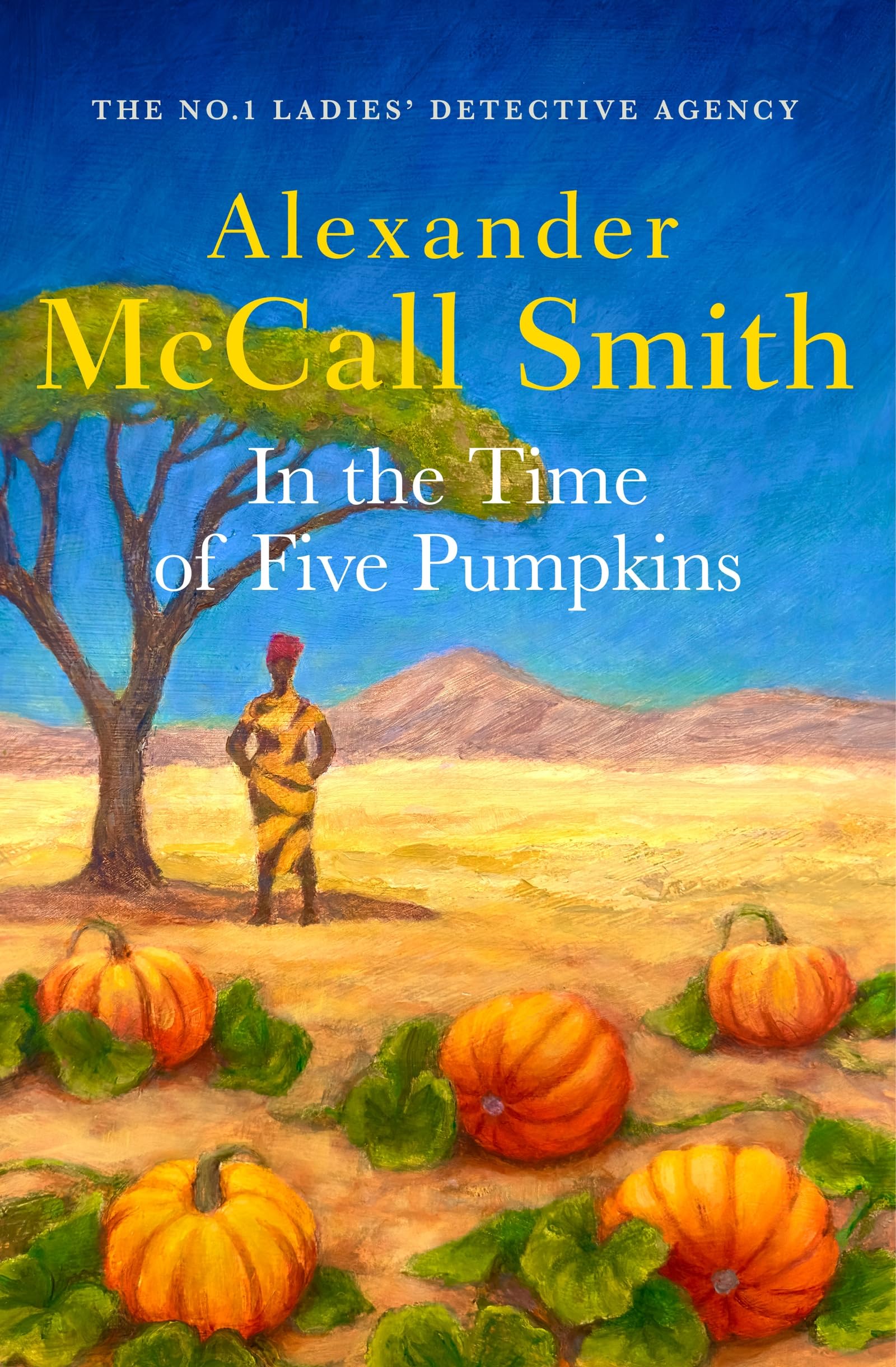
At the beginning of In the Time of Five Pumpkins, Botswana is waiting for the rainy season to begin. The days are hot, the nights do not offer enough relief. People are on edge and prone to be short with each other. That tendency shows up in the novel’s first case, a husband who is worried that his wife is having an affair. That type of case is bread and butter for a private detective agency, but the man, Mr Excellence Modise, gets off on the wrong foot by presuming that Mma Makutsi is a secretary. She did train at the Botswana Secretarial College — and earned ninety-seven percent on her final exam — but she has long since having a role in the No. 1 Ladies’ Detective Agency with anything like a modest title. In fact, the first chapter contains another round of the long-running comedy in which Mma Makutsi gives herself another promotion in title, and Mma Ramotswe must take the change in stride. She also takes a moment to reflect on one of the most important reasons for her success.
Mma Ramotswe reminded herself of what she had learned from her father and of what she had picked up simply by being an engaged citizen. You could learn most things, she thought, by simply keeping your eyes open and listening. That’s where most people fell down — they would not listen. We spend a lot of time shouting at one another, Mma Ramotswe once observed. If we spent a fraction of that shouting time on listening, we would do far better. (p. 4)
The two detectives do not shout at Mr Modise, but they come closer to it than probably either of them would like to admit. They do listen to him, but he is very full of himself, and he compounds that by making sweeping statements, often wrong. But Mma Makutsi and Mma Ramotswe are professionals, and they agree to take his case, even if they decide afterward that they both have uneasy feelings about that man. Another brash man shows up soon in the story, this time in the company of Mr J.L.B. Matekoni, Mma Ramotswe’s husband. This is Mr Freddie Mogorosi, a colleague in the motor trade. He owns a Mercedes dealership, but he has brought his own car in to Tlokweng Road Speedy Motors for a repair. He trusts Mr J.L.B. Matekoni’s old-school skills. In the course of several conversations, he also seems to be cultivating Mr J.L.B. Matekoni as a friend, and furthermore wants to put his name forward for a position on a new board that will liaise between the government and the motor trade.
It is all a bit sudden for Mma Ramotswe, and more than a little suspect. She reminds herself that it is not easy for men to make new friends, especially established men with steady jobs and a family life that does not generally bring them into contact with new people. She further reminds herself that a spouse’s choice of friends is something that should be left entirely up to them, outside of extremely unusual circumstances. But when a fishing expedition unexpectedly involves a crocodile, Mma Ramotswe begins to wonder whether this might be one of those extremely unusual times.
The Modise case also takes a turn when Mr Modise’s wife realizes that she has been followed and in turn follows the detectives back to the agency. An awkward conversation follows, made even more awkward when she says that she thinks that he is the one having the affair. Could they not help her? It is, after all, the No. 1 Ladies’ Detective Agency. Surely solidarity among women must count for something, especially with so many no-good men running around these days.
Even in the twenty-sixth book in the series, McCall Smith finds ways to delight. Sometimes spending time with these characters is like visiting old friends. The latest news is in fact new, but the rhythms are familiar and comfortable. In the two previous books, McCall Smith introduced new characters that I thought might return. Unfortunately, they do not, and while a subplot at the Orphan Farm introduces a boy who might also be suited to future appearances, I think that is unlikely. I did like that in this book, McCall Smith concentrates on the main characters and gives them good cases to work with. On the other hand, over the course of recent books he has shown so little of the children that Mma Ramotswe and Mr J.L.B. Matekoni adopted that I think he doesn’t know what to do with them. The same holds true for Mma Makutsi’s boy. Children are tricky, of course, given how they grow and how quickly they change. How much time passes between volumes in the series? McCall Smith mentions the changing seasons as they pertain to the story — rain arrives about halfway through In the Time of Five Pumpkins — but he is constructively vague about the years that pass. Children do not fit with that vagueness, and I think that is at least part of the reason they have remained mostly off-stage.
In early 2025, McCall Smith said on social media that he was working on the last novel in the No. 1 Ladies Detective Agency series. I have not seen any more recent statements, so I do not know if The Big Cats Dance Party, which will be published in September 2026, will be the last. McCall Smith himself is in his late 70s, so I can imagine that he might want to bring down the curtain on his various series, including his stories of Mma Ramotswe and her detective agency. These are big thoughts about a long-running series, and in this book Mma Ramotswe herself has something to say on a related subject:
But you cannot think such things for long when you have to get to the shops before they close. Big thoughts like that should be kept for other occasions, when you do not have to buy the food for dinner and get back in time to make it before the family starts to complain that their evening meal is late. The people who thought about such weighty subjects, and who even wrote books about such things, did not have to make dinner — that was clear enough, she thought. (p. 59)

 Al Singh
 Doug Merrill
 Doreen Sheridan
 Emily Lauer
 John Pitzel
 Lars N. Goldschlager
 Laura Eilers
 Professor X
 Robert Maedgen
 Sylvere Ap Leanan
 The Shire