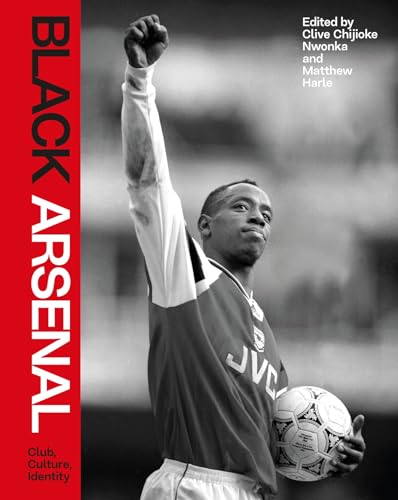
Contrary to the “editors” stated intentions, I very much enjoyed this book as a celebration of Arsenal and how it intersects with global ideas of Blackness. I think it’s weird to assume that a celebration of the subject would necessarily negate a close examination of it: a concept isn’t a person, and it’s feelings won’t get hurt if you rightfully critique the parts it could improve upon. In fact, to celebrate Arsenal’s ties to the Black community without looking at the dark side of the relationship — which in this book is presented almost entirely as a handwringing over capitalism, on which more later — would be infantilizing, and not something the thoughtful reader would want.
 Tho speaking of infantilizing, I spent a lot of time wondering exactly who this book is for. On the one hand, it caters to an audience so far removed from sport and popular culture that it feels the need to explain the concept of, for example, hype in boxing in the most pompous way I’ve ever encountered. These academic chapters are so tedious, and bookend the volume so comprehensively, that it almost feels like it’s trying to turn the average reader, whether Arsenal fan or otherwise, off of its very own contents.
Fortunately and on the other hand, you have an engaging oral history that not even the academics can wholly suck the joy out of. While Paul Gilroy’s opening essay has its moments, the book only really feels like it comes alive with Amy Lawrence’s reporting on Kevin Campbell’s reaction to the North Bank mural containing only white faces. The subsequent firsthand accounts of what it means to be Black and an Arsenal player, staff and/or supporter are almost uniformly compelling, as are the fascinating insights into the ways that the relationships between Blackness as a cultural entity and Arsenal as a brand continue to evolve. This is a book that both lives Arsenal and explores the lived experiences of Black people engaging with what Arsenal stands for. I do wish that Gail Lewis’ closing chapter on the intersectionality of being female, Black, gay and an Arsenal fan was more about that and less about her ability to self-regulate and prescribe the same to others based on inflated credentials, but the many references to Clive Chijioke Nwonka’s work in the piece are a likely reason for why it was chosen to cap the volume instead of, say, Baroness Lola Young’s less pedantic but equally lived-in entry.
It just pisses me off as a fan to read a book that’s so clearly trying not to celebrate Arsenal and failing miserably, like bringing your snobbish friend to a game and having them act like they’re too good for it all even tho you know they secretly enjoyed the experience. Which would be forgivable in and of itself, except that they then use the experience to show off to their similarly snobby friends how they’re capable of slumming it but would never actually deign to be one of “those” people. The fretting over capitalism is also very champagne socialist-coded, especially in the way that it’s all complaining, with no actual solutions suggested. Yes, it is good to worry that Arsenal’s marketing towards the Black community could be exploitative/extractive, but it’s also good to point out (and not just glancingly in the chapter about the Jamaica shirt) that the ongoing relationship between Blackness and Arsenal is a symbiosis where both parts of the equation gain cultural cachet. Complaining about the love letters Arsenal sends to the Black community via its marketing efforts feels very much like complaining about your friend who goes all out on Valentine’s Day because you’re “anti-capitalist.” We all know that capitalism is not what this is about.
It also bugs me how poorly the book itself is actually edited. The most glaring mistake in my Kindle version was “Colony Carpool” for the hilarious digital series run by Frimmy at the Colney training grounds, but I guess everyone else had fallen asleep by that point of the unnecessarily long-winded essay. Dr Nwonka is seemingly not a person who can edit himself, which begs the question of what he and Matthew Harle are actually doing here.
I would venture to guess that the answer to that is curatorship, which is an incredibly valuable job! Going out and getting all these different voices to commit to this project is work, which they’ve accomplished very well here. But I am not shocked that no one has signed the preface (at least in my Kindle version,) and that the name of an actual and likely beleaguered editor is tucked into the fine print in the back matter. For a cover named editor who thinks it’s necessary to differentiate between “credibility” and “legitimacy” when it comes to the establishment, of all things, of the World Boxing Organization in a book about an entirely different sport, this seems like a convenient lapse in standards. The message here is, “I am a curator therefore I am an editor but I do not actually have to do the basic job requirement of the latter title.” That’s bullshit! Forgivable bullshit if you were more interested in telling a compelling story than in painstakingly covering all your bases, but since the “editors” contribution to this book seems primarily of the latter kind, then no, it is not up to the efogging standards, as our current gaffer would say.
Dear reader, I am so sorry that I seem to be focusing so heavily on the negative of this otherwise really terrific book. We’ve been reading it for Arsenal Book Club and the bewilderment most of us had on the uphill grind of getting through the first two chapters led to many of us stalling out completely. As a professional reader, I quickly figured out the problem and told people to skip those bits to get to the actually interesting parts, and oh there are so many interesting parts! My personal favorites were Clive Palmer’s account of being a fan home and away; Stardious Christie’s role as a vendor and fan; Steven Davis’ account of his years working at Highbury (my heart genuinely broke a little when his job didn’t carry over to Arsenal Stadium,) and Celia Facey’s involvement with Arsenal In The Community. I also loved the separate contributions from South Asian writers Samir Singh and Anamik Saha that both touch on how Arsenal’s embrace of Black culture is only the most visible proof of the club’s dedication to multiculturalism, and how encouraging that feels to other ethnic minorities also looking for a place to belong in the often hostile — tho, thankfully, increasingly less so — world of British sports.
The pictures are what really kick up this volume from being interesting to being a must-have for Arsenal fans. The quality is stunning, and even more so in the physical version of the book that was kindly brought to Book Club for those of us who only have it in electronic or audiobook format to appreciate. I really loved this book despite the academic disdain for fandom that is an unfortunate undertone of too-large parts of the text. My main recommendation: if a chapter starts boring you or giving you the ick, it’s okay to skip it. There are other far more interesting, diverse, thoughtful pieces in this book that have been written by actual fans who care about their relationship with the club and with Blackness.
Black Arsenal edited by Clive Chijioke Nwonka & Matthew Harle was published March 4 2025 by Weidenfeld & Nicolson and is available from all good booksellers, including

 Al Singh
 Doug Merrill
 Doreen Sheridan
 Emily Lauer
 John Pitzel
 Lars N. Goldschlager
 Laura Eilers
 Professor X
 Robert Maedgen
 Sylvere Ap Leanan
 The Shire