The Slow Horses series is ostensibly about the fuck-ups and cast-offs of British intelligence, gathered together in Slough House and given make-work designed to push them into resigning, while they hope for redemption and a chance to re-join the regular Service. Nevermind that that plan has never worked for anyone; each hopes to be the first exception. In many ways, though, the series is really about what happens to an intelligence service when outside threats recede and internal jockeying for money and power becomes the greatest game. An external threat is no guarantee that intramural rivalries will recede — one of the CIA’s early and obviously non-public slogans was “bigger than State by ’48” — but the lack of one for the UK of the mid-2010s brings the jockeying front and center in Mick Herron’s books. Budgets are shrinking, and everyone wants to preserve theirs. Ministers want to show the civil service who’s boss; long-serving civil servants want to make clear that ministers come and go, their wisdom and experience are indispensable. Private ambitions or vendettas and the public interest are often difficult to distinguish for those on the inside. Everyone above a certain rank, it seems, wants to lay traps for their rivals while leaving no fingerprints or traceable files.
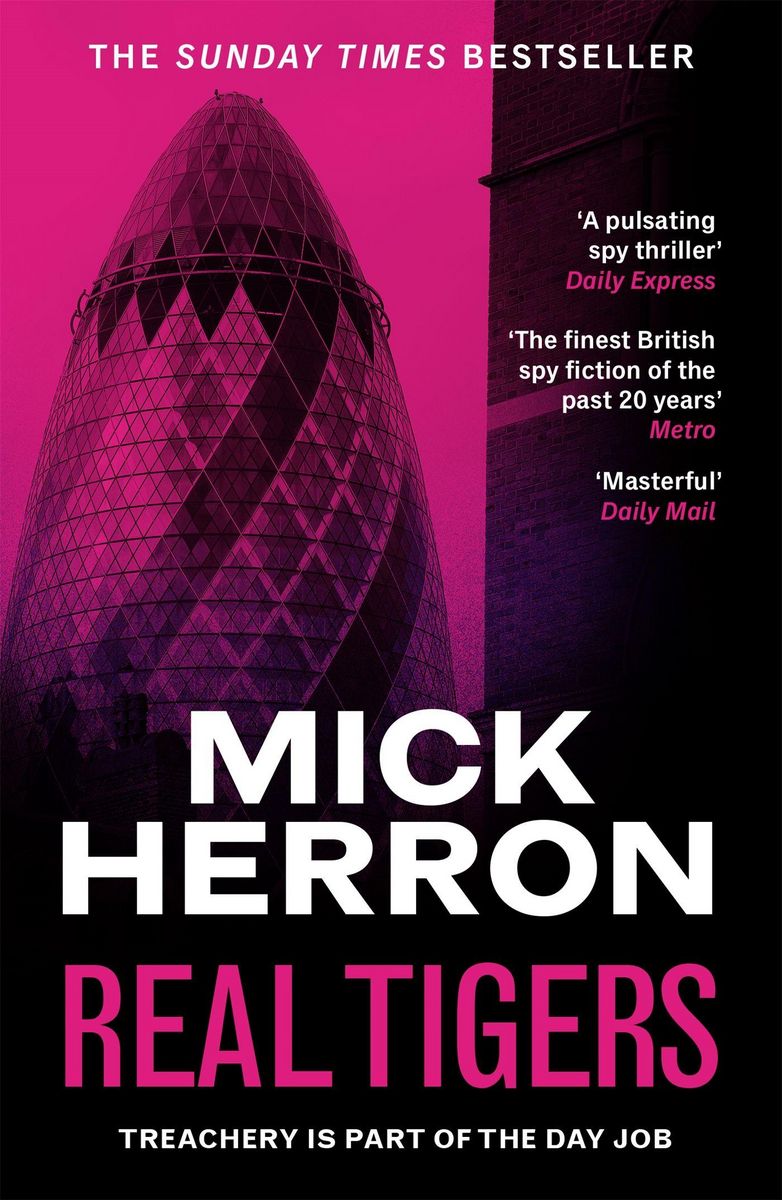
Catherine Standish’s mistake is not turning back into Slough House as soon as she has an inkling that she is being followed. Or maybe a little bit earlier when Sean Donovan, a man from her past, addressed her by name on the street not long after she left work. “Because Catherine Standish — never a [field agent] — knew this much too: that chance encounters might happen in some places, to some people, but they never happened here, to spooks.” (p. 11) Not to spoil the plot too much, but by the end of the first tenth of the book, Standish has been kidnapped, and she knows some of the people involved. The rest of Real Tigers is devoted to finding out who they really are, what they are up to, and trying to get her back in one piece.
One of the nice things about the series is that the Slow Horses are not secretly super-competent agents, relegated to internal exile by mistake. They make genuinely bad decisions all on their own and only sometimes manage to evade the consequences. River Cartwright, grandson of a Service legend, runs off impulsively at the first sign of information that might lead to Standish, and gets into far deeper trouble. Two of the other denizens decide that their hunt will be time wasted and go off for ice cream instead. The one with a gambling problem ducks out for a quick flyer on a horse race, gets lucky, and then spends a chunk of the afternoon losing the winnings and then some; meanwhile, his colleagues are counting on him to do things he is manifestly not doing.
The plot behind nabbing Standish gets deeper and twistier, and the Slow Horses aren’t the only ones making mistakes. Peter Judd has turned up earlier in the series as a sort-of Boris Johnson stand-in, only with much stronger ties to the British far right, out at the end where violent nativist politics overlaps with crime and corruption. Herron also mentions “Boris bikes” in London, thus keeping one mop-haired politico in the background and the other in the thick of scheming. In Real Tigers Judd is Home Secretary with plans for rising higher still. He’s a good villain, unsavory, ruthless, and seemingly untouchable. His discussions with two of the top women at MI6 are terrific scenes of cut and thrust, merely verbal but with implied violence on both sides.
Herron is particularly good at witty and occasionally insulting back and forth, especially when Jackson Lamb, head of Slough House, is on stage. He, too, was a Service legend back in the last years of the Cold War, and yet people continue to underestimate him just because he’s been placed in charge of a house of misfits. Usually it’s to their cost, though it often takes them a while to realize it.
By killing off one of the Horses in Dead Lions, Herron has shown that he is willing to put his characters in real danger, that a reader cannot assume any particular outcome. Standish’s location proves one of the safer places in Real Tigers as the plotting and counter-plotting at the other end of the tiger’s tail spirals increasingly out of control. Will her colleagues figure out the scheme in time? And will all of them still be around if and when they do? Herron keeps the tension high through the very last page, with plenty of surprises that make sense upon reflection.
The humor keeps going right to the end, too. After all appears to be said and done, Lamb has a conversation with Diana Taverner, who is almost head of MI6 and would like to excise the “almost.”
Taverner said, “This is not the sort of juggernaut you want to walk in front of, Jackson.”
“Oh, I don’t know. Don’t forget I have my team to consider.”
“Really? That’ll be a first.”
“They have a natural respect for me.”
“That’s not respect. It’s Stockholm syndrome.”
“How do you think they’d feel if I said we’d just let it go, all those folk trying to kill them? They have a right to know what was at stake.” He scrunched his nose up and sniffed noisily. “Maybe take a vote on it.”
“… You have got to be kidding.”
Lamb turned heavy eyes on her, his expression momentarily obscured by the smoke he’d exhaled. Then he said, “Of course I’m fucking kidding. Getting shot at’s a day at the races as far as they’re concerned.” (p. 355)
He knows his Horses all too well.
+++
Doreen waxed enthusiastic about Real Tigers here.

 Al Singh
 Doug Merrill
 Doreen Sheridan
 Emily Lauer
 John Pitzel
 Lars N. Goldschlager
 Laura Eilers
 Professor X
 Robert Maedgen
 Sylvere Ap Leanan
 The Shire
2 comments
Hi Doug, thank you so much for taking the time to read Once Upon a Russia (from cover to cover!). I really appreciate your review! I’m sorry we didn’t know each other when I was putting the anthology together since I am sure you and your wife would have made a valuable contribution!
Best regards,
Steven Fisher
Author
Hi Steven! Thanks for finding me — Steve O’Connor gave me your mail a while back and said I should send you a link to the review, but you know how it is with to-do lists and starting new correspondence. Anyway, I am really glad that you found the review. The book brought back so many memories, and I’m very happy that it is out there as a chronicle of an era and a state of mind. Plus the hope that better days will come.