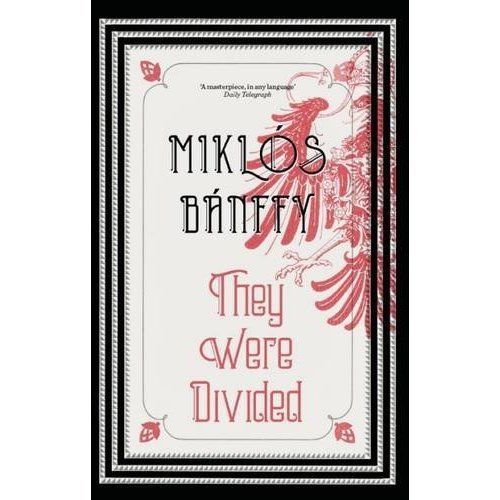
Having taken the first two volumes of his Transylvanian Trilogy to immerse readers in the sometimes glittering, sometimes earthy world of Hungarian aristocracy prior to the First World War, Milos Banffy brings his stories to their immutable end in They Were Divided. The concluding book was published in Hungarian in 1940, and there could hardly be a better way to ensure that this great work sank into obscurity for decades. The Hungarian language is not quite an isolate, but neither is it one of the major European languages that would give the trilogy a naturally larger audience. In 1940, Hungary was on far friendlier terms with the Axis powers than with the Western Allies. (The same was true about the USSR until the middle of the next year, of course.) After the war, a Communist government soon ruled in Budapest. Needless to say, a series of novels about the nobility written by a former foreign minister who had organized a royal coronation was not part of their cultural program. And so it was that that these novels languished for decades; they were first re-printed in Hungary in 1952, two years after Banffy’s death, and they were first translated into English in 1999. Translations into Spanish, French and German followed around 2010.
Banffy was writing about his people and the society of his early years. He writes with great sympathy for the individuals and a cold rage about their collective decisions. The two main figures of the trilogy are noble cousins Balint and Laszlo, both roughly of an age with Banffy. Like the author, Balint is heir to an ancient and distinguished Transylvanian family, landowners on a great scale, practitioners of noblesse oblige, occasional servants of the public good and observers of all the proper social forms. Balint’s father died when he was young, and his mother, Countess Roza, has run the estates for years with a steady hand. Balint himself spent some years in the diplomatic service of Austria-Hungary, and as the trilogy opens he is returning to his homeland to take a more active role in the family’s businesses and, in due course, to take up a seat in parliament to look after local and regional interests. His cousin Laszlo comes from an equally distinguished lineage but is orphaned at an early age. He is adopted by relatives who attend to his rearing and education, but they also do not ever let him forget their generosity in taking him in. Laszlo’s true passion is music, and he is both an excellent musician and a potentially groundbreaking composer. There are some parallels between Laszlo and Bela Bartok, whose ideas and compositions Banffy championed.
The cousins have their faults, too. Balint has the arrogance of a high-born aristocrat who has served in the imperial government. He can treat people further down the social scale as equals — indeed, he has a strong sense of justice and equality — but in practice he has to remember to do so. He also forgets that while he has interests in many different places and circles, most of the people he encounters are very tied to one place, and will have the same relations and neighbors for their entire lives. Reforming forestry, improving land husbandry and even rooting out corruption are much more fraught for these people than for Balint. His generosity can cause problems, even when he has the best intentions, and even when everyone around is being honest, which is not always the case. One of the trilogy’s strengths is how clearly Banffy shows the complexity of village and town life, how a change here can have unforeseen consequences there. For example, a crooked small-town notary is known to and on friendly terms with every lawyer in his district, and has been a long-time ally of the local judge. Preventing the notary from further illicitly enriching himself at the expense of some smallholders means finding a lawyer whose business does not depend on the notary’s services, and ensuring that the judge can render a verdict without losing face himself. Balint is apt to move like a bull in a china shop, not even knowing what he might shatter by turning left or right.
Laszlo labors under the burden of being an orphan in a society in which family and connections matter more than almost anything. He compensates with pride, which indeed goeth before a fall. He is also prone to two of the vices of his class: drinking and gambling. The ideal Hungarian nobleman is rich beyond counting, and willing to wager immense sums on games of skill and chance, heedless of either winning or losing. When he is of age and admitted to the society of gentleman, Laszlo tries to live up to these ideals, but he is too young and inexperienced to know that other men of his class are perfectly willing to take advantage of another noble, willing to use their skills and to take their winnings while they are still ahead. Some of them also have far deeper pockets than Laszlo does and are willing to play that advantage, goading him into bets that they can cover but he cannot. In the trilogy’s first book Laszlo serves a spell as the dance master and all around master of ceremonies for carnival season in Budapest society, a role that suits his skills with music and dance, melody and showmanship. It also propels him into social roles for which he is unprepared, into intrigues that would be tricky for an older man to negotiate that are full of traps for someone just recently come of age. To make matters worse, Laszlo has problems with alcohol. That is hardly unprecedented for any European society in the early 20th century, but drinking distracts him from developing his talents. It inflates his pride and leads to poor decision-making at the gaming tables and among the sharks of high society. He soothes his ego and conscience with more drinking, and the wheel turns. Over the course of all three volumes, one of the overriding questions is whether Laszlo can recover and become the brilliant composer that he could be.
Both Balint and Laszlo have difficult love lives, which is hardly surprising for men in their early 20s. They are both, in the abstract, good catches in the marriage market of Hungarian aristocracy. Balint is rich, steady, with good prospects, and he is utterly in love with an unattainable woman. Laszlo is personally poor for an aristocrat but brings a distinguished name, and his unmistakable talents could open the doors of culture and society to, say, the daughter of a wealthy but stolid merchant family, especially one who has set her sights on elevating her family’s status. The social and romantic aspects of the trilogy would form terrific novels by themselves, but Banffy’s work contains much more. Though the two cousins are the central characters, the full panoply of characters is vivid and ranges from hunters and foresters in the Transylvanian mountains through small-town merchants, petty nobles, musicians, old grandees of the Empire’s most distinguished families, a conniving butler, stable hands, a confidante of the Heir who was Balint’s friend in the diplomatic service, a dreadful aunt, politicians at their ease, and many, many more. Banffy led a full life, and he poured his experience and keen observation into these books, bringing a lost world back to life.
There are scenes early on in They Were Divided, whose page I unfortunately forgot to note, whose power depends entirely on what the characters do not say. Over the course of the first two books, Banffy has depicted his characters so clearly that a readers know what they want to say, what they want to express, and why they feel that they cannot. Both author and reader trust each other enough — and have enough life experience — to grasp the poignancy of the moment without anyone ever having had to say it directly. Banffy shows similar skill with the characters’ moments of fulfillment and happiness; readers know what some time with Balint’s beloved means to both of them, what redemption in a young person’s eyes and a chance to play an exalted role for them, to be the glittering Count who is the toast of Budapest, means to Laszlo. There is a death scene in which a character whose faculties have been failing experiences a last day of beauty and happiness, so that their passing reads more like a fulfillment than a departure, the summation of a life lived by true principles to its very end. The numerous deaths that are necessarily a part of the final volume are true to life and varied: some long expected but still a surprise when the day comes, others products of a particularly Hungarian form of despair, yet others as sudden as apoplexy. They are all harbingers of a world soon to be lost.
That lostness is the overarching theme of They Were Divided. Parliamentary politics come to the fore in this book, as Austria-Hungary hurtles unknowingly toward its appointment with doom in the Great War. Banffy is by turns incredulous and outraged at how little the leaders in Budapest paid attention to events outside their own circles. Their overwhelming concern is with asserting Hungary’s independence from Vienna, with guarding their particular privileges and scoring points in internal skirmishes, regardless of what else might be happening in the wider world.
Few people had then paused to reflect that the trade unionists would never really co-operate with any other group and had only joined in the call to overthrow the existing government because they themselves had never expected to be called upon to face the realities of political power; nor that there were forces in the running of a great nation far greater and more complicated than were admitted in the seductive paragraphs of the radical press. It never occurred to the majority that the real national interest lay in the sound administration of agriculture, industry and commerce, in the defence of the realm and the maintenance of law and order; and in fair treatment of the ethnic minorities and the underprivileged. It was on how such matters were handled that the presige of the Dual Monarchy and its position as a great power that the continued prosperity of the individual depended. And yet, simple and logical as this proposition might have appeared, it still seemed beyond the grasp of the general public. (p. 29)
Or, much later, as international crises mount and tensions in the Balkans threaten to ignite a general European war:
Soon [Balint] believed that he had discovered what had led people who should have known better to act in that ridiculous way. It was nothing more than the almost universal belief of Hungarian politicians that their voices could only be heard inside their own country. Their whole conception of politics was based on this, and nobody for a moment believed that their actions and words were watched or heard by anyone abroad … In the heat of domestic passions it had never occurred to them to think of such matters as anything but the skirmishes of party politics which no one outside Hungary could for a moment understand or even be interested in. To these men the horizon extended no further than Vienna and outside this circle, this little Hungarian globe, there was nothing! (p. 229)
They are all operating within a closed circle, unaware of the catastrophes approaching from outside their ken.
It may seem odd that at the end of nearly 1500 pages of Banffy and his Transylvanians I should have wanted more, but I did. They Were Counted, the first volume, is not quite twice as long as They Were Divided. That allowed for more characters to develop fully, for asides and sub-plots that showed a greater range of life in Austria-Hungary. I think that They Were Divided would have been an even greater book if Banffy had devoted as much detail to his denouement as he did to demonstrating the old world in the first place. Then I remember he was writing in 1940 as the German war machine rampaged across the continent, and I am glad that he finished the book at all. It is a melancholy finish, but that was clear from the beginning. It looks back in sweet sorrow at what was lost, with clear vision about why and how it was lost. Banffy’s work contains many lives, and it returns an entire era to life more than a century after it has passed with a brilliant work of art that may finally, slowly, be finding the large audience that it deserves.

 Al Singh
 Doug Merrill
 Doreen Sheridan
 Emily Lauer
 John Pitzel
 Lars N. Goldschlager
 Laura Eilers
 Professor X
 Robert Maedgen
 Sylvere Ap Leanan
 The Shire