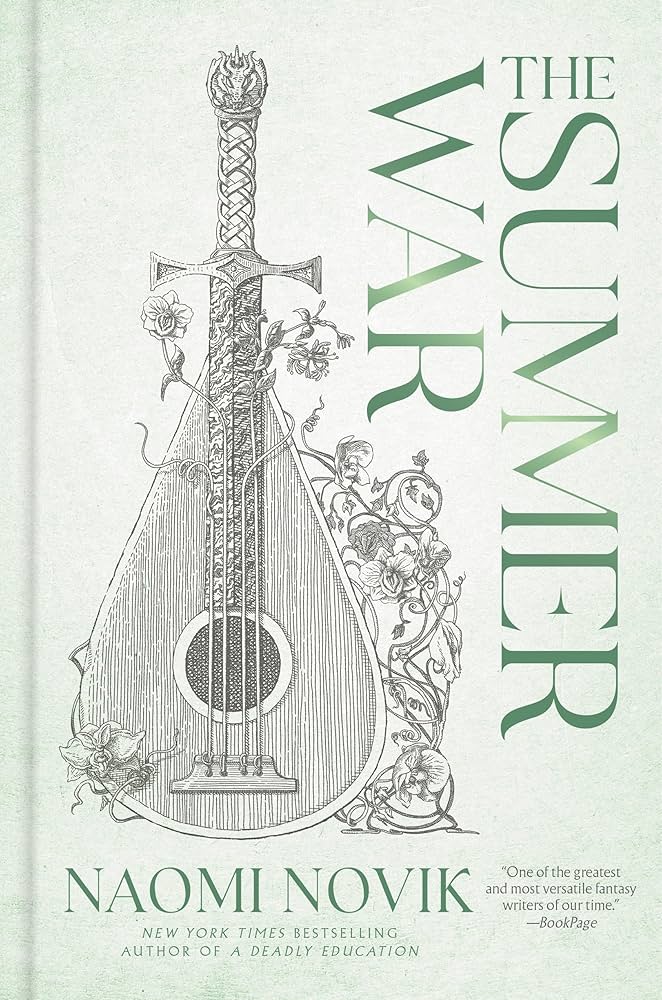
In contrast to Cinder House, The Summer War is not a classic fairy tale re-told in a more modern idiom but a re-working of fairytale elements, a new story told entirely in the register of a fairy tale. Thus the kingdom that is the setting for a bit more than half of the story is called Prosper. The adored older brother is named Argent, and he shines like the silver that is his namesake, particularly when seen through the eyes of his younger sister Celia. “… Argent, whose mother had been the daughter of an earl, mattered in every way there was. He was Father’s heir and the best knight in the world, so everyone said. Argent was very handsome, too, with black hair that curled and blue-grey eyes, and he’d played with Celia ever since she’d been born. He’d been trained at home, instead of being sent to the king’s circle, and she’d run after him as soon as she could run.” (p. 3) Argent had been well disposed toward Celia, but fundamentally she had not registered, in that way that’s common among older siblings busy clearing a path into the world. Argent also has a burden that he has kept to himself since he was twelve, and his father, Grand Duke Veris, savior of the kingdom and cleverest of warriors, had shown him what happened to men who loved other men.
“I remember them begging you for mercy. You didn’t give it. You ordered them caned on the spot, right there in the court. I remember every blow, the screaming. And afterwards, you stripped them of their names, to spare their families the shame of them. And you ordered them taken to the border of your lands and thrown out, never to return, on pain of death.” …
“I was only twelve,” Argent went in. “I barely even knew, yet. I didn’t understand what you were trying to do. All I understood was that there was something wrong with me, the same thing that was wrong with them, and you were showing me what it meant. What you had to do about it. And I didn’t see anything I could to stop being wrong, because I hadn’t done anything to start. So afterwards, I was only waiting for you to come and take me, to do the same.” …
“I was so terrified,” Argent was saying, with an odd sound of wonder in his voice, as if he couldn’t believe the scale of his own fear even now. “Nothing has ever frightened me since. Everyone calls me brave, but it’s only that nothing else comes close enough to that fear. I lived with it for three days and three nights, waiting, until I couldn’t bear it any longer.” (pp. 8–9)
Argent tried to kill himself by taking nightshade. Celia has been eavesdropping on what Argent has returned from the Summer Wars to tell their father. “Yes, Celia wanted to whisper. Yes, I remember. It was a vague, half-forgotten terror in her mind: the time when Argent had almost died. She’d been five years old, and she’d already loved him more than anyone else in the world.” (p. 9) He was uppermost in her mind, but not vice versa. And so it is in the encounter between Argent and their father; Argent has planned the confrontation for a large part of his young life, and probably never once thought about how it would affect Celia. Having reminded his father of the past, Argent renounces his name and returns the sword that his father gave him. “And I will go now, away beyond the border of your lands, and never return again.” (p. 11)
She catches up to him just before he rides off, and calls his name desperately. “He stared at her as if he didn’t know her.” (p. 11) So little has she figured in his reckoning. He says he’s sorry, and it dawns on her that she has played no role in his planning.
“No, you’re not,” she said, barely above a whisper, her throat tight. “It doesn’t really matter to you. I don’t. If I mattered, you couldn’t go away forever, without even saying anything.” It was horrible to know that she didn’t matter to him, but she saw it too clearly not to know. He hadn’t given her a single thought. He’d only come to take revenge on Father and go away again. The only reason she even knew he’d some at all was because she’d been up. Waiting. She asked helplessly, even knowing it was stupid and would only make it worse, “Why don’t I matter?”
“You do,” he said, and she wanted to believe him, but then he said, “Celie, I can’t stay, it’s his castle—” and she lost her temper and ran at him and hit him with both her fists, high on his chest.
“Shut up!” she said. “Shut up, you liar … Do you think I’m stupid? What if I say I want to go too? What if I ask you to take me away with you, so I don’t have to marry that fat old duke? … I’m not stupid. Now that you’ve cast off your name, you don’t owe anything to Father, to anyone. You’re going to take your magic sword and go have adventures, and all the boys you like, and you’re casting me off, too, because I’d only get in your way,” she said, savagely … She was burning with anger, more because he’d tried to lie to her than anything else. It was bad enough that he was casting her off; it was bad enough that he didn’t care. He didn’t need to tell her insultingly stupid lies on top of it. (pp. 12–13)
And then with the utter fury and sincerity and full heart of being twelve, hurt to the core by the person she loves most, she says “Go to the Summer Lands! Go ride a shaihul, fight a dragon, be the greatest knight who ever lived. Just see if it makes you happy! I hope you meet a hundred beautiful summerling boys and none of them love you. I hope no one else is ever stupid enough to love you again!” (p. 14)
Which takes readers back to the first sentence of The Summer War: “Celia was twelve years old on the day she cursed her brother.” (p. 3) Because she had indeed cursed him with all of her heart and all of her might. Much of the rest of the novella is about the effects of what she said that day. The second sentence is “She had two brothers, but she didn’t count Roric, the middle child, because no one did.” (p. 3) And indeed, Roric goes unmentioned for quite a while, and when Novik does bring him into the story a little, it’s mostly to confirm the third sentence, “He was a thin sour weasel who glared at her whenever he saw her, and almost not a real son of the house.” (p. 3) Celia does not count Roric, the way that Argent had not counted her. While Roric did not feel the same way about Celia the way she did about their eldest, and being left out of the story works changes on him too.
But stories are twisty things, and this one is not just about sibling loves and rivalries but also about a family whose fate is entwined with that of the kingdom, and with a long-running war against the fae that the siblings’ father had not won, but only put in abeyance. Like many a good fairy tale, The Summer War has more fighting, bargaining and betrayal than it first seems. Some of it is also about stories themselves. Much later, when honor and betrayal seem to have trapped everyone, “Except that Celia knew how that story ended: in a century of war and sorrow. After her father and her brother had avenged her, what summer lord would decide that Elithyon’s murder had to be avenged in turn, for the trick that had broken the peace? And how many people would he slaughter?” (p. 97) The ways seem shut. “Celia wanted that story to end. She didn’t want to be the next chapter, the cause of another round of senseless war. But the only other ending she could write was the one where Argent died trying to save her, on the blade of the thirty-ninth or forty-third or seventy-first summer knight, and she did step off the tower afterwards, instead of starving slowly to death.” (p. 98)
Novik carries readers to a satisfying conclusion, clever and moving, with the end tied closely to the beginning. In this modern fairy tale, not everything will be happily ever after, but they will be a fitting resolution to the conflicts of the Summer War.
+++
Doreen also thought very highly of The Summer War. Her review is here.

 Al Singh
 Doug Merrill
 Doreen Sheridan
 Emily Lauer
 John Pitzel
 Lars N. Goldschlager
 Laura Eilers
 Professor X
 Robert Maedgen
 Sylvere Ap Leanan
 The Shire
2 comments
Great review – I kept mine a bit shorter, but I loved this fairy tale just the same!
Author
Thanks, glad you liked!