
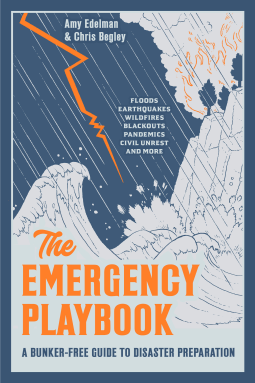
 The Emergency Playbook: A Bunker-Free Guide to Disaster Preparation is out today! It combines practical to-do lists for before, during and after disasters, with big-picture context for how disasters often play out. The authors, Amy Edelman and Chris Begley, present all this information in an enjoyable, easy-reading format.
I learned a lot from it: I feel more prepared for whatever might come just by knowing this stuff, and I feel I know practical next steps to be even more ready for whatever emergency crops up next. Good page layout and low use of jargon make it read quickly, so I anticipate that it will be useful to consult during an actual emergency as well.
Amy Edelman is a career journalist and most of the book is in her voice. Statistics and history about climate change, the current political landscape and what we anticipate might come next are delivered in a chatty tone, with a progressive stance.
In both tone and content, The Emergency Playbook kind of reminds me of Burnout. Both books say, “here’s what the world is like; here are some things you can do to hopefully survive and thrive in it.” The preparedness advice in The Emergency Playbook includes taking part in your community, learning where and how you can get information reliably, and planning and packing with your household and loved ones. Generally, talk to your neighbors more often. Specifically, make a portable waterproof firestarter by putting petroleum jelly on part of a cotton ball and then sealing it in duct tape.
I was especially encouraged to see information literacy explained as part of emergency preparedness! Assessing the information you get during an emergency is vital, and thinking about that ahead of time means you can be making more informed decisions during a stressful time. Similarly, Edelman and Begley also provide information for dealing with panic attacks. Learning that ahead of time means that you are not first trying to learn how to deal with a panic attack while having a panic attack.
While I generally agree with the politics, I don’t always share Edelman’s worldview in other matters (for instance, she cites her “homeopathy advisor”), so I was glad to see a Bibliography at the end, citing sources I already trust, like academic papers from reputable journals. I do agree that it makes sense to have some dark chocolate as part of your emergency food storage, though.
Chris Begley’s contributions to the book include pull quotes from his extensive travel and archeology experience, and overall expertise. He’s an accomplished guy.
Most of this book is addressing people who own houses with yards and have cars. However, I live in a city apartment, with a lot of infrastructure surrounding me but no backyard, no garage, and limited storage. Luckily, the page layout of The Emergency Playbook makes it easy to skim bits like “You might be able to drink the water in your pool” that are obviously not applicable to my situation, and there is still plenty of information that does apply.
Organized by what you’ll need to be prepared, and then by types of disaster, The Emergency Playbook is a satisfyingly useful and surprisingly fun read.

 Al Singh
 Doug Merrill
 Doreen Sheridan
 Emily Lauer
 John Pitzel
 Lars N. Goldschlager
 Laura Eilers
 Professor X
 Robert Maedgen
 Sylvere Ap Leanan
 The Shire