Since time immemorial, at the eastern edge of the continent the Leviathans have risen from the sea to make their way along the Titan’s Path to the Lake of Khanum. For centuries, though, the Empire has blocked their progress, erecting successive walls across the continent to first contain the Leviathans’ journeys and then prevent them entirely. Now with four sets of walls protecting the Empire’s interior and its citadel above all, most citizens can go about their normal lives even in a wet season, secure in the knowledge that the Legions and the Engineers are keeping them safe. If and when a Leviathan rises, they will kill it with the latest cannons, and incorporate its corpse into the Empire’s defenses.
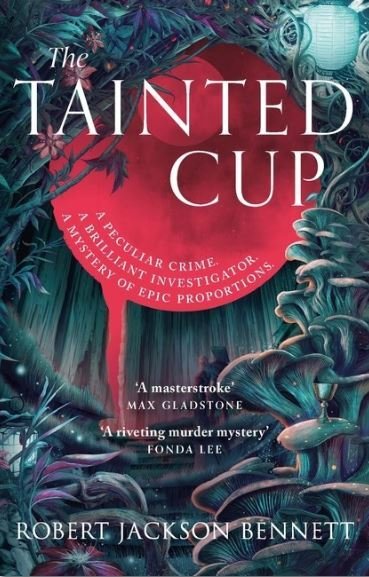
Dinios Kol, holder of the Imperial rank of Signum and first-person narrator of The Tainted Cup, is not fortunate to live in the Empire’s interior. He has been posted to Daretana, a settlement between the Third Ring Walls and the Sea Walls, the latter being the Empire’s outermost defenses, tested almost every wet season. The world that Robert Jackson Bennett has created is a lush one, in which vines can function as gate guards at a patrician family’s villa, vines trained enough and fast-moving enough to prevent a visitor from entering, unless of course the visitor presents a vial of exactly the right scent. One of the marks of wealth in the villa is the presence of “a massive kirpis mushroom [that] had been built into the corner of every main room—a tall, black fungus built to suck in air, clean it, and exhale it out at a cooler temperature.” (p. 7)
Humans have extensively altered not only plant and animal life, they have changed themselves as well. Din himself is an engraver, a person altered to have perfect memory, to accurately engrave moments into their brains. Like the guard vines, engraver sometimes use olfactory cues to open up memory, to make some moments more readily accessible than others. This alteration suits Din’s current assignment. He is assistant to Ana Dolabra, two Imperial ranks higher at immunis, eccentric if not downright peculiar, and possessed of far-reaching connections, as Din discovers over the course of the case.
For Din has not passed through the villa’s guards to gawk at the lives of the rich and notorious. He is there because someone has died there, in a most spectacular way that not even the immense wealth of the Haza clan can keep hidden.
The chamber within was a bedroom, as grand as the rest of the house, with a wide, soft mossbed in one corner and a fernpaper wall and door separating off what I guessed was the bathing closet—for though I’d never seen a bathing closet inside a house, I knew such things existd. …
But the most remarkable feature of the room was the clutch of leafy trees growing in the center—for it was growing from within a person.
Or rather, through a person.
The corpse hung suspended in the center of the bedchamber, speared by the many slender trees, but as Otirios had said it was initially difficult to identify as a body at all. A bit of torso was visible in the thicket, and some of the left leg. … The right arm was totally lost, and the right leg had been devoured by the swarm of roots pouring out from the trunks of the little trees and eating into the stonewood floor of the chamber. (p. 9)
Further, the deceased was an Engineer, on leave as it turns out from duty at the Sea Wall. His death might be tied to his work, it might cause problems especially since the wet season is just about to begin, or it might be a novel form of contagion. With as much alteration as the Empire does, contagion is a constant danger. Within living memory, a particularly virulent contagion even depopulated an entire province in the far south. Din’s investigation is therefore more than just a matter of local justice.
It is also more than just a little bit unusual, given that Din is an assistant for an investigator who does not go out into the field at all. Ana Dolabra is brilliant, but so sensitive to sensory input that she spends most of her time blindfolded in her rooms. She can read texts from the indentations that the pen made when it wrote. She can hear motion and smell moods. She does not have the eidetic memory of an engraver, but she retains immense amounts of information concerning things that interest her. Boredom is her worst enemy. Except, perhaps, some patricians whose lives her previous investigations have made more difficult. She would be legendary if she were not so secretive. As a literary character, she’s immense fun.
Din, of course, is in way over his head. The Engineer’s murder turns out to be as twisty as the vines guarding the estate, with roots and branches that extend far from the small outpost. The world that Bennett has created is immersive, its humidity a feeling and its many growths visible, the wet season a slog that holds the danger of Leviathans suddenly appearing to wreak havoc. The Empire has Roman overtones but a weight of its own; it is a living and strange polity. The people that Din meets along the way have their own lives and motivations that Bennett credibly shows, so that I felt Din and Ana were moving within an existing world, rather than having that world bend around them to meet the needs of the story.
In short, The Tainted Cup was a terrific blend of fantasy and mystery, adept enough to surprise people who have read deeply in both genres, and populated with real people whose believable stories contain and go beyond the main tale of murder and revenge. I’m looking forward to picking up A Drop of Corruption very soon, and a third book—A Trade of Blood—will be published in August of this year. The game is afoot!
+++
The Tainted Cup won the 2025 Hugo Award for Best Novel. Its sequel, A Drop of Corruption, is a finalist in the same category this year. Doreen’s review of The Tainted Cup is here, and her review of A Drop of Corruption is here. Writing in September 2025, she correctly expected that A Drop of Corruption would be a Hugo finalist.

 Al Singh
 Doug Merrill
 Doreen Sheridan
 Emily Lauer
 John Pitzel
 Lars N. Goldschlager
 Laura Eilers
 Professor X
 Robert Maedgen
 Sylvere Ap Leanan
 The Shire