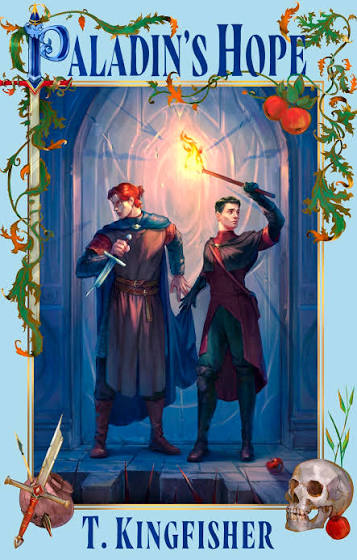
Galen, the paladin of the third Saint of Steel book, was seen in Paladin’s Strength as Istvhan’s second in command. He also had a reputation as happy-go-lucky, willing to bed more or less any man who struck his fancy, and able to catch them too. Paladin’s Hope begins less cheerfully: with a corpse. Observing the corpse are some men from the city guard, a gnole who is also with the guard, and Doctor Piper, a lich doctor, something of a medical examiner in the city’s setup. Like many smart and talented people stuck in the middle of bureaucracies, Piper is impatient with the obvious. “Well, if you want my professional opinion, this great god-damn hole in his chest is probably what killed him.” (p. 2)
Kingfisher takes the opportunity to tell the reader more about Piper:
Doctor Piper dealt with corpses and for the most part, he preferred them to the living. He didn’t mind living people, he was perfectly happy to meet them and talk to them and even work with them, but corpses never, ever asked stupid questions. You learned to appreciate that when you spent all day analyzing why and how people had died. The dead didn’t say things like, “Are you sure he’s dead?” when the man’s head was half off or, “Dear god, what happened?” when it was bloody obvious that someone had shoved a sword through him. The dead just laid there and go on with being dead.
He definitely preferred them to the city guard. Piper was suspicious of power, particularly power that thought it was the arbiter of justice. He knew Captain Mallory well enough to know that the man was that rarest of creatures, an honest policeman, but that simply meant his dislike was tempered with pity. Mallory did not engage in graft or extortion and for this sin, he had been assigned the poorest and most crime-riddled quarter of the city, where he could be handily forgotten until his superiors decided they needed someone to blame. (p. 2)
Piper’s sense of justice gets the book rolling. It transpires that this corpse is not the only peculiar one that has turned up lately, and Captain Mallory may be honest, but the city guard as a whole is not interested in how these men died. Mallory even goes to the trouble of warning off Earstripe, the first and so far only gnole on the city guard. Just as the badger-like gnoles are second-class residents, Earstripe is definitely a second-class member of the guard. If he has an idea that pans out, humans get the credit; if something goes awry, he is quick to get blamed. Earstripe himself is somewhat philosophical about his situation: being a job-gnole gives him status, and the community has decided that having at least one gnole within the guard organization is better than being excluded or holding themselves aloof. He knows he is not being treated equally, but what can one gnole do?
What that one gnole does is to investigate the similar corpses on his own time, without informing his superior officers. He comes to the conclusion that they were killed outside of the city and floated in on the river, the journey having taken enough time to cause some bodily decay, but not so much that the fish of the river have feasted too much on the bodies. Piper’s expertise helped identify the timing, but the fatal wounds were varied enough that he could come to no solid conclusion. Armed with this knowledge and on Earstripe’s intitative, Piper and Galen join the gnole to investigate on the various noble estates upriver from the city. They are joined by Brindle, who was part of the expedition in Paladin’s Strength and who is much happier to have an ox cart this time instead of having to wrangle mules.
Most of Paladin’s Hope is a straight-up fantasy adventure, as finding the right estate only puts the party into greater danger. Things go whoosh and things go swish, and the two humans and one gnole (Brindle is elsewhere with the oxen) are very lucky to keep all of their parts attached. Then other things go thonk, and it becomes apparent that getting smushed is as much a danger as getting minced. All along there has also been a burgeoning romance between Galen and Piper. In previous books, Galen has been mentioned as happily promiscuous and resolutely unattached; that Piper might be more than a dalliance throws him for a loop. Piper is not exactly shy and retiring, but his personality and occupation have meant that sex and romance are not uppermost in his mind. Could Galen bring out a different side of him?
Of course and of course, because this is the kind of book in which the romantic conclusions are foregone and the art is largely in how it happens. The gnoles are good foils to the humans’ occasional tongue-tiedness, and to their equally occasional meetings of tongues and other parts. Gnoles can smell humans’ moods long before any verbal communication takes place, and on several occasions they show that they have known things that the humans hadn’t admitted to themselves. It’s a very funny counterpoint to the occasionally overwrought doctor and paladin.
After cracking the case, and with considerable help from Piper’s standing as a lich doctor, they even manage to improve the situation between the gnoles and the city guard a little bit. It’s a satisfying ending to a fast-paced, well-crafted adventure in the world of the White Rat. Paladin’s Faith is next, and then I am caught up with all of the paladin tales that Kingfisher has written to date, although there are three more servants of the deceased Saint of Steel whose stories she has not yet told.

 Al Singh
 Doug Merrill
 Doreen Sheridan
 Emily Lauer
 John Pitzel
 Lars N. Goldschlager
 Laura Eilers
 Professor X
 Robert Maedgen
 Sylvere Ap Leanan
 The Shire