
Like its predecessor The Element of Fire, The Death of the Necromancer begins with a heist. Wells gives the first line to Madeline, an actress and singer who is rising in the theatrical world of Ile-Rien’s capital city, Vienne. She is also tightly entwined with a leading figure in the city’s criminal underworld. “The most nerve-racking commissions,” she thinks, “were the ones that required going in through the front door.” (p. 327; all page numbers are from the omnibus edition, The Book of Ile-Rien.) The man on her arm as they go in through the front door is Captain Reynard Morane, a former cavalry officer to whom some considerable scandal has become attached. He is not the underworld boss, but the two of them are in fact thick as thieves. The front door they are going through is that of Mondollot House, where the eponymous Duchess is giving a large winter ball. Their job, though it is not immediately apparent, is nothing so simple as liberating valuable jewels from the Duchess’ keeping; instead, they are to facilitate a far greater theft of gold bars from the lower levels of Mondollot House by temporarily bringing down some of its magical defenses.
They are working on behalf of and in partnership with Nicholas Valiarde, aka the criminal mastermind Donatien. Nicholas is a descendant of an ancient and, it transpires, entirely disreputable noble family, though he himself grew up in poverty. When his mother died, he turned to petty thievery until he was rescued and taken in by a magician named Edouard Villard. Nicholas owes him everything, and so his improper conviction of and execution for necromancy — which takes place well before the novel begins — turns Nicholas’ life upside down. The heist that begins The Death of the Necromancer is part of an elaborate plan to bring justice to the man who was instrumental in Edouard’s framing.
The team carries off the heist, but there are oddities. Someone had been to Madeline’s goal before her and used a different method to circumvent the magical defenses of Mondollot House. Who? Why? Someone had also been in the lower cellars where Nicholas and the rest of the crew carried off a significant amount of gold bars. These others had either ignored the gold or not known about it, but they had plainly been looking for something. Had they found it? What was it? And who were they? They had also either left or unleashed a number of ghouls, leading to a narrow escape for Nicholas and company.
From there, questions and threats multiply, compounded by the sudden appearance in Vienne of one Doctor Octave, a spiritualist who seems to have genuine necromantic abilities that he definitely should not have, necromancy having been banned on pain of death more than a hundred years ago. To make matters worse for Nicholas and company, Inspector Ronsarde, a Holmes figure, may finally be closing in on their criminal enterprises. The Death of the Necromancer gradually reveals the answers to the questions posed after the initial heist, but only at the costs of great danger to Nicholas’ crew, a band of thieves with actual honor among them. To paraphrase All the President’s Men, these are bright guys (with just a few gals) and things get out of hand.
The Death of the Necromancer is a twisty, well-plotted, well-observed adventure novel. The setting has guns and magic, and technology that approximates parts of the early 19th century, though mass industrialization is not part of the world of Ile-Rien. The pace is not breakneck, which gives Wells time to explore the characterization of her large-ish cast and to flesh out the plots and counter-plots. It’s not a door-stopper fantasy epic, but it’s not the kind of thing that I can knock off in an afternoon, and sometimes I found myself wishing it were.
The ending, when it comes, is a satisfying one. Questions are answered, makeshift alliances are resolved, loose ends are tied off. As promised in the title, the necromancer dies, though careful consideration of the title yields multiple meanings for which necromancer it is talking about. As with The Element of Fire, the ending is a bit open; not everything is completely wrapped up. The reader can imagine more adventures, and can wonder which characters stick with Nicholas and which believe they have to find their own way.
+++
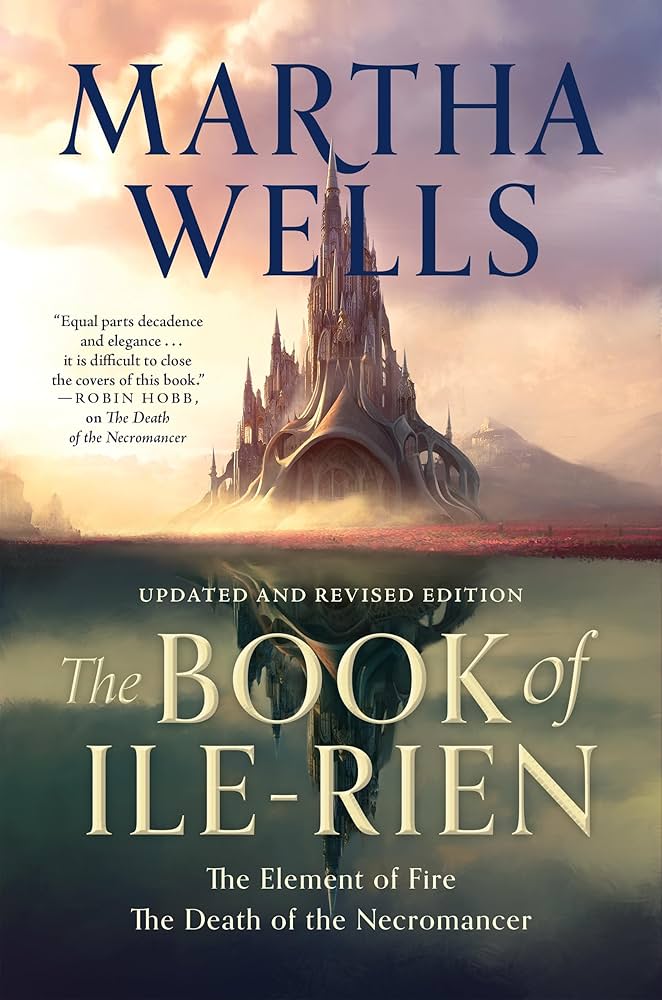
The Death of the Necromancer is more readily available as part of the omnibus volume, The Book of Ile-Rien.

 Al Singh
 Doug Merrill
 Doreen Sheridan
 Emily Lauer
 John Pitzel
 Lars N. Goldschlager
 Laura Eilers
 Professor X
 Robert Maedgen
 Sylvere Ap Leanan
 The Shire