Dickie Bow got left behind by the spy game after the collapse of European communism, and never really found anything else. By the time that Dead Lions begins — it was first published in 2013 — he’s barely holding on with a job in a sex shop and a routine of steady drinking that will kill him later rather than sooner. But when an unmistakable Moscow spook turns up in his local, reflexes kick in, and it’s not long before he learns that some things will kill him much faster than an excess of booze. Dickie follows the spook without any preparation and with little thought; he figures that he can sort things out later. They go on a regional train, which is delayed and then cancelled by technical problems on the line. In the crush of passengers switching from trains to busses, Dickie feels a sharp prick to his thigh, but does not lose his man and they both board the same bus. The bus makes its way to Oxford where, as Herron writes, “it would deliver one soul fewer than it had gathered, back in the rain.” (p. 6)
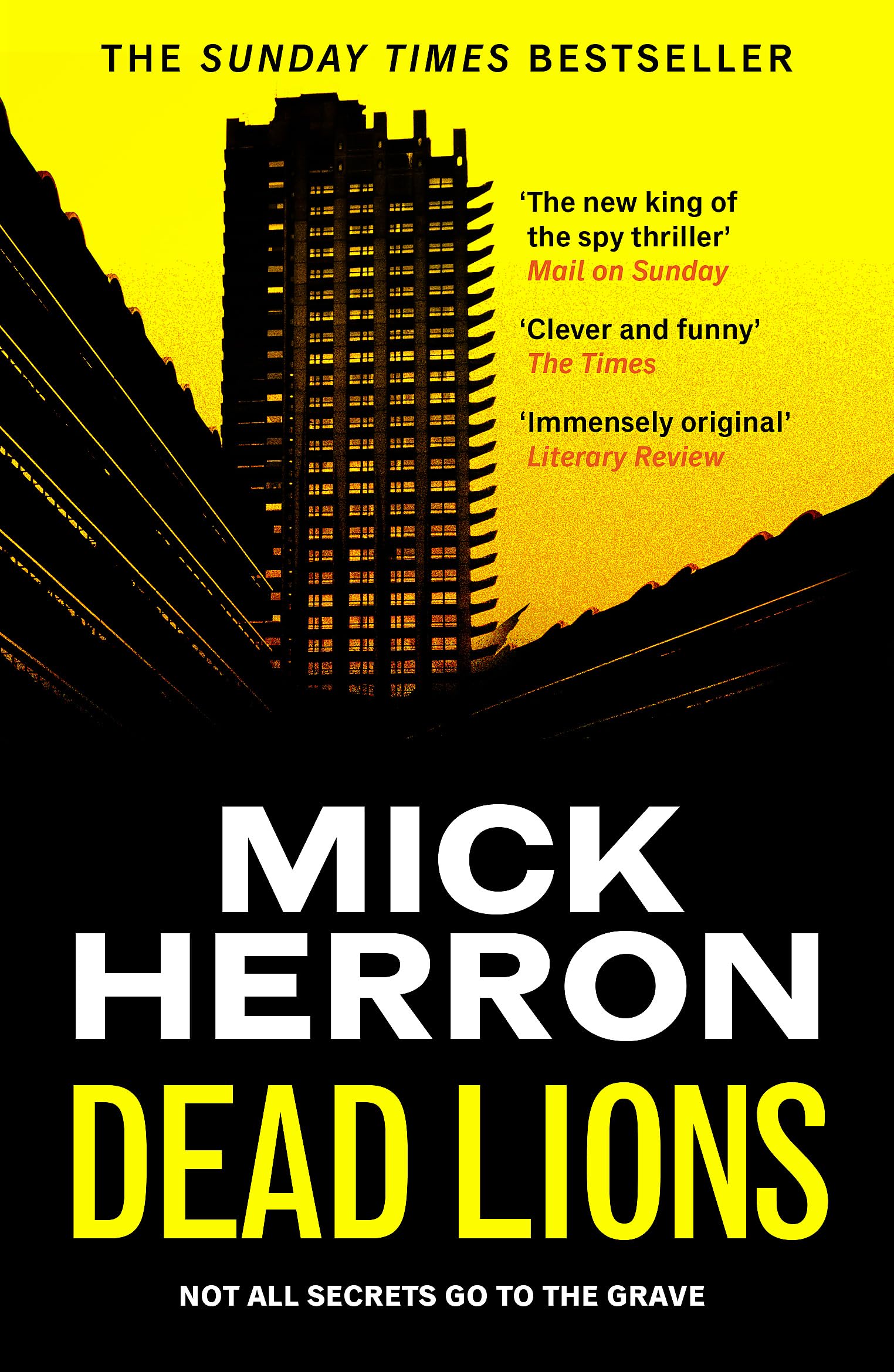
After the first chapter, the reader is ahead of British secret services, and in particular ahead of Jackson Lamb, the head of the unit that is colloquially known as Slough House and even more colloquially as the slow horses: people who have screwed up badly in the line of duty, but who for one reason or another cannot be summarily fired. Lamb is soon on the scene in Oxford. The official verdict is heart attack — given Dickie’s health and habits, it’s not a surprising one — but Lamb knew Dickie from when they both worked in Berlin, which was then spook central. A heart attack is one thing. A heart attack when you’re on a bus without a ticket for any part of the journey, and less than £20 about your person is quite another. Herron gives readers some funny scenes as Lamb tries to moderate his usual abrasive manner so that he can get useful information from the train and bus staff at Oxford station without revealing his secret service affiliation. He doesn’t get a lot of information, but from between the cushions of the seat where Dickie Bow died, he finds something potentially more important: the deceased’s mobile phone. (Dead Lions is set in a time before smartphones were ubiquitous, so the phone is both more and less than it initially seems.) Going through the phone later, Lamb sees just how socially impoverished Dickie’s post-Service life had been. He also finds an unsent message without a recipient; one word, “cicadas.” It’s a code word Lamb recognizes from Cold War days.
The straightforward level of Dead Lions is an attempt to unravel interlocked mysteries. Who killed Dickie Bow? Why? What was that code word doing in his final message? The deeper levels are no less interlocking. There is the plot and background of the story. The Cold War was two decades over by the time the book was first published, but that did not mean old scores had been forgotten. Just because the Soviet Union was gone did not mean that its legacy was lost. How are modern Russian spies, and oligarchs, and politicians, and criminals (to the extent that these are disjunct categories) related to their Soviet predecessors? The UK had its own far left factions, and its secret services no small problem with Soviet double agents. Have those legacies all been left in the past? Dead Lions touches on all of these questions interestingly, though of course without resolving any of them. Lamb himself is a creature of the old era, holding on in the book’s present day. River Cartwright is still in the Service because his grandfather is a legend of the old days, and in this case some of his obscure memories prove quite relevant. When River connects some of the dots, he is left wondering how much of the Cold War ruthlessness is appropriate to the new era. Was it appropriate even then?
Then there is the level of Dead Lions as a spy novel. Each event as it happens is plausible enough, and part of Herron’s skill is to usher readers along with a mix of revelations and setbacks, to keep them thinking they are on the verge of figuring it all out only to show them what they have gotten wrong while dangling more clues that this is what’s really happening. In the end, the schemes at play are rather complicated, and they depend on a fair number of things going just so. It’s a satisfying fiction that smart people are in charge — and on the other side, that competent antagonists are hatching long-term plans that it will take clear thinking and decisive action to foil. One thing that Herron does well is show that the slow horses have earned their place, and they continue to do things that are well-meaning but also bad practice. They’re failing in understandable ways that they can’t see, but an attentive reader can. One of them pays for such a mistake with their life, and Dead Lions shows some of the repercussions. For the health of the series, I think it’s good that Herron shows he is willing to keep the cast in real danger. He’s not (yet) a GRRM, let alone a Dorothy Dunnett, but he serves notice that he will keep readers on their toes.
Dead Lions ends with an ambiguous victory, and a reminder that even an apparently momentous spy operation is best when it never causes a ripple in the ordinary lives of most citizens. After the book’s finale, there are a couple of empty desks at Slough House. Jackson Lamb remarks that they are staffed with screw-ups; those desks won’t stay empty for long.

 Al Singh
 Doug Merrill
 Doreen Sheridan
 Emily Lauer
 John Pitzel
 Lars N. Goldschlager
 Laura Eilers
 Professor X
 Robert Maedgen
 Sylvere Ap Leanan
 The Shire
1 ping
[…] killing off one of the Horses in Dead Lions, Herron has shown that he is willing to put his characters in real danger, that a reader cannot […]