In the world of the White Rat, the gods call clergy and paladins to their service. Clergy are straightforward enough; they minister to the faithful, they administer the affairs of people and property affiliated with the deity, they perform the necessary rites, and so forth. Paladins are holy warriors for their faith; filled with the god’s energy, they smite the enemies of the faith. Paladins can enter a berserker state, fighting with superhuman strength and ignoring wounds as the god enters them and lends them power. Not all gods call paladins — the White Rat, for example, does not — but all paladins are called. The paladins of the Saint of Steel served happily and faithfully, right up until the day their god died.
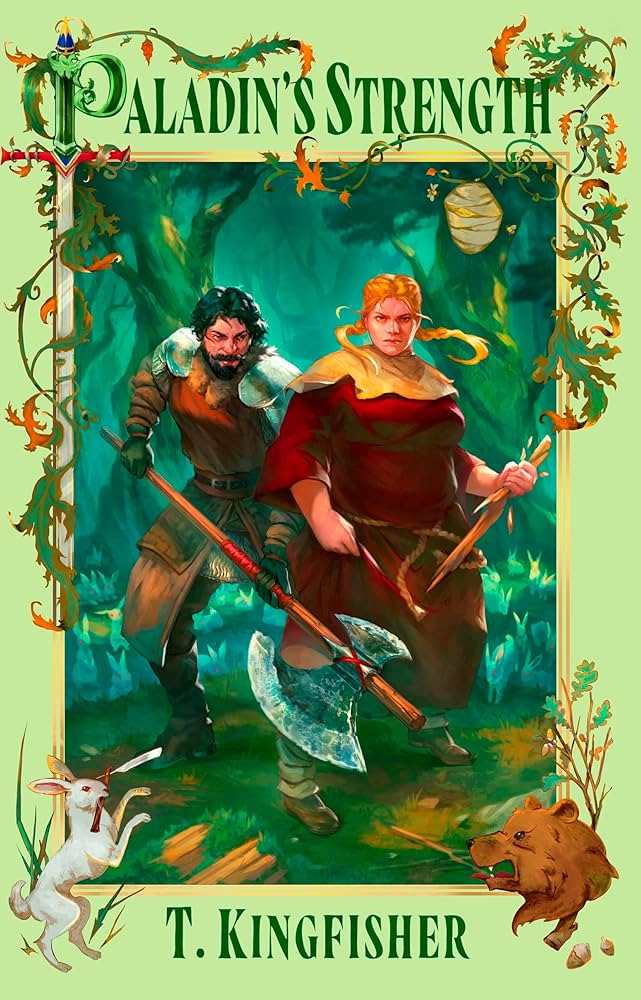
Kingfisher gave more detail in Paladin’s Grace, the first of presently four novels that follow the lives of the seven surviving paladins of the Saint of Steel, as they try to rebuild their lives after they lost what gave them meaning and direction. Paladin’s Strength takes place several years after the death of the Saint, and follows a brief but indeterminate period after the events of Paladin’s Grace. It’s not strictly necessary to have read the previous book — this novel’s story is independent — but Kingfisher provides more background than in this one.
T. Kingfisher is a keen practitioner of the arresting first sentence, and Paladin’s Strength is no exception: “Clara stood outside a stranger’s tent, holding a naked sword in her hands.” (p. 1) To make a hilarious opening scene short, Clara if offering the sword to the leader of a small caravan who wish to pass through the lands of the Arral. A misunderstanding of local customs has already led to the caravan leader killing a young man. Now, peace is to be bought in a peculiar way. Because the young Arral lost his challenge, his family must offer the victor his sword and something of value from his household. Not to put too fine a point on it, that something is Clara, who is not Arral and can be offered without too much loss to the household. The leader, whose name is Istvhan (I pronounced it the Hungarian way, EESHT-vahn, because it spelled so close to István, the Hungarian version of Steven), does not want to take in Clara but is eventually persuaded that rejecting her would cause violent offense, and the caravan still has to pass through several days’ journey of Arral lands.
Along the way to agreement, Clara reveals that she is a nun, a lay sister of the Order of St. Ursa. Raiders recently sacked and burned her convent, and kidnapped the sisters who survived the fire. Clara had been kidnapped as well but got free. She was following them and working up ways to free the others when she ran afoul of the Arral, which in turn led to the novel’s opening scene.
In Paladin’s Grace, Kingfisher established that Istvhan is a big man; one of his first jobs in that book is to loom menacingly at a trial. Clara is similarly built.
She was a big woman. Nearly as tall as he was, which put her well over six feet, with heavy breasts and belly, hips and thighs. Her shoulders were broad and she carried herself with the confidence of one who is used to being the most physically powerful person in the room.
Istvhan had carried himself like that once, though it had been beaten out of him long ago. There was always something bigger than you, no matter how big you were.
He wondered idly if he could take her in a fight. It seemed likely, but he wouldn’t assume. Such assumptions had also been beaten out of him long ago. (pp. 9–10)
Despite the apparent truce, both are keeping a great deal of information to themselves. Clara gives only the barest story about her sisters, her role at the convent, and why someone might go to such lengths to kidnap these particular nuns. Istvhan is a little bit more forthcoming, disclosing the caravan’s eventual destination. He adds that in addition to the valuable barrels they are delivering to a coastal city, they have also heard rumors about an unusual and disquieting kind of killing, and they are keeping eyes and ears open to learn more along their journey. This type of killing was central to Paladin’s Grace, so readers learn that the problem was not quite as resolved as it seemed at the end of the other book.
Complications ensue — bandits, for example — and they gradually learn more about each other. Istvhan has been posing as a mercenary captain, not quite mentioning his own relationship with the supernatural. Until after one particular fighting encounter Clara declares that she is going to take a mountain route without the caravan, something Istvhan is dead set against.
Clara drew herself up to her full height. “I am not asking your permission, Captain Istvhan. I am not under your command. I am very grateful for your escort to this point, but our ways part now.”
She took half a step forward and Istvhan wanted to laugh with recognition. She would have loomed over a smaller man, and if he took a step back, even involuntarily, he would lose the battle before it had begun. He’d done it himself any number of times.
Oh, no [he thought]. You cannot physically intimidate me, Domina. … I know this dance too well. He took a half-step forward instead.
Something flickered in her eyes. Acknowledgement? Something else? He did not know. He realized too late that he was too close. He could have leaned forward and kissed her. She could have reached out and choked the life out of him. And if we combine the two [he thought], things will get extremely strange. …
“You’re still not going alone,” he said.
“You cannot stop me.”
“From going? No. So I’ll go with you.”
She hadn’t expected that. Her eyes flicked again and there was an edge of uncertainty to her voice. “You’re a mercenary, Captain Istvhan. And I am not paying you.”
He sighed. “I’m not a mercenary,” he said. “I’m a paladin.”“A paladin? A holy warrior?!” Clara put her hands on her hips. “And you’ve been giving me crap about being a nun when I’m only a lay sister?”
“Is this really the time?” asked Istvhan.
“Yes, it’s the time!”
“It’s only that men who would like to put you in a zoo are probably going to come back soon.”
“They can wait! I am not done yelling!”
“Yes’m,” said Istvhan, and stared contritely at his toes.
“You’re a paladin!”
“More or less. Less these days.”
“But a paladin!”
“I feel very bad about it.”
Clara waved her hands in the air and had to catch her robe before it fled for the ground. She didn’t know why it was so aggravating, except that it was. Over a week and he’s never mentioned it and she’d been acting like he was a particularly noble mercenary instead of a particularly ignoble holy warrior and … and … dammit, it wasn’t fair. (pp. 124–25)
As circumstances have brought the two of them closer together, a meeting of physical and intellectual equals might become more but neither can quite believe that the other might harbor similar feelings. One of Kingfisher’s characters has observed elsewhere that a paladin’s two main feelings are duty and guilt. Istvhan has duties to his men and his mission (and his gnole); he has also taken on a duty to help Clara find her sisters and rescue them if possible. He also has clear ideas about what one does and does not do with a nun, even a lay sister. And nobody in his troop makes the obvious joke about that title. Clara’s vows do not include celibacy, but she is appalled with herself that she would consider any distraction when her sisters are in danger. She harbors secrets too, including a reason no man to date has wanted to have a lasting relationship with her. She fears that Istvhan would be like the others. They get in their own way so much that later in the journey, when physical danger has ebbed for a while, even minor characters try to give them advice on getting together.
Paladin’s Strength is a well executed adventure story, it’s laugh-out-loud funny in many places, and the supporting cast is a delightful collection of wit and skill. Fellow paladin and second-in-command Galen is there with the sardonic comment, Doc Mason has an original traveling medicine show with all the patter, and Brindle the gnole puts up with humans with only the occasional wry observation to notes about how clueless we are. The last chapters are an action sequence that’s both thrilling and touching. Structurally, I like a little more uncertainty about the romantic plot. I get that in the genre Kingfisher is writing in, a reader’s enjoyment is supposed to come more from the how of the leads’ getting together, and the obstacles along the way, than the question of whether they will or not. That foregone conclusion is not my personal preference, at least not as a steady stream in my reading.
In the other novels set in the world of the White Rat, the existence of the gods and their involvement in human affairs has been take as self-evident. Magic is shown to work, ergo the divine is actually present as well. Except that in Paladin’s Strength Istvhan in particular and Clara to a lesser extent begin to wonder. Did the gods call men and lend them the ability to become a berserker? Or were some men berserkers by nature, who then followed a god to sanctify the battle tide that took them? Clara cannot say whether Saint Ursa is or was real. She has her own supernatural abilities, as do her sisters, but in calling them the gift of St. Ursa is she talking about a divine personage who touched mortals, or is she giving a name to a happening and beliefs that have grown up around them? I like how Kingfisher shows a different paladin’s view of his experience, and that she uses that to make the world both more complex and more like a fully inhabited world.
There are at present two more paladin books. I expect that two more of the Saint of Steel’s surviving servants will find adventure and love, and I hope that that they will also find ways to reveal more about the world around them.

 Al Singh
 Doug Merrill
 Doreen Sheridan
 Emily Lauer
 John Pitzel
 Lars N. Goldschlager
 Laura Eilers
 Professor X
 Robert Maedgen
 Sylvere Ap Leanan
 The Shire