One of the things that I have come to overlook over the course of the first five books in Mick Herron’s Slow Horses series of British spy thrillers is the number of once-a-decade or even once-a-generation events that take place in a much shorter span of time. Further, the death count among the horses approaches that among the whole of the CIA, and I mean, sure, they’re objectively bad spies, that’s why they’ve landed in the British secret service’s most dead-end office, but they’re not that bad. So over the course of these very enjoyable books, I have come to accept that Herron is providing not just a form of alt-history but a version of spy stories that is more heightened reality than closely observed and carefully controlled skullduggery.
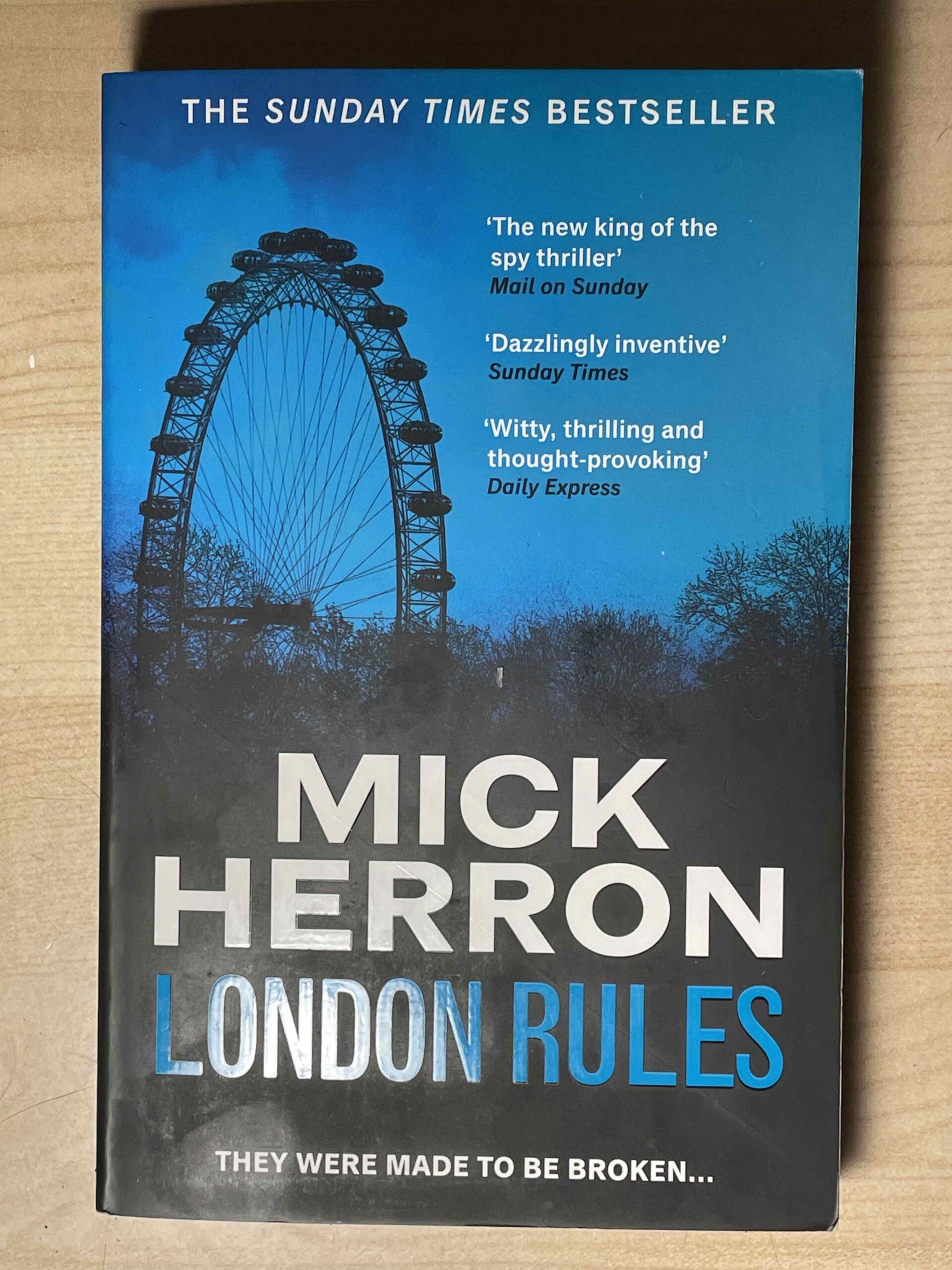
Another trademark is the first chapter that serves as a separate introduction to the novel. Sometimes it’s an abstract or disembodied observer taking the lay of the land; sometimes it’s a precipitating incident that the series’ main characters aren’t present for but which sets the plot in motion. London Rules takes the latter approach, describing a terrorist attack on a village like something that’s happening in the Sahel, only to reveal in the last sentence that it’s in Derbyshire. Then a quick jump to Slough House where dawn is slowly creeping up the squeaky stairs, and some time later the various horses start their working days. The book’s title comes up pretty quickly, too, as a view of the Barbican leads C.K. Coe to muse on how the world, and especially the secret service part of it, runs.
It was an Orwellian nightmare of a complex, a concrete monstrosity, but credit where it was due: like Ronnie and Reggie Kray before it, the Barbican had overcome the drawback of being a brutal piece of shit to achieve iconic status. But that was London Rules for you: force others to take you on your own terms. And if they didn’t like it, stay in their face until they did.
Jackson Lamb, for instance. Except on second thoughts, no: Lamb didn’t give a toss whose terms you took him on. He carried on regardless. He just was. (p. 17)
Jackson Lamb just was, and by the end of the chapter, Roderick Ho (Slough House’s computer guy, who is clueless and incredibly self-regarding) almost wasn’t. A car apparently tries to run him over, and he is only saved by the timely appearance of Shirley Dander, another denizen of Slough House, who bowls him over instead but does get him neatly out of the car’s path. What she doesn’t get is the car’s plate number as it speeds away. Roderick had been looking in the other direction the whole time, with his earbuds rocking out, so he missed any audio clues too. Lamb and the others initially refuse to believe that someone had put out a hit on Roddy. From the other side of the fourth wall, there wouldn’t be much of a book if it had just been a random bit of exceptionally bad London driving. But what could it possibly have to do with the Derbyshire massacre?
That question provides the mechanics of London Rules. The characters and situations that Herron set up over the four previous books provide the matter, and he turns them loose against each other. The upper reaches of the secret service are still trying to win against each other in musical chairs; the upper reaches of British politics are trying to ascend or stay atop the greasy pole; the actual business of governance often appears an afterthought. I like the twisty way that Herron thinks and writes, but in this novel I really came to appreciate how funny his people are. Jackson Lamb is well on his way to stealing the show as the horrible boss of Slough House. I have read that Herron writes Lamb by thinking about the most inappropriate thing that a character could say in a given situation, and then having him say exactly that. It’s appalling and hilarious. Lamb’s redemption is that he really does care about his people, unless of course it’s that he cares about his own ego so much that he can’t bear the thought of anyone else taking advantage of the people that he regards as rightfully his.
Here’s Lamb in conversation with Dander about the disposition of a gun that Marcus—a slow horse who got shot in the previous book—illegally kept in his desk.
“Dander, I’d hate you to get the idea that I give even the smallest of fucks about this, but you’re a junkie with a short fuse. Putting you in charge of a loaded gun would be like giving a three-year-old a box of matches. It might make for an entertaining ten minutes, but I’d have HR on my back before you can say ‘fuck me, smells like bacon.’ Besides, I hate to harp on about the paperwork. But Standish has me signing fifteen forms a day as it is.” He held up his hand in front of him, and grimaced sadly. “I think I’m developing repetitive strain injury.”
“Nobody would know,” she said. “Marcus shouldn’t have had it in the first place. It’s not even legal.”
Lamb affected shock. “You mean, if he’d been caught with it, he could have been charged with a criminal offence?”
“Yep.”
“Dodged a bullet there, didn’t he? Shame he didn’t make a habit of it.”
For what might have been half a minute she stared at him, but he’d adopted his most benign expression — post-coital warthog, or thereabouts — and gave every indication of being prepared to hold it until the final trump. (pp. 56–57)
He’s not any friendlier to people above him on the org chart.
“Playing the national security card for the cops is one thing, Jackson, even though we both know your clearance is just marginally higher than Thomas the Tank Engine’s. But acting dumb for the Park’s another story.”
“I’m not sure you’re allowed to say dumb any more. It offends the vocally impaired. Or idiots. I can’t remember which.”
“I’m not in the bood.”
“Yeah, I caught that vibe.”
“You were there, at Ho’s house, at whatever time in the morning it was. Which means you knew there was something going on. But you didn’t report it. Service Standing Order whatever the hell it is—”
“Twenty-seven three,” Lamb said.
“If you say so.”
“The three’s in brackets.”
“I don’t care if it’s in fucking Sanskrit, it’s there for a reason. If you knew there was a hit on one of your team, the protocol’s clear. You report it upwards. In this case, to me”
“Ordinarily, I would have. But there were special circumstances.”
“Which were?”
“I couldn’t be arsed.”
She drummed her fingers against the chair briefly, then stopped. Not letting Lamb see your annoyance was a primary objective of any encounter with him. A bit like not letting a shark notice your blood in the water. (p. 87)
The thing is, Jackson Lamb is the real deal, and people who forget that often regret it.
At Regent’s Park [J.K. Coe would] have had to back his assertions with hard evidence or statistical probability. In Slough House, all he’d had to do was convince Jackson Lamb. But then, Lamb had done his time behind the Wall, and could still read the writing on it. People talked about Spook Street — life in the covert world — but Lamb had served down the dismal end, where your instincts stayed sharp or you suffered, and he recognised the truth when he head it. Which didn’t mean he wasn’t a fat bastard, just that he was a fat bastard you dismissed at your peril. (pp. 170–71)
That’s another London Rule.
+++
I’m now ahead of Doreen in reading this series. I’m sure she’ll catch up in her copious spare reading time.

 Al Singh
 Doug Merrill
 Doreen Sheridan
 Emily Lauer
 John Pitzel
 Lars N. Goldschlager
 Laura Eilers
 Professor X
 Robert Maedgen
 Sylvere Ap Leanan
 The Shire