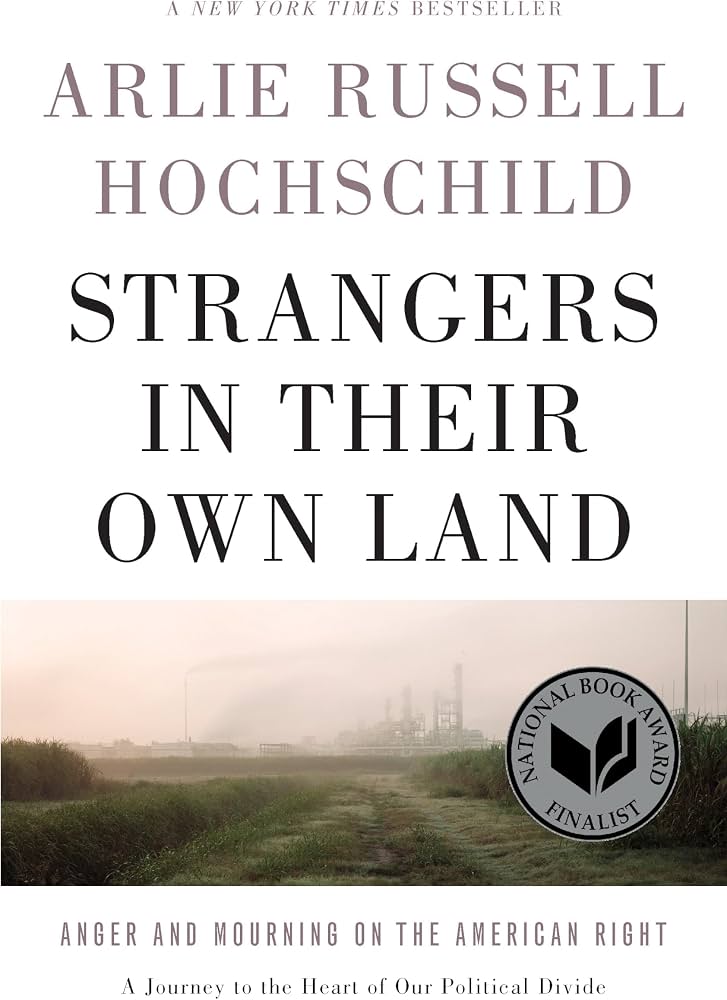
Strangers in Their Own Land is a book-length Cletus safari, and I hated much of the book when I dug in to read it. After a few chapters of reading from the beginning, I decided to read more like the grad student that I once was, and I developed a sort of grudging respect, but the whole enterprise still makes me spitting mad.
Why did I persist at all? Well, one of my kids asked me to. I say kid, but he’s now a college graduate. I grew up in Louisiana, where the book is set. He mostly grew up in Berlin. The extended family has all moved to Texas, so he’s never even visited Louisiana, and he was curious what I thought about Hochschild’s depiction. It’s not that her depiction is inaccurate in its details — she’s a careful sociologist, that’s part of the grudging respect — it’s just woefully, catastrophically incomplete. So let me say this, as at least a sixth-generation Southerner: Bless her heart, I’m sure she means well.
When she began her research in 2010, she was interested in the Tea Party, and more specifically what it felt like to be someone drawn to this seemingly new form of right-wing politics. A coincidental personal connection drew her to Louisiana, and she built a network of people willing to talk to her and to show her what this white world was like. And it is a very white world. In her opening anecdote, a white man named Mike is recounting who used to live where in the now-gone settlement of Banderville. The little cluster of shotgun shacks and small houses had been dismantled in the 1970s — the same decade that my family moved to Louisiana — and by the time that Hochschild and Mike drive around that part of Assumption Parish it is all sugarcane fields. In Mike’s telling, the settlement had been about three-quarters Black and one-quarter white. Mike describes one of the Black women he knew, but does not name her, and Hochschild does not recount anything more about three-quarters of the community. That yawning gap is typical of the rest of the book (as far as I can tell, though I did not read all of it), and that’s a tremendous problem because you cannot understand power and politics in Louisiana if you do not address race.
The grudging respect came when I skipped to the back of the book to read the appendices, which contain things like her research design, or some interesting results about correlations between pollution in an area and its voters’ proclivities, as well as a list of beliefs about public issues commonly held by Tea Party sympathizers and the truth values of those statements. Long story short, they’re all false. Like, not even a matter of interpretation, they’re flat-out wrong. Some of these common statements are borderline racist — “People on welfare depend entirely on money from us taxpayers to live,” “Everyone who’s poor gets a handout” — and one of them — “Black women have a lot more children than white women” is well over that border. What does it say about Hochschild that she spends the book constructing more or less sympathetic portraits of people who hold false and immoral things to be true and good?
Sure, some of the people have complexities. When a man named Lee was younger, part of his job was to pour toxic waste from the plant where he worked into a nearby body of water, illegally and secretly under cover of darkness. When he was involved with an accident with a hazardous material, the company put him on medical leave and then fired him for absenteeism soon after he came back. Decades later, at a public hearing on water pollution where that same company was trying to deny any responsibility, Lee revealed that he had been the one doing the dumping, making a mockery of the company’s attempts at obfuscation. But I’ve read too much Nazi and Soviet history to have a whole lot of patience for this kind of account. Sure, Opa was gentle in his old age, but he still shot prisoners on the Eastern Front. Sure, Olga looked after neighbor children until their mothers came home from work, but she also got that apartment by denouncing a different neighbor to the NKVD, who sent them to the gulag. The American case is marginally less extreme, but ordinary people can still do the most appalling things, especially if it protects their interests or sense of self. They buy Alligator Alcatraz merch to show their allegiance, they tip off La Migra to settle a personal score.
Donald Trump gave many of these folks permission to be their worst selves. A few of the people Hochschild detailed were not altogether sold. “Jackie Tabor … said in an e-mail, ‘Trump scares me'” but even she was taken in, because her next words were “which is too bad because he’s obviously an amazing businessman.” (p. 229) Apparently six bankruptcies, inability to make money while running a casino, and a steady stream of stiffing creditors didn’t penetrate Tabor’s consciousness. Sharon Galicia, “once president of Republican Women of Southwest Louisiana and an aspirant for a position in the state Republican Party” (p. 229) got closer. “I think he’s mean.” (p. 229) How do Galicia’s morals and interests balance out? “And if he becomes the Republican nominee, Trump has her reluctant vote too.” (p. 229) I hope she is having the kind of day and year that she voted for, presumably three times by now.

 Al Singh
 Doug Merrill
 Doreen Sheridan
 Emily Lauer
 John Pitzel
 Lars N. Goldschlager
 Laura Eilers
 Professor X
 Robert Maedgen
 Sylvere Ap Leanan
 The Shire