Jaan Kross was born in Tallinn, the capital of independent Estonia, in 1920, and he died in Tallinn, the capital of independent Estonia, in 2007. During his lifetime, Estonia was invaded and occupied by the Soviet Union, invaded and occupied by Nazi Germany, and then invaded and occupied a second time by the Soviet Union. The Nazis imprisoned him. The Soviets sent him to a branch of the Gulag in Siberia for six years, and kept him in the far north for two more years after he got out of the Gulag before allowing him to return to Estonia in 1954. He lived long enough to see not only the end of the occupation but to see Estonia join NATO and the European Union. It’s a lovely country, mostly forested these days, with a northern coast on the Gulf of Finland, a western one on the Baltic Sea and the Gulf of Riga, and a passel of islands off of both coasts. I first visited in 1994, not many days before the last Soviet soldiers departed and the occupation ended three years after independence was regained. I bicycled across the country, south to north, in the summer of 2003. I’ve been back several times since and have visited every region except the northeast, where some significant incidents of The Ropewalker take place. Alt-future Estonia turns up in Dave Hutchinson‘s Fractured Europe series, as one of the main characters has an Estonian background and gets up to some funny business on the country’s northern coast.
At the time The Ropewalker is set—the second half of the 1500s—Estonia does not yet exist. Most of what is called Estonia today was ruled by the Teutonic Order, which had conquered the region in the 1200s. By the time of The Ropewalker, their power is waning. The major towns, almost all of them part of the Hanseatic League, govern themselves, even when they owe nominal allegiance to the Order. The Danish, Swedish and Polish kings are all taking an interest with an eye toward expanding their holdings, if it does not cost much in the way of blood and treasure. About halfway through The Ropewalker, Ivan III of Muscovy (grandfather of the Terrible Ivan) looks westward with conquest on his mind, and the rest of the book takes place in the shadow of war, and what that means for all levels of society. On the manors where most of the country’s people live, the German lords continue to rule, although they often leave day-to-day management to overseers. Ivan simplifies his task by making promises to both the lords and the peasants; that he will be unable to keep both is neither here nor there to people caught in the middle.
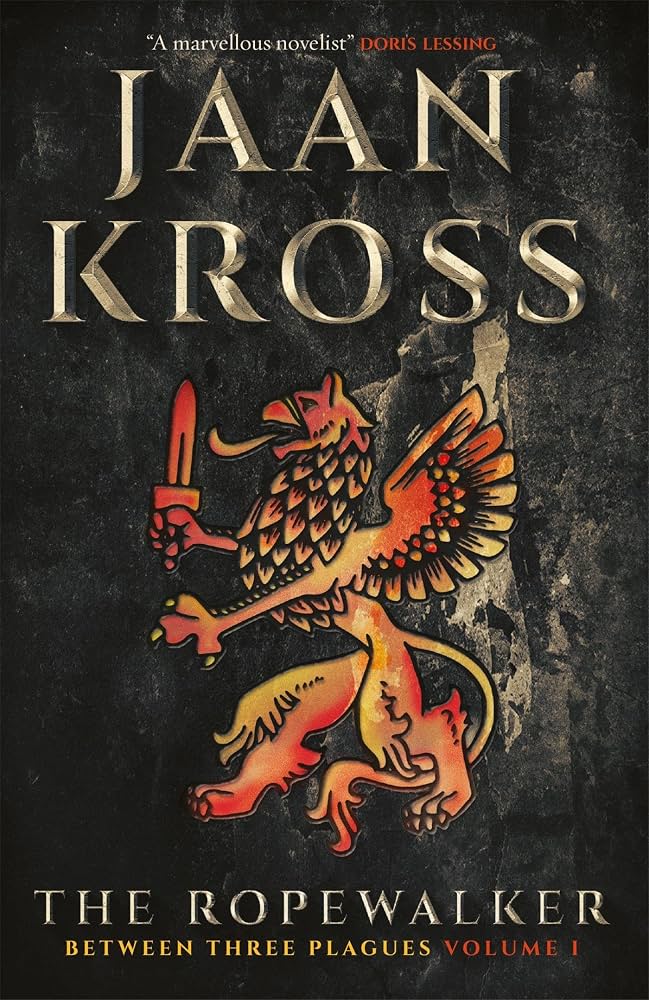
Kross tells his tale from the perspective of Balthasar Rüssow, who was a real person, so readers who check will discover that he survives the Livonian Wars and goes on to become one of the region’s most important chronicler. The whole tale takes three volumes in English (four in Estonian); it is called Between Three Plagues, not only for outbreaks of actual plague but also for the three powers contending for Estonia. The volumes that follow The Ropewalker are A People Without a Past and A Book of Falsehoods. Kross wrote them between 1970 and 1980, but they were not published in English until the late 2010s.
Kross begins with the incident that gives the book its name. Though Balthasar was born and spent his early childhood on a farm not far from Tallinn, his family has town connections. Those connections, his native intelligence, and some lucky breaks gain him a place at the German school, where he begins learning Latin, Protestant theology, and other necessities. One day a circus troupe runs a rope between one of the church steeples and the city walls, and they astonish the crowd by running up and down the rope whose upper end is more than 200 feet above the ground. Balthasar is overcome with curiosity and sneaks into the church tower mid-performance to find out how they manage the trick. Later on, he exchanges wisdom with his friend Märten.
“But what do these skywalkers drink? Before they go out on the rope? Couldn’t we find that out?” [said Balthasar.]
“There’s nothing to find out. I know what it is” [said Märten].
“Don’t blather!”
“But I know … They also drink dew.”
“Hogwash.”
“It’s true! I was around them for a whole week, and the girls—they could manage a little German—told me the whole story: On three cloudless nights before the spectacle, they spread out two oiled calfskins in a hidden place, and when the dew collects they gather up the drops into a crystal bottle.”
“But how does the dew come by this magic power?”
“Look, the sun takes dew up into the air in the morning, right? And if you have enough of it in your body…”
“I get it. But in that case, you could just collect all you wanted…”
“It wouldn’t help. When they flew along the rope in Vilnius, it had to be dew from Lithuania; and in Cracow it had to be from Poland. And in Tallinn only dew collected here will work. It has to be dew from the country you’re in, or you come hurtling down.”
“I suppose they have to practice, too?”
“That’s for sure. A whole lot. They practice seven hours a day. But without drinking the dew they couldn’t do the half of it!”
“Of course … And no doubt they say some magic words over the drink.”
“I would think so.” (Ch. 1)
Magic, science, religion all coexist in Balthasar’s world, and The Ropewalker shows how his understanding shifts among them, and how he adds to his knowledge of human nature as he grows into manhood. Balthasar does not go out on the rope right away, but that is who he will become: seeing more than his compatriots on the ground, daring more, but also exposed to the winds blowing in from afar, with a very narrow path to tread without falling. Kross gives readers a rich and detailed view into the past, from the country estate where Balthasar’s father lives and the customs that Balthasar joins in the rural rituals that combine practical work and ancient customs to mark the turning of the seasons and then back to the rhythms of the school where scholars are trained for the Lutheran priesthood. Kross’ work is also thoroughly grounded; it would probably be possible to find the house on the market square where Balthasar later has his lodgings.
As Balthasar grows, the book’s setting expands and its actions and motivations get more complex. Seeing his curiosity and lively intelligence, people test his capacities, his daring and his discretion. Can he write a letter that will make a merchant’s case? Can he deliver a message without being seen? Can he take a crucial piece of news across the frozen sea to Finland? Each step of the way takes Balthasar further away from his earthy childhood. Every now and then he stops to think whether that is what he really wants, and one of the overarching questions of the book is where his heart truly belongs, and what he will do for that.
By the end of the book, the story’s action has been to Narva on the border with Muscovy, to Stettin (modern Szczecin, today in Poland), and even to Wittenberg where Martin Luther himself preached and sparked the Reformation. Balthasar is given the opportunity to play a part in the intrigues that will decide who rules Tallinn and surroundings. When the country people, the peasants, the town’s Greys, the Estonians — however they are called (though that last name is not used), they are Balthasar’s family and the fellow speakers of his mother tongue — rise in rebellion against their manor lords he must choose where he stands. He begins to learn about life and women; he learns that even the oldest friends such as Märtens can change in unexpected ways.
Kross’ book offers adventure, growth, humor, desire, ambition and more. The secondary characters are as memorable as Balthasar, and sometimes as complex. Kross takes the theological perspectives of the characters as seriously as they do, without becoming tedious or pedantic. Positions on what seem — even to Balthasar — like obscure points of doctrine can become matters of life or death. One more thing: Kross wrote Between Three Plagues during the Soviet period, and much of the larger structure of this first volume could be read as an allegory of Estonians seeking freedom from Russian domination. To get published despite Soviet censorship, Kross had to make the narrative fit the communist rulers’ framework. In this reading, all is just as it appears. The German overlords are oppressing the peasantry. Feudalism is an unjust system that will wind up in the dustbin of history. Turn it just a little, though, and the disintegration of the Order’s power, the rebellion against foreign rulers, taking local control are all a way of telling a story about throwing off the Russian domination that held sway in Soviet Estonia. The Ropewalker is a well-crafted bildungsroman, it is a colorful historical adventure story. It is also a tale of fighting against Moscow’s attempts to rule. The past isn’t even past.

 Al Singh
 Doug Merrill
 Doreen Sheridan
 Emily Lauer
 John Pitzel
 Lars N. Goldschlager
 Laura Eilers
 Professor X
 Robert Maedgen
 Sylvere Ap Leanan
 The Shire