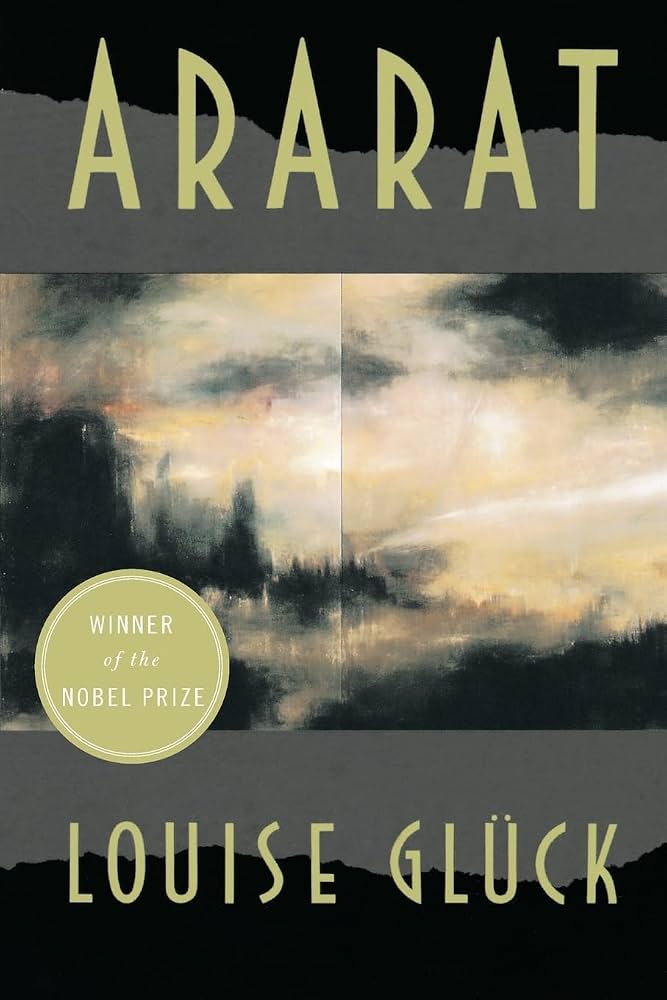
Barely two poems into this collection, I thought to myself, “Her dad died.” A quick visit to Wikipedia confirmed that, yes, her father passed away in 1985, the year Glück’s previous collection was published, and that the loss spurred the poems that became Ararat. This book is full of death and loss; there are a few other subjects, but even the poems that start elsewhere mostly make their way back to death in one way or another. Curiously, the subject made these poems easier for me to come to grips with than her other books had been. I found many of her poems somewhere between oblique and obscure, and slid right off most of them. Thinking about Descending Figure, I wrote that we had very different sensibilities, that I would find it natural to read her works into much wilder milieus with personified gardens that could talk back, or statues that could cavort. Concerning The Triumph of Achilles, I wrote that I connected with them glancingly at best.
Ararat is full of sadness, but it is an accessible sadness, one whose many aspects Glück shows with brilliant clarity. She writes candidly, openly about her family: her mother, her father, her sister, sometimes the older sister who died before Glück herself was born, sometimes about her son, her sister’s children, occasionally about the little group as a whole. (Though to me her family seems rather small and tidy. I come from a sprawling Southern clan, where an aunt who lived with one set of grandparents was really a second cousin, though I was mostly grown before I learned that, and the uncle who really was an uncle, well, a great-uncle, kept the Mississippi plates on his car despite decades in Tennessee. And that’s before you get to the second marriages and whatnot into my parents’ and my generations, a full panoply of people who may or may not be related but still turn up from time to time.) Anyway. Somebody’s dead or dying in most of the poems in Ararat, and that mournful universal made the works less oblique.
That very openness, though, also led me to wonder how much of the family history Glück polished up to make it into the material for poetry. Not prettified, for that is not her thing at all, but maybe some of the contrasts sharpened, some of the memories placed closer together. Would her mother and her sister see themselves in what Glück writes about them? Is there more than just the inevitable differences of two people describing the same events, the same relationships? These are unanswerable questions, of course, but it’s hard not to suspect, not to see some artifice in the artfulness.
The almost-title poem of the collection, “Mount Ararat,” is packed with gut punches. It starts, “Nothing’s sadder than my sister’s grave/unless it’s the grave of my cousin, next to her.” Not one dead child, but two. Glück is as daunted as her reader, or at least that’s what she says in the next lines. “To this day, I can’t bring myself to watch/my aunt and my mother,” two sisters, two mothers grieving their children, an unbearable pain doubled.
though the more I try to escape
seeing their suffering, the more it seems
the fate of our family:
each branch donates one girl child to the earth.
Aversion is a natural reaction, and indeed that’s the path that Glück says that she and her sister took. “In my generation, we put off marrying, put off having children./When we did have them, we each had one;/for the most part, we had sons, not daughters.” And furthermore, “We don’t discuss this ever.” Although Mount Ararat is presumably a refuge as the place where Noah’s ark came to rest, Glück does not feel safe at all. “… every stone here/is dedicated to the Jewish god/who doesn’t hesitate to take/a son from a mother.”
Glück addresses some of my questions, calling one poem “The Untrustworthy Speaker.” She frames a story of being mean to her younger sister with the warning “Don’t listen to me; my heart’s been broken./I don’t see anything objectively.” She ends with the admonition “That’s why I’m not to be trusted./Because a wound to the heart/is also a wound to the mind.”
In “Brown Circle” she writes about understanding her mother more now that she is also a parent, about how mistakes are inevitable. She wants to be a mother like someone who discovers a rare flower and just lets it be, gives it what it needs to thrive but otherwise steers clear. Instead, she finds that she “is the scientist/who comes to that flower/with a magnifying glass/and doesn’t leave, though/the sun burns a brown/circle of grass around/the flower.” Wryly, perhaps, she remarks that that is how her mother had loved her. “I must learn/to forgive my mother,/now that I’m helpless/to spare my son.” It’s one of the few poems in the collection in which nobody dies.
I wouldn’t say that I exactly liked the intense sadness of Ararat, but I felt that I connected with Glück in a way that I hadn’t in her previous collections. Perhaps our sensibilities meet up only in the universals of human life, but I am glad to see that she does not always remain distant and alien.

 Al Singh
 Doug Merrill
 Doreen Sheridan
 Emily Lauer
 John Pitzel
 Lars N. Goldschlager
 Laura Eilers
 Professor X
 Robert Maedgen
 Sylvere Ap Leanan
 The Shire