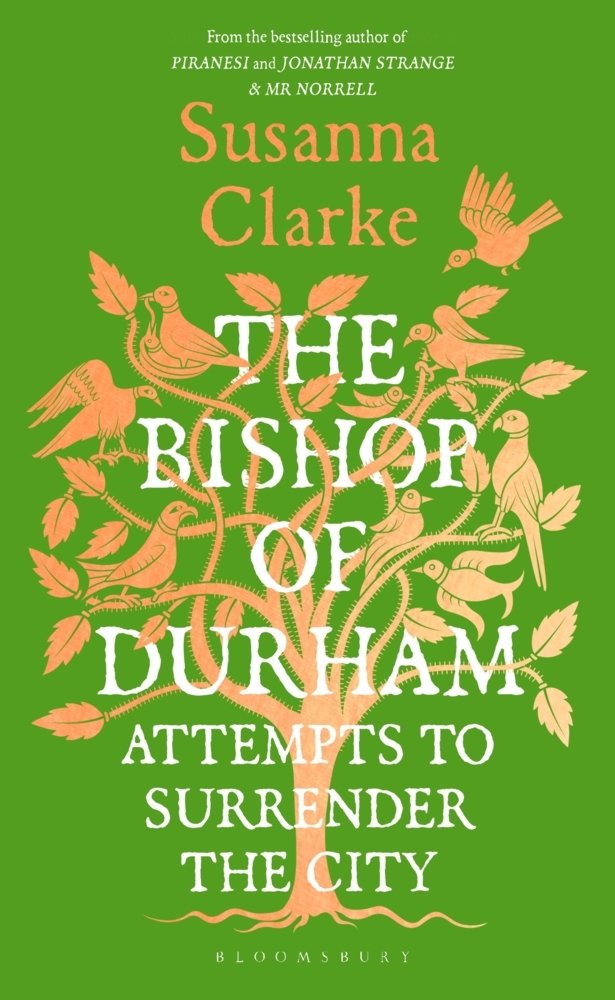
Another story in the world of Jonathan Strange & Mr Norrell, hurray! It’s not quite a new story, as a version of it was published in Fictionable in 2025, but publication as a standalone book from Bloomsbury surely brings The Bishop of Durham Attempts to Surrender the City to a much larger audience, myself included. The year is 1110, and the fairy host is busily conquering northern England. Fighting such an army is no simple task.
The Bishop of Durham — a man called Ranulf Flambard — led his knights and soldiers out of the city to meet the invading army. But the battle had scarcely begun before he was in difficulties. Sometimes he knew where he was — riding across grey winter meadows towards an eerie foe — but at other moments he thought he was in a frail boat alone and lost on a wild and featureless sea. And then the battle again. And then the boat.
Looking about him, he saw his knights wandering the field, the battle forgotten, speaking and gesticulating at people who weren’t there. Their horses shied when there was nothing to fright them. Who knew what they saw? Ranulf gathered up his army as quickly as he could, retreated into Durham and shut the gates. (pp. 7–9)
Durham is well suited to resist a siege. The fairy host does not offer one. They destroy the bridge and all the boats they can find and then ride away, leaving behind a thick mist covering the country. When the mist parts, the people of Durham see that their city has been surrounded by trees, more like to Tolkien’s Huorns than Birnam Wood come to Durham Town. Neither is the river inclined to let them out.
Two months after the host rode off, and no fairies having been seen since, Ranulf is prepared to surrender. But to whom? That is the problem of the first of the five sections of The Bishop of Durham. The act that lifts the siege proves simpler than Ranulf expected, but its aftermath raises new and surprising questions. “Ranulf gathered his knights and monks and set off with all haste to the New Castle on the Tyne, where the [fairy] King was. Ranulf intended to surrender the city. He also intended to improve his own position if he could. He had already served three kings. He did not see why he should not be useful to a fourth.” (pp. 18–19) Reaching the King, and communicating with the King — for it is said that he speaks no human language — turn out to be altogether more challenging.
But not all that difficult, in the end. The Bishop of Durham is very short for a book: 84 pages of main text, plus two of an epilogue and a six-page essay by Clarke titled “Childish Things.” The book is physically small, and the pages of the story contain about 200 words each, at most. That generous spacing leaves space for the marginalia-style illustrations of Victoria Sawdon. These accompany the action on that page with a lovely blend of whimsy and atmosphere that reminds me of manuscript illuminators who almost always took their tasks seriously. A full-color version of The Bishop of Durham would have been an absolute treat.
It’s a terrific story, told in the register of myth or fairy-tale, and there are probably depths to it that I missed on my first time through. That’s fine, I will be returning soon.

 Al Singh
 Doug Merrill
 Doreen Sheridan
 Emily Lauer
 John Pitzel
 Lars N. Goldschlager
 Laura Eilers
 Professor X
 Robert Maedgen
 Sylvere Ap Leanan
 The Shire