
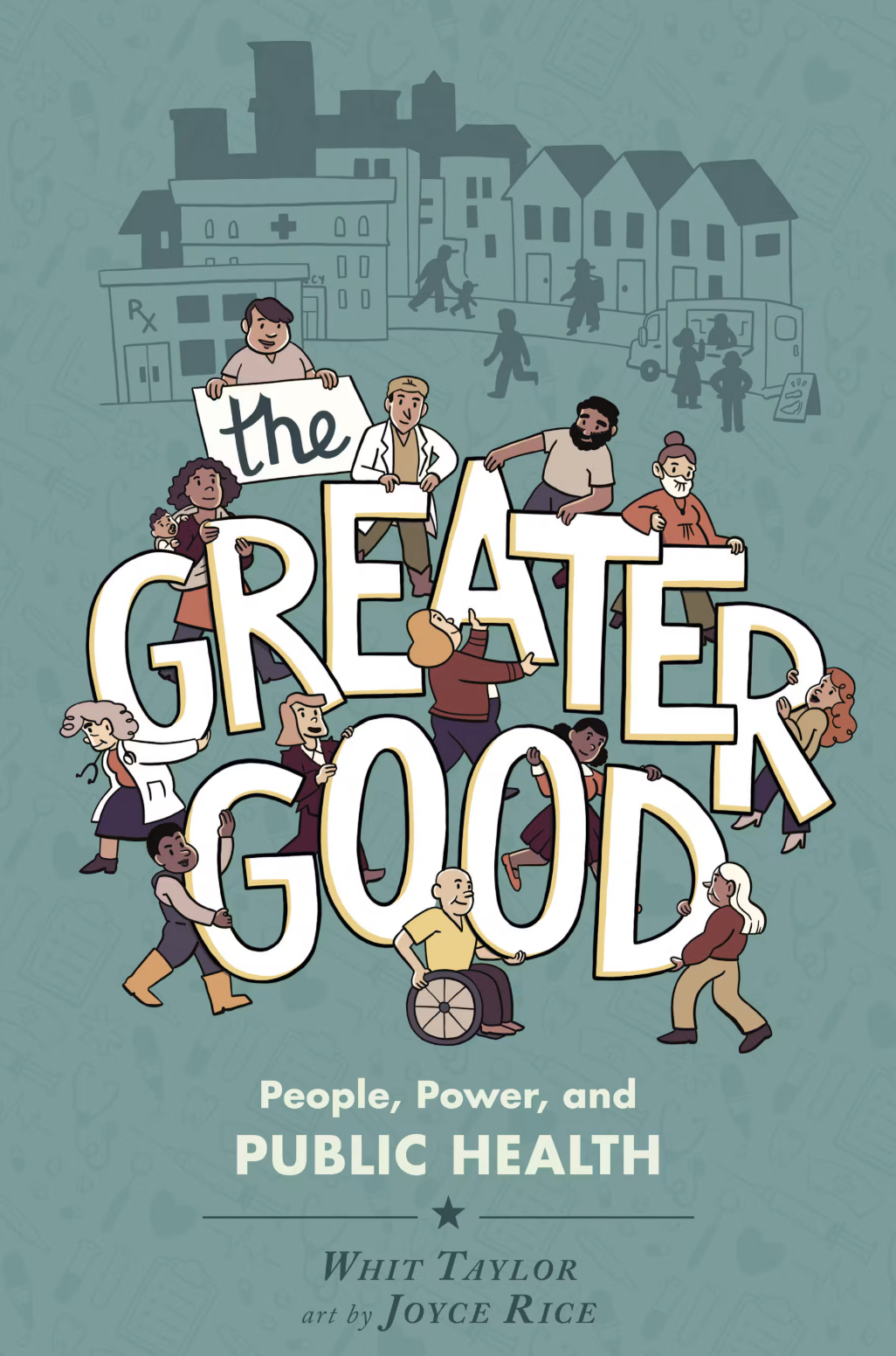
 The Greater Good: People, Power and Public Health, by Whit Taylor, is coming out December 1! With appealing art by Joyce Rice, this graphic nonfiction book is a fabulous introduction to the Public Health decisions that shape our lives.
The Greater Good is divided into chapters with historical case studies that address different categories of public health issues. Starting with “John Snow and the Origins of Epidemiology,” and culminating with “A Tale of Two Pandemics,” The Greater Good touches on everything from the history of immunization to contaminated water sources, to car safety.
As someone new to the breadth of what is classified as Public Health, I was surprised to see car safety show up at all, but I now understand how industry regulation can lead to a safer (and thus healthier) populace. I also appreciate the explanation of how safety measures can be aimed at the time before, during or after a collision, which seems to me to be applicable to a lot of disaster preparedness: what can you do before a disaster to avoid it, be ready for it, or minimize it? What can you during the disaster to mitigate any effects? What should you do after the disaster to recover from it as well as possible?
I was not surprised, however, by how frequently water contamination came up as a major issue of public health. That issue is unfortunately perennial, as humanity keeps finding new ways to contaminate water (toxic waste; fracking) to add to the mix. Even though feces-contaminated water continues to be an issue many places in the world as well.
The Greater Good is published by 23rd St., the imprint of First Second specifically for new adult works, and I think that pretty accurately conveys the intended reading audience. In tone and level, The Greater Good reminded me of John Green’s recent nonfiction book about health, Everything is Tuberculosis, which seems to be aimed at the same readership: youngish, intelligent, progressive adult readers who appreciate an engaging narrative to propel them along learning about an important topic that is pretty new to them.
I already knew Whit Taylor’s work from The Nib, and The Greater Good was so terrific I also sought out her other graphic nonfiction book, Harriet Tubman: Toward Freedom. Like the 2019 biopic, Harriet, this graphic biography focuses specifically on the part of Tubman’s life when she was first escaping and then rescuing her family members.
Unsurprisingly based on her other work, Whit Taylor does a good job making her Public Health history inclusive in The Greater Good. She highlights the contributions of women scientists, the achievements of non-western societies (though the focus overall is generally US-centric) and the socioeconomic and often racist disparities that affect ongoing Public Health concerns. The chapter “Public Health Disparities and Ethics” explicitly focuses on these issues with a case study of the Tuskegee Experiment, though they also show up in many of the other chapters.
I recommend this book to anyone who wants to know more about public policies, wonders why a functional FDA matters, or enjoys following the US Consumer Products Safety account on social media. I wholeheartedly recommend AGAINST eating lunch while you read this book, however. A lot of stuff is gross.

 Al Singh
 Doug Merrill
 Doreen Sheridan
 Emily Lauer
 John Pitzel
 Lars N. Goldschlager
 Laura Eilers
 Professor X
 Robert Maedgen
 Sylvere Ap Leanan
 The Shire