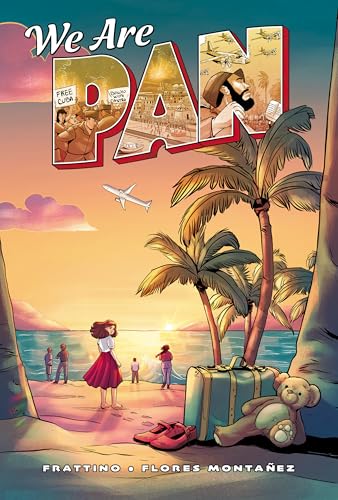
 with vibrant colors by Fabi Marques.
For the longest time, I thought this was a graphic novel for Middle Grade readers, likely due to its cover. It is very much a Young Adult+ story tho, revolving as it does around five young people who are sent away from Cuba to evade Fidel Castro’s regime. Operation Peter/Pedro Pan was a perhaps not all that well-thought-out, real life mission to airlift kids to “safety” out of Cuba, led by the undoubtedly well-intended Catholic priest Father Bryan Walsh.
The five kids at the heart of this book all come from different situations. Rosa, the eldest, waits tables at a cafe while her parents eagerly welcome Castro’s attempts to overthrow the dictator Fulgencio Batista. Eugenio dreams of studying art in Prague with his love Tomas, while his younger brother Joaquin seethes for reasons never fully explained. Wilfredo, the youngest, wants to be a musician just like his dad. And Antonia, whose voice carries the main narrative, is the pampered daughter of a lawyer who very much disapproves of Castro and passes that disdain on to his child.
We Are Pan does the best job it can to describe what it felt like to live in Cuba right before Batista fled, through Castro’s takeover and into the years beyond, as the liberation forces turned into an oppressive regime of its own. The kids all have differing experiences before they get on those planes, but most of them are sent by families scared of losing them to what they see as worse fates at the hands of the new government. Arriving in the United States is disorienting, as the kids are mostly split up while waiting for the rest of their families to make it over. The scenes with the kids doing their best to adjust and survive in the US were the most touching, for me.
But I had so many real problems with this story. Exemplifying my main issue is the fact that a character states that Batista was the head of a democratically elected government, then gets zero pushback for this categorically untrue claim. It’s also pretty clear that Antonia, tho clever and vibrant, is the snooty daughter of a self-aggrandizing man. Her narrative, especially, felt the most self-selective. Like, what happened to her sisters? And while the tale of Juanita is shocking, it’s essentially repeated again later in the book, as if that’s the best argument they could find against the Conrado Benitez Brigade, a movement to improve rural literacy. Antonia insisting at the end that any reports of Operation Pedro Pan kids all being abused and subsequently becoming drug addicts and sex workers were just Castro’s propaganda, while a more than fair assessment, is still pretty rich given that most of the book seems to be repeating anti-Castro, anti-poor people propaganda itself!
I can’t really blame Andre R Frattino for this: while his dad is from Miami, he’s only Cuban by marriage, so he’s had to rely on a bunch of testimony from older people, most of them strangers, whose lives were shaped by fear of Castro. Some of it is justified but some feels overheated, or at the very least uninterrogated. Again, the lack of pushback to the narratives — despite the author’s clear attempts to be even-handed — made it hard for me to really buy into this story. And the papering over of racism sure made me do a double take. Yes, Cubans were less stratified than Americans in the 1960s but pretending that they weren’t racist at all flies in the face of all historical evidence. While it’s humorous given the author’s own wry acknowledgment of the racist responses he received from some of the people he contacted for interviews for this graphic novel, it is yet another factor undercutting the credibility of the testimonies.
This is the kind of book that makes it painfully clear that no amount of justification makes bad ideas and decisions worthwhile. It doesn’t matter what kind of politics they have: no good governance can encourage secret police or revolutionary death squads to summarily execute people in the streets. And how ridiculous is it to send your kids away to strangers out of fear of… having your kids sent away to strangers? I just can’t sympathize with this kind of hysteria. I can only pity it, and the kids who suffered as a result. I’m glad that the vast majority of those kids came out more or less okay. I just find it hard to vilify Castro for these separations, or to see the parents as anything more than flawed people muddling through a highly emotional situation.
The art doesn’t help clarify things, unfortunately. While the characters are expressive, it was often hard for me to differentiate between them, or to tell how old some of these kids were supposed to be even before the age progressions. Ms Marques’ colors are great tho, painting each scene vividly. I do feel that this creative team tried their hardest to illuminate a truly shocking chapter of recent history, but were unable to overcome the inherent contradictions of the subject matter to present a story that was as affecting as they wanted it to be.
We Are Pan by Andre R. Frattino & Yasmín Flores Montañez was published June 2 2026 by Top Shelf Productions and is available from all good booksellers, including

 Al Singh
 Doug Merrill
 Doreen Sheridan
 Emily Lauer
 John Pitzel
 Lars N. Goldschlager
 Laura Eilers
 Professor X
 Robert Maedgen
 Sylvere Ap Leanan
 The Shire