
Hans-Jürgen Massaquoi was born in Hamburg in 1926, son of a working-class German woman and a son of the Liberian consul general in the city. The liaison that produced him did not last — both mother and father were young to be parents, and his father returned to Ireland to continue his studies in law — though the connection to Liberia did. Hans’ grandfather, the consul, took them in to live at the consulate. Eventually he was recalled to Liberia; Hans and his mother remained in Hamburg. They lived in Barmbek, a working-class district of close quarters, small shops and businesses, and tight community. Hans always stood out because he was Black, the only Black child he knew of in Hamburg. That also meant that he grew up as a German kid among other German kids; there could be no question of a separate community for him because there simply wasn’t anyone else.
When he was seven, the Nazis came to national power. He remembers being disappointed about not being allowed to join the Hitler Youth, which from his perspective looked like a fun organization with cool uniforms. He also remembers a PE teacher from elementary school who kept moving the goals to ensure that he would never be able to meet them. Decades later when he wrote his memoirs the shame and the unfairness still hurt. Nazi regulations also meant that he was forbidden higher education and was tracked into vocational schooling followed by an apprenticeship. The close-knit nature of Barmbek sometimes worked in his favor. One night when he was stopped by an SS member and taken to the local police station as a loiterer and a hoodlum, the officer on duty recognized him as an apprentice at the same firm as another policeman’s son and closed the case with no further actions taken. It was of course just one of many reminders of his unequal status in the society of his birth, and the ways that arbitrary state power could change his life instantly, or even end it.
Ironically, Nazi racial laws may have kept him alive by barring his entry into the army. Many, many years later he learned more about what became of his school classmates, and the share of male classmates who died in the war was not small. Eventually, it was not just Germans who went to war; in due course the war came to Germany. Nearly all of Hans’ neighborhood was destroyed by Allied bombing. He and his mother relocated to a basement dwelling they found with help from Hans’ friend Ralph Giordano, who was half-Jewish and whose family survived the war in hiding.
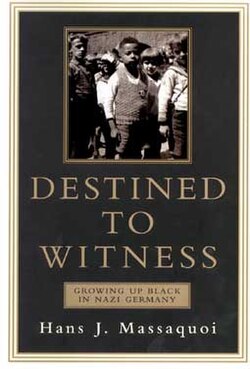
This extraordinary childhood and youth are chronicled in Destined to Witness: Growing Up Black in Nazi Germany, which was published in 1999. It’s a terrific book, and it shows how very German Massaquoi was as a kid. I am not sure that he ever felt fully at home anywhere after getting bombed out of Barmbek. (If he did, it was in Chicago at least a decade later.) Certainly in the latter days of the war and in its immediate aftermath he is dislocated, though he never calls it that in the book. He gets involved in cigarette smuggling; he is further into the black market than survival required. His interest in jazz blooms, he is making a style of music that had been verboten in the Nazi era. He makes friends among the GIs of the occupation forces; he encounters other Black people for essentially the first time ever. He and his mother survived the war, but it is not surprising that he was deeply alienated from the land of his birth. Destined to Witness ends with an epilogue noting that he left Germany for Liberia in 1948 before emigrating to the United States in 1950 where he served in the army in Korea and then went on to a career in journalism, capped as managing editor of the leading Black magazine Ebony.
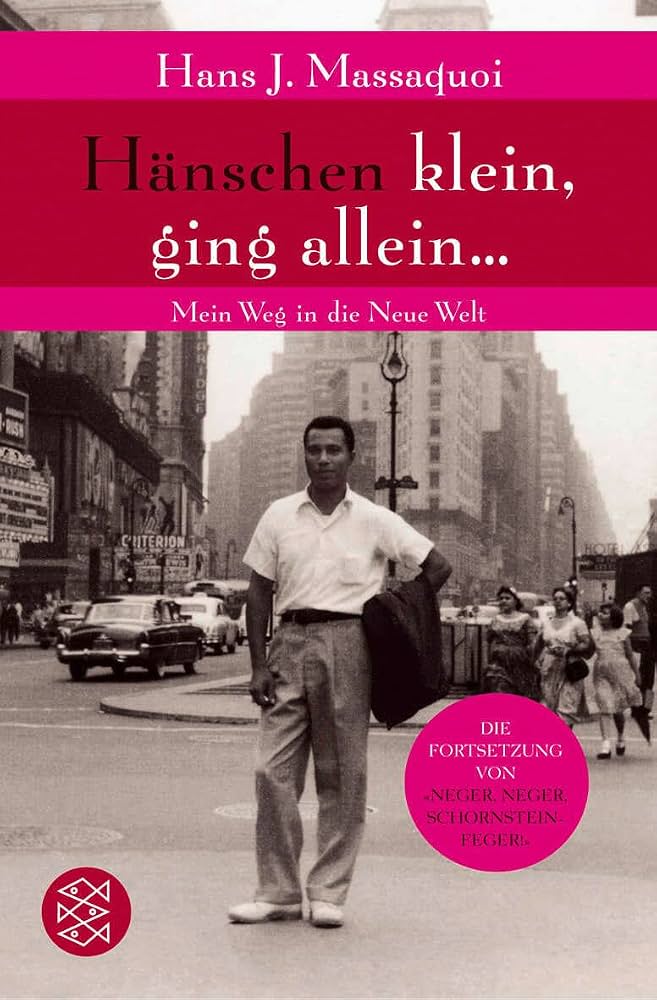
Hänschen klein, ging allein picks up where Destined to Witness left off. Unfortunately, for English speakers who don’t read German, there is not an English-language edition. Massaquoi doesn’t explain why until nearly the end of the book. He put off writing a memoir until after his retirement from journalism, even though people had been saying he should write one for decades. For example, Massaquoi became friends with Alex Haley (and told him that Roots was not a good title), and Haley asked regularly when the world would see an autobiography from him. When Massaquoi finally had a manuscript and started looking for a publisher, he shared the draft with his old friend Ralph Giordano, who had stayed in Hamburg after the war and grown up to become a well-known writer. Giordano helped him find a German publisher, and that version — titled Neger, Neger, Schornsteinfeger — was published shortly before the English edition. The English version did well enough, but the German edition sold and sold and sold, eventually staying on the bestseller lists for something like three years. It was made into a two-part television movie. The story of a Black childhood in Nazi Germany struck a nerve. Many people wrote him asking what happened next, and so five years later Hänschen klein was published in German. Massaquoi wrote the manuscript in English; the title page lists two translators.
The German title of his first memoir is not quite as racist as it appears. It translates as Negro, Negro, Chimney Sweep and is basically a nonsense rhyme. In the second book, Massaquoi writes that he did not like the title and was reluctant to allow it, as he had heard the rhyme too often growing up. But he could not deny the catchiness, and so he allowed himself to be persuaded. Hänschen klein, ging allein… is much sweeter and better. Hänschen is a diminutive form of Hans, so the title translates as Little Hans Went Alone…. It’s the beginning of a children’s song:
Hänschen klein, ging allein in die weite Welt hinein.
Stock und Hut steht ihm gut, ist gar wohl gemut.
Aber Mama weinet sehr, hat ja nun kein Hänschen mehr!
“Wünsch dir Glück!” sagt ihr Blick, “Kehr nur bald zurück!”
Roughly, with no attempt at rhyme or meter:
Little Hans went out into the wide world
Walking stick and hat look good on him, and he was in good spirits
But Mama cries a lot because she doesn’t have little Hans anymore
“Good luck!” says her look, “Just come back soon!”
And young Hans Massaquoi went far in the wide world. He skips over his two years of service in the 82nd Airborne entirely, even though it included service in the Korean War. I suppose that Massaquoi had seen more than enough war already and did not want to return to it in his memoir. About this period he does mention that thanks to a sister who was already in Illinois, his mother was able to emigrate from Germany to the United States. Massaquoi also tells of how the recruiters’ promise of citizenship following army service turned out to be not entirely accurate, and several rounds with immigration bureaucrats were necessary before he could regularize his status, even as a veteran. A sympathetic officer told him the magic forms and phrases that ensured he was on a path to citizenship. Even in the 1950s, it was not easy to immigrate “the right way,” and the bureaucracy was more than willing to spit you out. Massaquoi says he was reminded of a line from Schiller that he had often heard growing up: “The Moor has done his service. The Moor may go.” (p. 14)
The gap between American promise and American reality was also made clear after Massaquoi finished his degree in journalism, which he had gained thanks to GI Bill benefits. He had good grades, good experience and good samples of his work to show potential employers. (Journalism was then a growing field, in contrast to its massive shrinking in the last 20 years or so in the US.) But at that time, no white-run newspaper or magazine in the area was going to hire a Black reporter. Through some networking and a lucky break or two, Massaquoi gains an interview with John H. Johnson, the founder and publisher of Jet and Ebony, a legendary entrepreneur known universally as Mr Johnson. The rapid interview goes well, but even after Massaquoi accepts the job offer he continues to give reasons why he would be an asset to the company. Mr Johnson cuts him off and delivers the first of many business lessons that he will give Massaquoi over the years, “After the sale, advertising is no longer necessary.” (p. 36)
For German readers with only a vague notion of American history, the book is probably a revelation. Massaquoi delivers a ground-level view far from the usual Washington-New York-California axis that even today dominates German coverage of the United States. He combines tales of interviews with leading figures of the Civil Rights struggle with memories of his own times in Chicago, how his neighborhood went from ethnically mixed with many recent immigrants to all Black in the course of a few years. (Michelle Obama had a similar experience in a different part of Chicago at roughly the same time.) Massaquoi also gives a sense of how important Jet and Ebony were for Black life in America, something German readers would have no idea about if they only read white people’s reports from the US. In June 1960, Massaquoi became a naturalized American citizen, something which, he writes, “I had longed for since I had first made friends with African-American sailors in Hamburg’s harbor” (p. 59) shortly after the end of the war. He says it was not economic self-interest that prompted him but rather the feeling that in Germany he would always stand out as separate, that he would be alone in his struggles against an often hostile environment. In America, by contrast, he was one of 30 million African-Americans. He was not just part of a community, he was part of a community that had meaning, had power, and even if American life was far from the ideals the country proclaimed, the power of that community could not always be ignored.
Part of the advice that Alex Haley gave Massaquoi about writing a memoir was to treat each chapter as a magazine article. He had decades of experience crafting stories, so he should not think too hard about the book as a whole. He should concentrate on telling the stories, and before he knew it, he would have a book. And so Hänschen klein tells about interviewing Malcolm X (he had a premonition he would not live long), Muhammad Ali (who became a friend), Alex Haley (years before Roots), Lola Falana (who is put off by his astrological sign), Winston E. Moore (first Black director of a notorious Chicago jail, who cleans up a corrupt system), André Watts (a piano wunderkind), and many more. The magazines send him back to Germany to see what has changed, and perhaps what has not. He meets “the German Satchmo” and reflects on the business of show business. As his stature at Ebony grows, international assignments come his way, too. He meets Shirley Temple Black in her role as American ambassador to Ghana. Massaquoi had been a childhood fan of her films. “Because all American films were dubbed in German, it was not entirely clear to me [as a young boy] that Shirley was not a German. … When Shirley laughed, I laughed too, and when she cried, I cried.” (p. 193) He was impressed with how this white former actress who was new to diplomacy had built a good relationship with the people and government of Ghana. He interviewed Seretse Khama, the first president of independent Botswana. Massaquoi also attended the funeral of Liberian president William Tubman, where he saw members of his extended family for the first time in many years.
The stories carry readers along through the years. Massaquoi concentrates on external happenings, on interesting or funny or historic occasions connected to his work. His writing short on personal reflection, which is altogether typical for someone of his generation and origin. He does not skip telling readers how much joy fatherhood and raising his sons brought him, but they are mostly off-stage. One personal aspect that does come through strongly is how much of a difference in his life the unstinting love and support of his mother made. Raising a Black child in 1920s and 1930s was extremely difficult, but young Hans never felt anything but completely accepted by his mother. He was able to tell Nazi teachers that he was a German just like everyone else because that is how she raised him. In America, she did well. She quickly found work as a nurse, and she found love with a Yugoslav immigrant who was completely devoted to her. Hänschen klein was never allein with her in his corner.
The book closes with some anecdotes about the publication of his first book, which I found very interesting, especially the explanation of why there isn’t an English edition of the second one. He follows with almost 20 pages of letters he received in response to his first book. They show a wide range of experiences and reactions; they illustrate how he touched a nerve. Some people had their eyes opened for the first time, while others write about their own narrow escapes from Nazi persecution. Still others knew him or his classmates in school, and tell him what happened to people he lost touch with more than 50 years previously. He is far from the only one looking back and taking stock. Hans-Jürgen Massaquoi passed away on January 19, 2013, his 87th birthday, not quite a full decade after the publication of Hänschen klein, ging allein. In 2026, the centennial year of his birth, I am glad to have read the second half of his extraordinary life story. I am sorry that commerce has kept the book from finding an English-speaking audience, but pleased that so many people in his country of birth have been able to take his full measure.

 Al Singh
 Doug Merrill
 Doreen Sheridan
 Emily Lauer
 John Pitzel
 Lars N. Goldschlager
 Laura Eilers
 Professor X
 Robert Maedgen
 Sylvere Ap Leanan
 The Shire