Two years after the events of The Hedge Knight, Dunk and Egg find themselves at the ass end of nowhere, sworn to serve a knight who’s not far from a hedge himself, while much of the region struggles with a drought. The novella opens with the two of them returning from an errand to buy casks of wine from a neighboring town. They had to go further than expected because raiders (from the Iron Islands, for people familiar with more of Martin’s stories) had plundered the nearer place that they had planned to buy from. The drought is making maintaining order more difficult. At the edge of the lands of Ser Eustace Osgrey they find another knight of Dunk’s acquaintance, Ser Bennis of the Brown Shield, who is serving Ser Eustace along with Dunk and Egg.
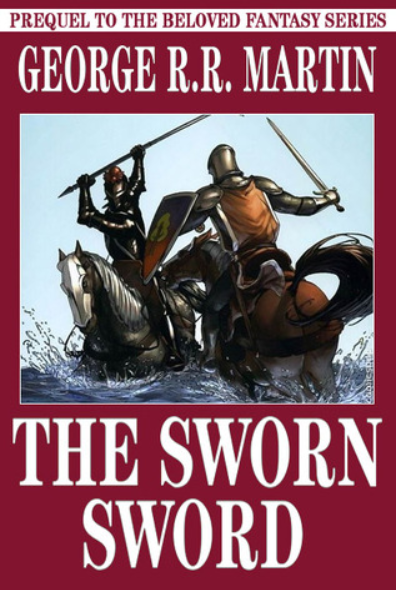
They also find that the stream that Dunk had hoped to cool off in has dried up in the few days that they were away. Ser Bennis attributes the dry creek bed to the drought, but dunk insists on following the course upstream. When they do, they find that a neighboring landholder has dammed the creek and the workers are still there. In the confrontation that follows, Ser Bennis cuts the face of one of the workers. The Osgreys and the hedge knights serving them might have been in the right about the stream before blood was drawn, but that sword stroke puts the dispute into a different category. The Osgreys have a proud history, but poor political choices reduced them to the one town that Ser Eustace is spending his declining years in, his heirs having perished in a war about a decade previous. The neighbor in question is Lady Rohanne Webber of Coldmoat, also known as the Red Widow. At the age of 25, she has already buried four husbands, and of late her reputation has preceded her leading to a dearth of new suitors.
She has more land and more more money that Ser Eustace. More to the point, she can summon far more fighting men than the paltry eight untrained peasants that Dunk calls together when he realizes that the dispute is going to escalate. The stream might have been Osgrey water, but now that Ser Bennis has provoked a confrontation, might is likely to make right, and who will argue the Osgrey side if Ser Eustace is no more. The rest of the novella tells how Dunk searches for a vaguely just solution without betraying his oath of service, without revealing Egg’s true background, and without getting himself killed or the Osgrey levy wiped out. It’s a tall order, possibly taller than Dunk himself. Worse, nobody but Dunk seems to be telling the whole truth.
The Sworn Sword was first published in 2003, between the third and fourth novels in A Song of Ice and Fire. I expect that readers at the time were happy to read a simpler Westeros story, one with a single narrative strand, and far from the grand politics of the bigger novels. Martin’s hedge knight tales are a reminder that princes and kingdoms do not automatically make for a more moving story. The course of a stream can alter the course of characters’ lives, and local matters matter immensely to local people. Small-time quarrels like the one in The Sworn Sword are also how local rulers take their measure against each other. Lady Rohanne reminds Dunk that ruling is inestimably more difficult for a woman in Westeros. Every lord on her borders is looking for the slightest sign of weakness, looking for an excuse to take her in marriage “for her own protection,” or just to take her and her lands because he can.
“I remember once some little lord in the stormlands took Ser Arlan into service,” [Dunk said] “to help him fight some other little lod. When I asked the old man what they were fighting over, he said, ‘Nothing lad. It’s just some pissing contest.'”
Lady Rohanne gave him a shocked look but could sustain it no more than half a heartbeat before it turned into a grin. “I have heard a thousand empty courtesies in my time, but you are the first knight who ever said pissing in my presence.” Her freckled face went somber. “Those pissing contests are how lords judge one another’s strength, and woe to any man who shows his weakness. A woman must needs piss twice as hard, if she hopes to rule. And if that woman should happen to be small … Lord Stackhouse covets my Horseshoe Hills, Ser Clifford Conklyn has an old claim to Leafy Lake, those dismal Durwells live by stealing cattle … and beneath mine own roof I have the Longinch. Every day I wake wondering if this might be the day he marries me by force.” Her hand curled tight around her braid, as hard as if it were a rope, and she was dangling over a precipice. “He wants to, I know. He holds back for fear of my wroth, just as Conklyn and Stackhouse and the Durwells tread carefully where the Red Widow is concerned. If any of them thought for a moment that I had turned weak and soft…” (p. 218)
It isn’t the game of thrones, but it can be just as deadly to the players, or the players’ sworn swords, or one of the smallfolk who happens to be in the wrong place at the wrong time.
The novella delivers an unexpected adventure from a wine-buying errand, and it ends with a reasonably satisfying conclusion. It doesn’t have the force of The Hedge Knight, and it doesn’t deliver as many surprises, but some of those are things that can only surprise once, so Martin has to take a different tack in any sequel. I was glad to see that he kept the story at a small and local level, that he did not try to have his hedge knight rise in the hierarchy. I was a little disappointed to see Martin making use of one of the characters’ secrets to defuse part of the conflict. I would have been happier if that had remained as just a possibility, and the characters had found a way out of their corner with only their own resources. Martin’s narration implies that they had been through numerous scrapes without making use of the revelation, and I would have preferred to read one of those. Soon enough I will read The Mystery Knight, the third Dunk and Egg story, and get to find out if it’s one.
+++
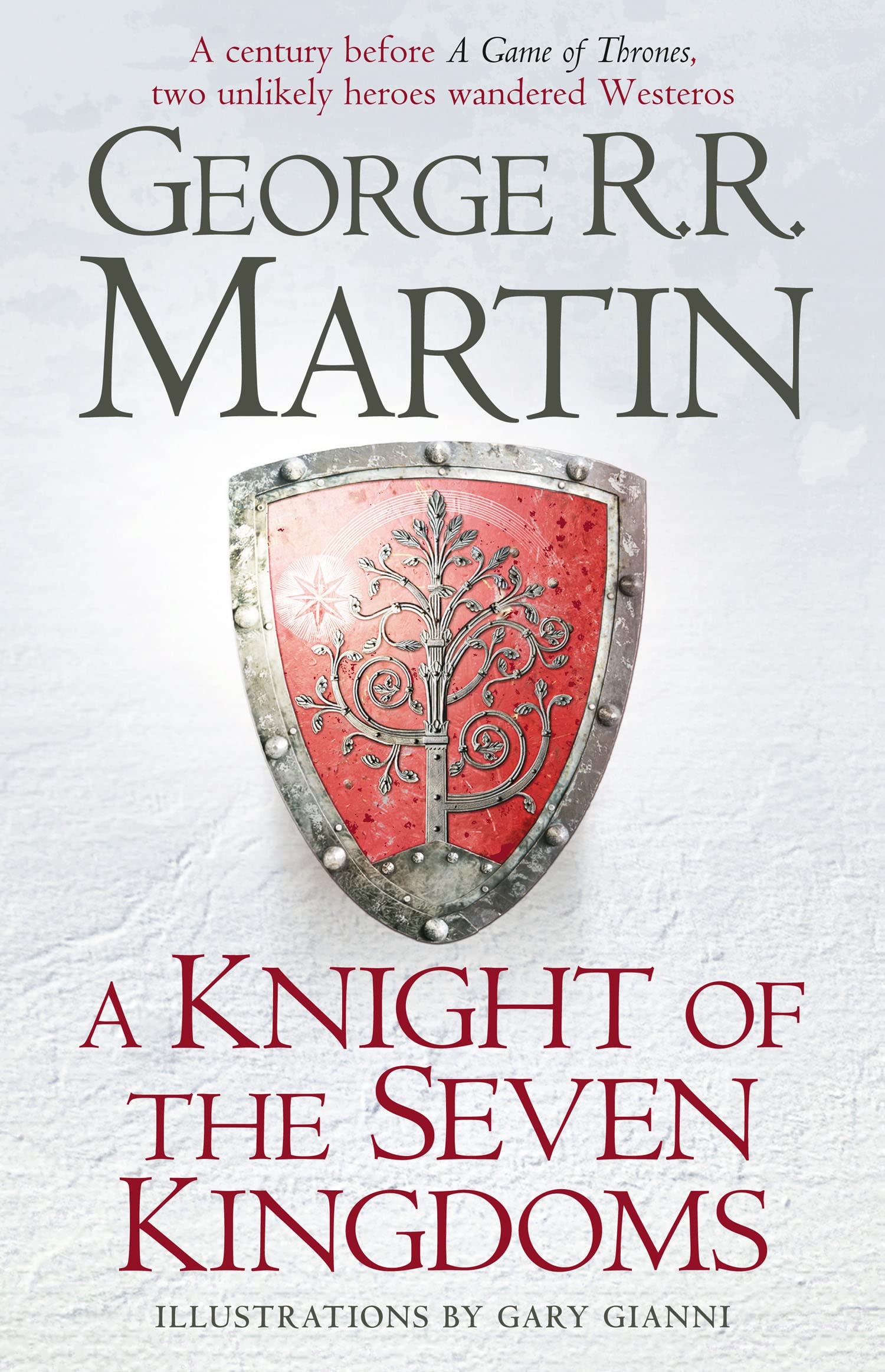
Because I am late to the game, I read The Sworn Sword as part of the compilation volume A Knight of the Seven Kingdoms, which is much easier to find these days.

 Al Singh
 Doug Merrill
 Doreen Sheridan
 Emily Lauer
 John Pitzel
 Lars N. Goldschlager
 Laura Eilers
 Professor X
 Robert Maedgen
 Sylvere Ap Leanan
 The Shire