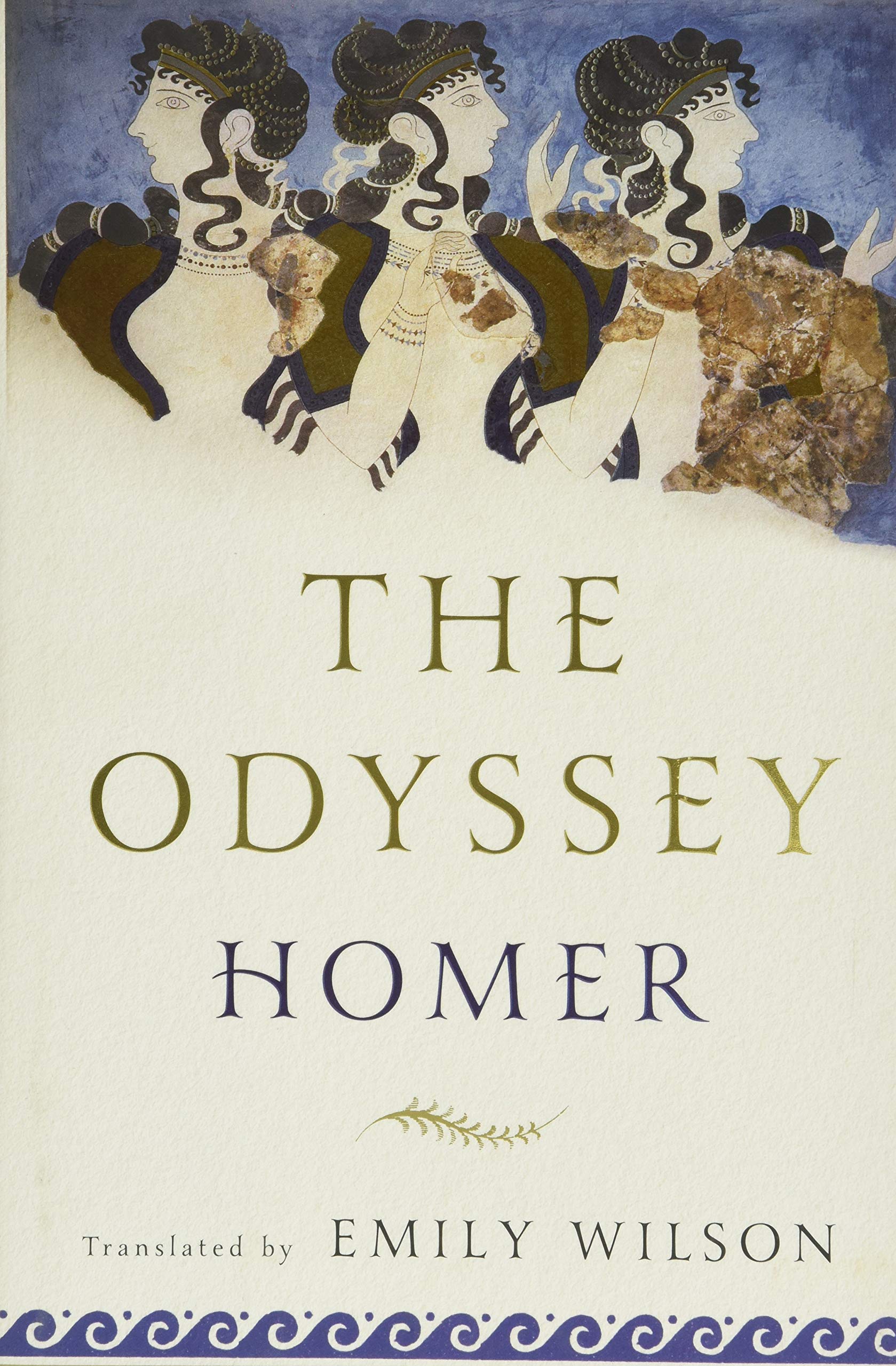
 Even writing down the title of this post enrages me, because this entire experience has been an exercise in pedantry that makes me get all Ben Affleck exclaiming “Fictional characters!” in Jay And Silent Bob Strike Back. We at The Frumious Consortium don’t usually credit translators in post titles, but in this case it feels very necessary, as Emily Wilson’s choices are stamped all over the work. Which is fine, great even! But given the source materials and publishing conventions and the recent controversies, writing the title this way feels like referring to Ultimate Spider-Man as “Spider-Man by Stan Lee, translated by Brian Michael Bendis.” I freely acknowledge that that might be an iykyk reference but I am sick to the teeth of this book and this drama, yet feel obligated to write about it and hopefully, after today and my subsequent newsletter, never treat it as the main subject of a piece again.
Yes, this grumpy ass attitude is going to permeate the rest of this review, sns. I think I would be more inclined to generosity if Ms Wilson had displayed a similar munificence of spirit in addressing the recent Christopher Nolan movie that also adapted this ancient story. I guess this is going to be both a review of her translation of this book as well as the film that she’s so bizarrely tied herself to, via her vituperative yet media-illiterate criticism of it. Feel free to bail on this review at any time, dear reader, or check out Doug’s far less annoyed perspective.
Anyway, here’s a lot of back story as to where I’m coming from with my review. I’ve been obsessed with Greek mythology since I was probably about eight years old, if not earlier: coincidentally the same age as Ms Wilson’s own discovery of the canon. Along with superheroes (which you know I will continue to reference in this review,) they were my favorite thing to read about. As a child, I read about both A Lot, and continue to read about each probably more than the average adult does nowadays.
At the age of 11 or so, my best friend’s parents gave me a copy of Homer’s Odyssey by Jaroslav Hulak & Jiri Behounek, a handsome hardback interpretation suitable for my reading and maturity level. It was one of the best presents I’d ever received, and I read and re-read that thing religiously over the next few years. Well, maybe not religiously, because in my worldview, these mythical characters were as much grounded in reality as the heroes of the Marvel and DC Universes, some of whom were merely different versions of the gods and goddesses of The Odyssey themselves. But here’s the thing: even at that young age, I knew that it was madness to insist that there is only one acceptable interpretation of any character or legend. There are only so many stories — some would argue that there are only two stories (or three or seven, but I find these latter people tiresome) — yet a myriad of trappings and understandings. Even when I disagree with an adaptation, I’m not going to rip it apart based on nitpicky details, ignoring the constraints that probably came to bear on its construction. I’m not going to be one of those weirdo Comic Book Guys, for example, who trashed the first X-Men movie because Halle Berry’s Storm had bangs, or because their favorite character from almost forty years of storyline didn’t make the cut. For this translation, I respect that Ms Wilson made the interpretive choice to rewrite the original text in iambic pentameter, in the exact number of lines that have come down to our era. For his movie that she so mercilessly (and often inexplicably) derided, Mr Nolan had his own constraints of budget and runtime. Whether discussing these recent iterations of Odysseus or Wonder Woman, my duty as a professional critic is to judge these works by what they’re trying to do, within their obvious parameters, and whether or not they succeeded.
Tl;dr both are perfectly fine in their own ways, and succeed for their intended audiences.
More specifically, Ms Wilson has created an accessible translation, shorn of traditionalist hauteur, for the English-speaking masses. Her Introduction lays the groundwork, even as the Translator’s Note reveals a self-consciousness that makes her criticisms of Nolan’s film feel even more baffling. I did appreciate her decision to shed the repetitions that she claims modern audiences find boring. I wholeheartedly agree, and cannot help but feel that she did her absolute best to liven up a text that would have bored me to tears otherwise had it adhered even more closely to the original.
As it was, I struggled with this story, as I do with almost all epic poetry. This volume took me SIX DAYS to read. In contrast, I recently finished the first two 300+ page novels of the Dungeon Crawler Carl series in a day each! I usually manage about 200 pages daily, depending on how good the writing is, and can consume poetry in even less time. And look, I know I’m barely even a journeyman when it comes to the classics: my favorite Greco-Roman poems are Ovid’s Metamorphoses, as translated by Mary Innes and, later and especially, by Ted Hughes. I have been bored by Beowulf and bounced off Chaucer, tho adored Bocaccio’s Decameron (I think it was the G H McWilliam’s translation I devoured in a volume borrowed from my college library.) The original shifting timelines of Homer’s Odyssey, however, struck me less as conscious invention than semi-rambling digressions while storytelling. The entire story felt like patchwork pulled together after the fact vs a carefully constructed narrative; the oral equivalent of a compendium of more-or-less related comic book tales repackaged into one trade paperback. In my opinion, what we have today of Homer’s work requires muscular translation for it to capture the sustained interest, much less emotions, of modern audiences.
Ms Wilson absolutely gets this, and has done her best here for readers who expect still a certain sheen of antiquity a/o classical authenticity over the proceedings. After all, that’s why you’d read a translation instead of an adaptation, where even more liberal choices may be made. I will say that I thought it was a little weird that she provided summaries of each part at the end, to accompany her much more welcome and often interesting notes. I also didn’t care for the mixtures of pronunciations in her glossary: if you’re going to stick with the Anglicized version of Aphrodite, it doesn’t make sense to use the Greek pronunciation of Amphitrite. Were I, however, to treat this entire work the way she treated Mr Nolan’s film, I would insist that this somehow undermined the credibility of her whole project, and that I would have been ashamed to write a single word of her translation.
Hyperbole aside, having both read this book (finally; my childhood best friend, whose parents gave me that earlier copy of Homer’s Odyssey, was also the person who sent me a first edition of this volume back in 2018) and seen the movie, what strikes me most is that Ms Wilson’s scathing reviews understand neither movie-making nor the difference between translation and adaptation. Worse, she seems baffled by the idea that you wouldn’t attest to the veracity of divinity in a 21st century production. One of Mr Nolan’s smartest choices was to view divinity only through his mortal character’s beliefs, lessening the need for most viewers to suspend disbelief further than already required. Should you wish to read more of my criticism of her criticism, check out this edition of my newsletter, written after I saw the movie but before I read this book. I still stand by exactly what I said there, as reading this translation only made her reviews look that much more absurd.
Anyway, this is a good volume for people wanting an accessible translation to get a feel for the original without needing to know how to read Ancient Greek. But my God, don’t read her criticisms of other adaptations. While she might be an expert on the classics, her understanding of more modern entertainments is highly suspect. It has genuinely turned me off reading more of the classics and of her writing, tho I felt I needed to at least read this volume in order to give the entire debacle a fair judgment (unlike Paris, who should’ve chosen Hera, ijs.)
The Odyssey by Homer, translated by Emily Wilson was published November 7 2017 by W W Norton & Company, and is available from all good booksellers, including

 Al Singh
 Doug Merrill
 Doreen Sheridan
 Emily Lauer
 John Pitzel
 Lars N. Goldschlager
 Laura Eilers
 Professor X
 Robert Maedgen
 Sylvere Ap Leanan
 The Shire
5 comments
Skip to comment form
Yay! I’m glad you took the plunge, even if it was at times exasperating and ate up a bunch of reading time.
I totally agree (and am pretty sure I said so in my review) with iambic pentameter as a choice, but I think same number of lines is an unnecessary constraint. Given that Wilson abandoned that for her Iliad, I have a sneaking suspicion she does as well. Does her introduction draw a connection between the oral tradition and the shifting timelines? (I’ve forgotten since I read it in 2022.)
Which Beowulfs (Beowulfen?) bored you, btw?
Author
Tbh, I enjoy the constraint of the line number total. It keeps an already unwieldy piece from bloating even further. It’s not a Necessary constraint, but it’s an exercise in discipline that I think works well here.
God, I really don’t want to read through the 80ish pps of intro again to answer your question, especially since I’m on deadline. Sorry.
Seamus Heaney’s translation bored me to tears but, again, I believe that this was not his fault. Epic poetry is repetitive and much of the meaning is lost when it’s flat on a page, just like song lyrics.
No worries about the question! Maybe I’ll skim a bit and see if I can spot an answer; I thought you might have it in short-term(ish) memory from your recent reading.
I read the Heaney back around the turn of the century and don’t have any particular memories. I enjoyed the heck out of Maria Dahvana Headley’s, the only other Beowulf I’ve read, and I reviewed it for Frumious in 2020.
That one also got “translated by” in the review title, as did my reviews of Wilson’s two epics. I see you did the same for Ken Liu’s Dao De Jing, as well as your review of The Master and Margarita. Two more examples, Invisible Planets (again Ken Liu, but my review) and A Horse Walks Into a Bar (Jessica Cohen, your review). But it is interesting to observe when we do it and when we don’t.
Author
I think a large part of my ire in re: the translator credit here was the fact that, like the Dao, enough people call it “Author’s Work” to merit a “Homer’s The Odyssey translated by” etc., as I did for Laozi’s Dao De Jing translated by Ken Liu. Bulgakov, alas, has not yet reached those lofty heights; neither has Grossman. I probably shouldn’t have added Cohen to the post title for that last, but that was also before we’d started establishing standards here: that review didn’t even include the cover photo that are now de rigeur.
Honestly, I shouldn’t even defend myself: I was just being as nitpicky and nonsensical as Ms Wilson was critiquing The Odyssey, lol.
Honestly, I shouldn’t even defend myself…
Nah, no worries. Once I spotted that I had also used the phrase (without really thinking) when I wrote about Wilson’s versions, I got curious about whether and how much we had used it previously.
I think your approach makes sense, especially when they’re works that have numerous translators. Although now that I have gone and checked, I see that I didn’t use it when I reviewed Karamazov. No biggie; Frumious evolves.