
What Work Is was my introduction to Philip Levine, back in 1991 when it was new and I was working at the late and lamented Oxford Books of Atlanta, Georgia. Oxford was the largest independent bookstore in the Southeast, and something of a pioneer of the superstore model, bookstores that kept 100,000 or more titles on hand. It was also about 50 yards from my first apartment in Atlanta, and as soon as I moved in I knew that I could either work there or be resigned to spending most of my paycheck there. (Or possibly both.) So I was a graphic designer by day and a sales clerk by night, because Oxford stayed up until quite late. There was also a distinct wave of customers who came in after 10pm and made the night hours interesting.
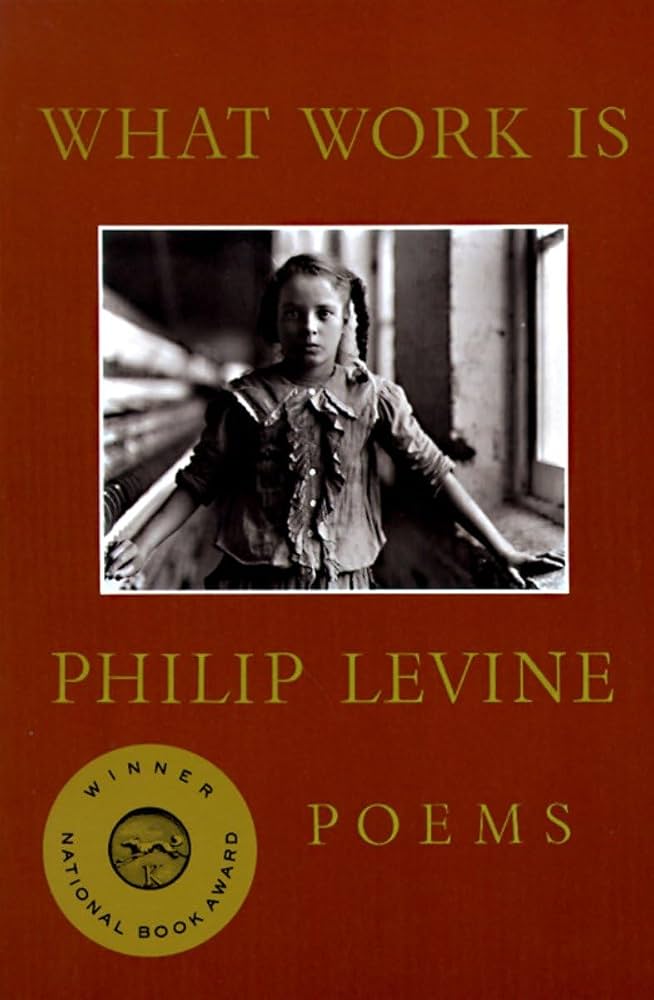
My work was different from a lot of the work that Levine writes about in this volume. He was a good forty years older than me, and his milieu is mid-century Detroit, a world of assembly lines, tight budgets, bad housing, cold winds, and maybe camaraderie if you are lucky. Those jobs are valorized now but Levine lived some of that life himself — he was working in auto factories when he was just 14 — and people all around him worked those jobs much longer. Levine writes about how the work sites were loud, dirty and dangers; how the work would physically break you if you did it long enough, even if you avoided accidents on the job. He writes about how mind-numbingly boring it was doing the same limited set of physical motions hour after hour, shift after shift, year after year. The bosses would try to take what little autonomy you had. They would try to speed up the work. They tried to make sure you knew your place, and that place was under their thumb.
Yet Levine does not write litanies of misery, and neither does he write Socialist Realist paeans to Stakhanovite labor achievements. Instead he captures the inescapable human moments, the times that show that even on the assembly line these are people not machines. He writes about the communities outside of the workplaces, and little moments in life that mean the world. Here’s a bit from “Soloing,” in which his mother has dreamt of John Coltrane playing, and Levine has driven hours through the night to see her:
What a world, a mother and son
finding solace in California
just where we were told it would
be, among the palm trees and all-
night super markets pushing orange
back-lighted oranges at 2 A.M.
“He was alone,” she says, and does
not say, just as I am, “soloing.”
What a world, a great man half
her age comes to my mother
in sleep to give her the gift
of song, which—shaking the tears
away—she passes on to me, for now
I can hear the music of the world
in the silence and that word:
soloing. What a world—when I
arrived the great bowl of mountains
was hidden in a could of exhaust,
the sea spread like a carpet
of oil, the roses I had brought
from Fresno browned on the seat
beside me, and I could have
turned back and lost the music.
Levine writes about California, where he taught in Fresno for more than thirty years. It’s not the California of Hollywood or Silicon Valley. Instead, it’s the California of Central Valley farm workers, of dusty boxing gyms within sight of the Sierras, of “gray cabins breathing steadily/in moonlight, tomorrow wakening/slowly in the clumps of mountain oak” (“Scouting”), and even redemption under the palms that he found in “Soloing.”
The title poem, though, is the one that has stuck with me through the years. I would like to commit more of it to memory than I have, maybe even the whole thing. Here is how it begins:
We stand in the rain in a long line
waiting at Ford Highland Park. For work.
You know what work is—if you’re
old enough to read this you know what
work is, although you may not do it.
Forget you. This is about waiting,
shifting from one foot to another.
Feeling the light rain falling like mist
into your hair, blurring your vision
until you think you see your own brother
ahead of you, maybe ten places.
But of course it’s somebody else’s brother because yours is “home trying to/sleep off a miserable night shift/at Cadillac so he can get up/before noon to study his German.” Your brother “Works eight hours a night so he can sing/Wagner, the opera you hate most, the worst music ever invented.” Even brotherly love has its limits, apparently.
Here is how it ends:
How long has it been since you told him
you loved him, held his wide shoulders,
opened your eyes wide and said those words,
and maybe kissed his cheek? You’ve never
done something so simple, so obvious
not because you’re too young or too dumb,
not because you’re jealous or even mean
or incapable of crying in
the presence of another man, no,
just because you don’t know what work is.

 Al Singh
 Doug Merrill
 Doreen Sheridan
 Emily Lauer
 John Pitzel
 Lars N. Goldschlager
 Laura Eilers
 Professor X
 Robert Maedgen
 Sylvere Ap Leanan
 The Shire