I found it a little hard to believe that The Hedge Knight is closing in on 30 years since its first publication in Legends, an anthology edited by Robert Silverberg. (I haven’t read it, but the table of contents looks great.) I think the conversation around the television series “A Knight of the Seven Kingdoms,” the first season of which is an adaptation of The Hedge Knight made the novella feel like a more recent publication. On the other hand, it feels almost timeless. Martin has written that the 1952 film version of Ivanhoe was a major inspiration for The Hedge Knight, and Ivanhoe the novel was published in 1820. Martin’s language is modern, but his story, well, it could probably have come along almost any time since the thousand and one nights.
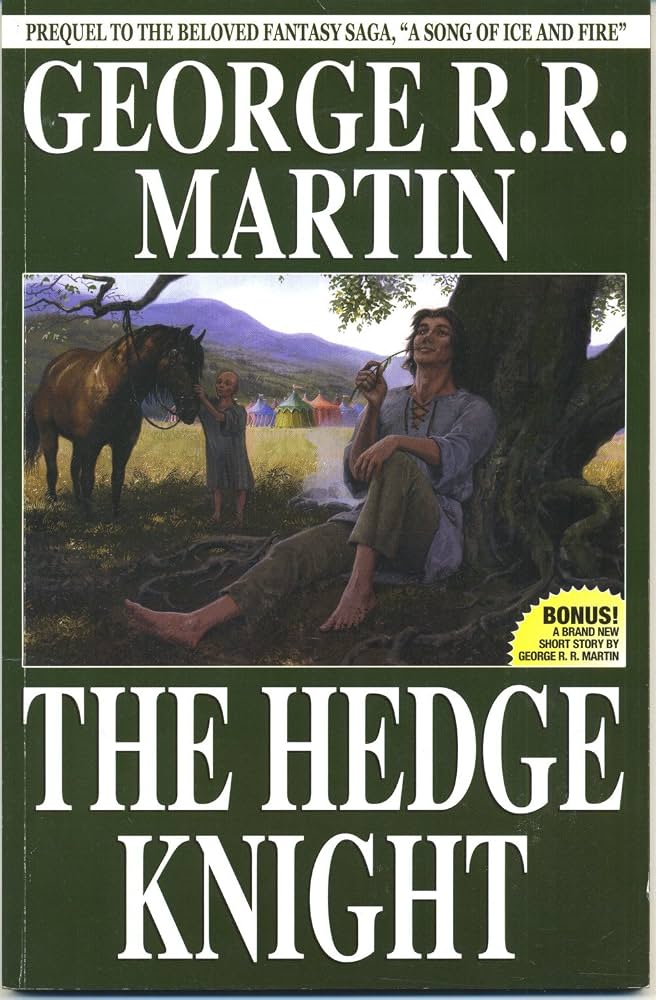
He begins with a knight, an itinerant fighter, but one with ideals. He is in his late teens and has grown up fast as squire to Ser Arlan of Pennytree, a landless knight who takes up service with a wealthier lord when he can. In Martin’s Westeros, a fighter like Ser Arlan is known as a hedge knight. Unfortunately for young Dunk, the squire, Ser Arlan caught his death in the rain as the two of them were on their way to a tournament at Ashford. With no master, little money and scant prospects, Dunk decides to enter the tourney himself and hope for some winnings. He gathers up the late Ser Arlan’s sword, shield and armor, and leads their three horses onward toward Ashford. He will tell people that Ser Arlan knighted him before dying, but Martin begins his story after that has supposedly happened, so readers are left to draw their own conclusions. He will call himself Ser Duncan the Tall, for he is noticeably taller than anyone else in the tale.
On the way to Ashford, Dunk stops at an inn, nearly deserted as everyone in the area has already headed to the tournament. In the stables, he finds a boy of about eight, whom he tells to take care of his horse. The boy is precocious and headstrong. He is also bald and goes by the name of Egg.
[Dunk] found the stableboy mounted on Thunder [Arlan’s warhorse] and wearing the old man’s armor. The hauberk was longer than he was, and he’d had to tilt the helm back on his bald head or else it would have covered his yes. He looked utterly intent, and utterly absurd. Dunk stopped in the stable door and laughed.
The boy looked up, flushed, vaulted to the ground. “My lord, I did not mean—”
“Thief,” Dunk said, trying to sound stern. “Take off that armor, and be glad that Thunder didn’t kick you in that fool head. He’s a warhorse, not a boy’s pony.”
The boy took off the helm and flung it to the straw. “I could ride him as well as you,” he said, bold as you please.
“Close your mouth, I want none of your insolence. The hauberk too, take it off. What did you think you were doing?”
“How can I tell you, with my mouth closed?” The boy squirmed out of the chain mail and let it fall.
“You can open your mouth to answer,” said Dunk. “Now pick up that mail, shake off the dirt, and put it back where you found it…” (pp. 10–11 in the omnibus edition, A Knight of the Seven Kingdoms)
The dialog and actions do not always ring true to the ages that Martin gives the characters, but Dunk has grown up fast amid battles and the life of serving a hedge knight. As for Egg, there are good reasons that he does not sound like an ordinary stableboy, though it takes Dunk a long time to discover them. He is tall, he is strong, he has good reflexes, and he has a certain amount of experience, but he is also not the swiftest on the uptake.
In classic fashion, Egg attaches himself to Dunk, and the young, newly-knighted Ser Duncan does have the good sense to accept him as squire. Ashford shows the wider world for the first time. It also shows both Dunk’s excitement about taking part in a large-ish tournament and how far over his head he might be. He is unknown, and the masters of the lists prove reluctant to accept him as a potential challenger. A rich lord first mistakes him for a stableboy and then airily dismisses him. Dunk may have some physical advantages, but his equipment is not finely wrought, and he has neither the training nor the battle experience that wealthier and older competitors do. He may not have his equipment or his horses for long either; as a master of the lists reminds him, a joust’s loser’s mount and arms are forfeit to the winner but may be ransomed. Dunk of course has nothing with which to pay a ransom.
A classic set-up: the virtuous but poor outsider trying to make a name. Naturally he is quite taken with a young woman, a performer with a puppetry troupe he sees putting on a play at the market that is part of the festivities. More classic elements: Dunk later learns that he would have been entitled to watch the first jousts from the grandstands, but he feels more at home among the smallfolk. Egg, too, seems reluctant to be observed by the higher gentry. The armorer who fits Dunk with protection suited to his size takes a liking to him. Encountering lords of the realm, Dunk learns that not all of them are haughty and heedless, but he is also reminded that a wrong word at the wrong time could have fatal consequences.
Martin mixes these elements and makes them fresh. The large cast of nobles at the tournament is also a reminder of one of the attractions of Martin’s Westeros: it is a big world, full of people who have histories and relationships, people who are starring in their own stories even if they are just passing through the tale at hand. The world does not bend around Dunk, it could just as easily leave him shattered like a big shield, broken at the first tilt.
The pacing of The Hedge Knight is terrific. The novella length keeps Martin focused on the matters at hand, and he does not linger too long anywhere. Naturally, not everything is as its seems, and a chivalrous gut reaction by Dunk soon plunges the tournament into much deeper waters. He is fighting unfairness, but the costs may turn out to be more than anyone expects. Supremely satisfying storytelling.
+++
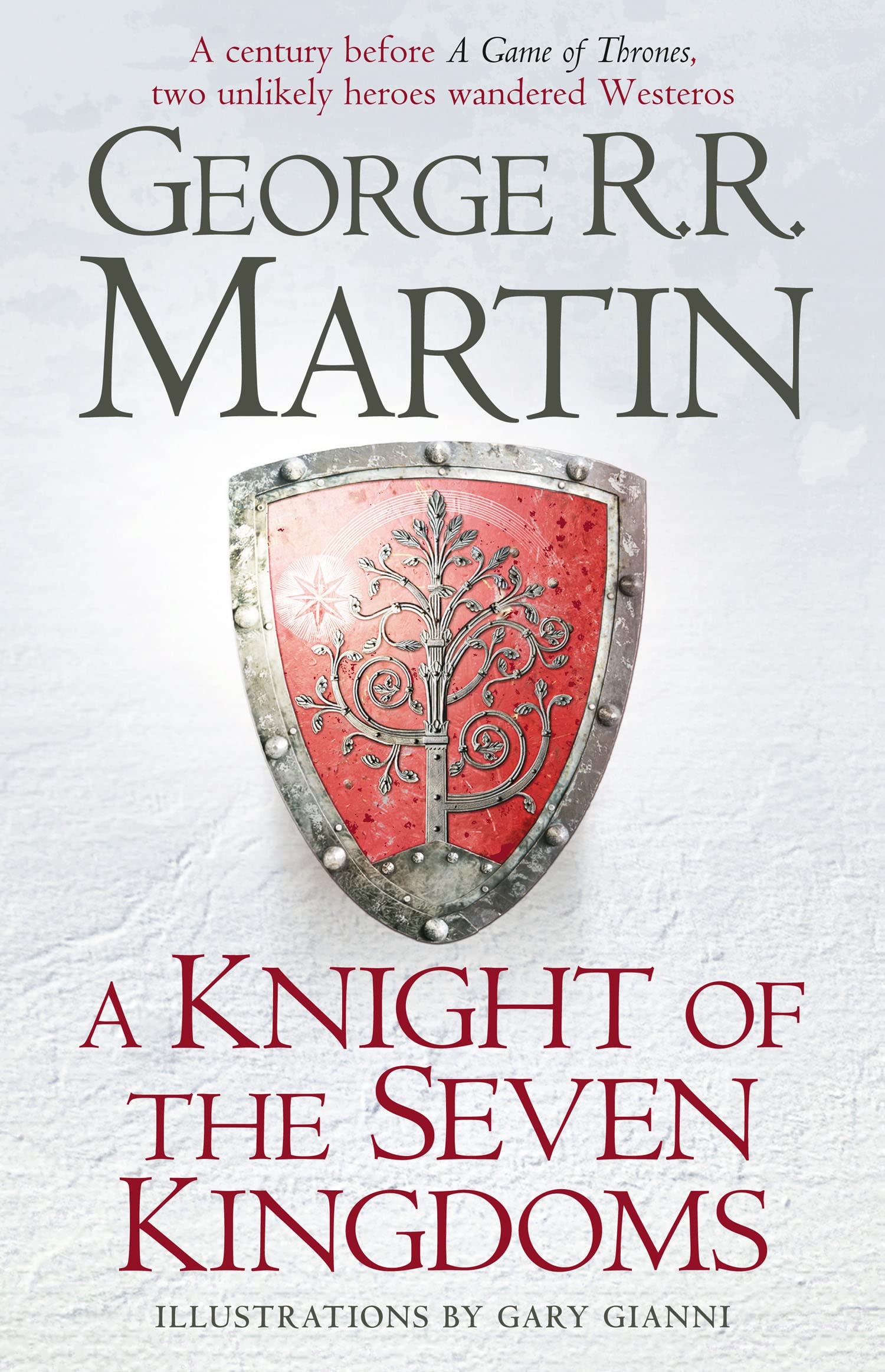
Because I am late to the game, I read The Hedge Knight as part of the compilation volume A Knight of the Seven Kingdoms, which is much easier to find these days.

 Al Singh
 Doug Merrill
 Doreen Sheridan
 Emily Lauer
 John Pitzel
 Lars N. Goldschlager
 Laura Eilers
 Professor X
 Robert Maedgen
 Sylvere Ap Leanan
 The Shire