I’m not really a blurb person, but as short descriptions of A House With Good Bones go — “(a) funny, (b) scary, and (c) charming. You will gulp this book down like sweet tea on a hot day.” (Charlaine Harris) and a “special blend of horror and snarky mundanity, wherein the not-so-dearly departed demand half-frozen ham, terrifying abominations hunger for blood, and the vacuum is full of ladybugs. A creepshow in taupe with extra vultures.” (Travis Baldree) — are pretty darn good ones. Kingfisher sets the tone with the very first sentence: “There was a vulture on the mailbox of my grandmother’s house.” (p. 3) She continues, knowingly —
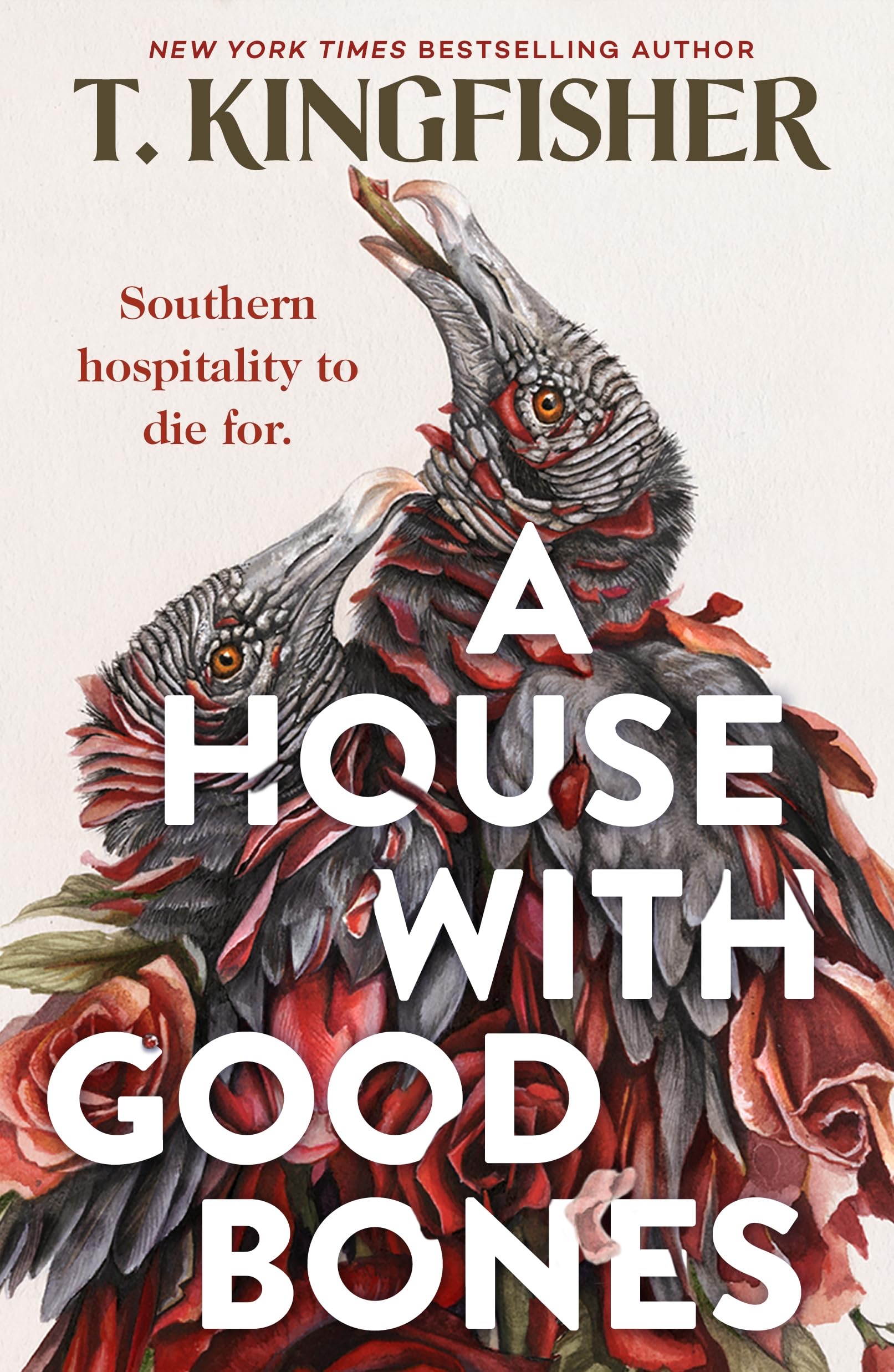
As omens go, it doesn’t get much more obvious than that. This was a black vulture, not a turkey vulture, but that’s about as much as I could tell you. I have a biology degree, but it’s in bugs, not birds. The only reason that I knew that much was because the identification key for vultures in North America is extremely straightforward. Does it have a black head? It’s a black vulture. Does it have a red head? It’s a turkey vulture. This works unless you’re in the Southwest, where you have to add: Is it the size of the small fighter jet? It’s a California condor.
We have very few condors in North Carolina.
“I bet you have some amazing feather mites,” I told the vulture, opening the car door. The vulture tilted its head and considered this, or me, or my aging Subaru.
I took out my phone and got several glamour shots of the bird. When I tried to upload one to the internet, however, my phone informed me that it had one-tenth of a bar and my GPS had conked out completely.
Ah yes. That, at least, hadn’t changed. (p. 3)
The first-person narrator, Samantha, has an insect-related biology degree. She drives a car that’s deep into its service live. She’s back in a neighborhood that’s very familiar to her. Kingfisher will soon relate that she’s back to visit her mother, who lives in the house that she inherited from her mother eighteen years previously. The subdivision is somewhat isolated off of a rural road and full of slightly peculiar characters. The narrator’s grandmother had been one; there’s nosy neighbors who watches the others with binoculars from barely parted curtains; the vultures, her mother says, belong to a lady down the street.
“Well, not belong exactly. There’s a tree.” She waved her hands toward the end of the street. “Oh, never mind. I’ll explain later. Don’t worry, they’re harmless.”
“Don’t they puke when they get upset?” This is about the only fact I know about vultures, and only because an ex-boyfriend of mine got too close to one once and found out the hard way. In retrospect, the vulture may have had the right idea. (p. 5)
Samantha has things in common with other heroines of Kingfisher books that are set in the mundane world. Forthright approach to life. Questionable taste in men, and no partner on the scene when the story begins. Peculiar specialist knowledge. Precarious economic position. These last two are what has brought Samantha — sometimes Sam — back to North Carolina. She’s an archaeoentomologist, which Kingfisher presumably did not put in just for the nice collection of vowels in the middle of the word. She studies insect in archaeological remains. She had been scheduled to spend six months on a dig, but then someone discovered human remain and the project was put on hold until people could “sort out what tribe the bones belonged to and if they had any living relatives who would want them back for burial” (p. 7) Samantha relates that regulations like that annoy some archaeologists but she figures it would be “rude, and just generally tacky” (p. 7) to bother anyone’s ancestors.
Anyway, give me a trash heap over a grave any day. A grave tells you how people when they’re on their best behavior in front of Death. Trash heaps tell you how they actually lived.” (p. 7)
As a follow-on to the vulture signalling, this is another sign that Samantha will soon be encountering people who are not on their best behavior even in the face of death, and after, and that actually living will play a key role in getting out of that situation. Her mother has lost a lot of weight since Sam last saw her. She has also repainted the much of the house’s interior. After they moved in following Gran Mae’s death, they had painted “bright yellow in the kitchen, lime green on the staircase, deep blue in the downstairs bathroom” (p. 8) because her mother had always liked bright colors. Now everything is in slight variations of white, and the guest room where Sam drops her bags is antique rose, almost the same color that her grandmother had there.
In addition to the weight loss, there are other signs that not all is well with her mom. She seems to care much more about Gran Mae’s views than when she was alive. In fact, the next day Samantha discovers that her mom has re-hung a wedding portrait that had been up as long as her grandmother had been alive — the groom was in a Confederate uniform — and come down the very first day that Samantha and her mom had moved in.
Mom is quasi-retired, but she isn’t good at it so she works as a media escort these days. Media escorts are basically people wranglers for minor celebrities, keynote speakers, lifestyle gurus, authors on book tours, that sort of thing. Anybody who has a publicist but not a personal jet. She meets these people at the airport or the hotel, has their itinerary all printed up, and drives them to where they need to be. She also handles emergency laundry, makes sure they’ve got bottles of water, mails packages, makes sure they eat, things like that. Then she drives them back to the airport and sees them off to the next stop. It always struck me as a weird job, but Mom is very good at mothering strangers and accommodating their various requests, and she can make small talk all day long, which is a skill I did not inherit.
“Anybody exciting?” I asked, meandering into the kitchen and locating the box of wine. “Martha Stewart? Salman Rushdie?” She won’t gossip about her charges, but I do get tidbits occasionally. Apparently motivational speakers are the absolute worst. Her all-time favorite was a man who wrote a book on bondage for beginners, who said she was genuinely delightful and made his audience give her a round of applause for all her help. (p. 15)
It’s funny that Kingfisher mentions Martha Stewart, because she in fact did a signing at the Atlanta bookstore where I worked in advertising and promotions in the early 1990s, and I am reasonably sure that the media escort our store regularly worked with took care of her for the day. Like Samantha’s mom, Esther was a Southern lady of a certain age who was good at ensuring her guests had what they needed to be at their best. I can’t say anything about motivational speakers, but as far as authors go, she was perfectly discreet unless there was something the store really needed to know — good or bad — for future tours. My duties always ended at the bookstore, except for the day of the Rodney King riots, when I and another youngish man rode with her downtown. I have no idea what we would have done if there had been a problem, but she felt better and the guest felt better, and in the end nothing happened. Martha Stewart, by the way, is taller than you think, and she has a great deal of physical presence. (My boss might have used the word “Amazon.”) Anyway, she was perfectly lovely, no vultures appeared, and to the best of my knowledge nothing supernatural was going on.
Which, as any reader of Kingfisher’s other books will know, is more than can be said for Samantha and her mother. Ancestors are involved. Bugs are involved. The vultures eventually get involved. Space and time do strange things. Death is on the table — but fortunately for the living characters, no Sicilians are involved. And it’s not so much that hilarity ensues, it’s more that thanks to Kingfisher’s droll sensibility, it’s there on almost every page.
I had one foot on the doorstep when [the vulture] half-spread its wings, and I nearly jumped out of my skin. Then it settled, turning away as if it was bored now. How did you get rid of nuisance vultures? They were undoubtedly protected by the Migratory Bird Treaty Act, which meant you couldn’t kill or harass them, or disturb their next sites. Would an air horn count as harassment? How about yelling “Shoo!” really loudly while wearing a hazmat suit against vulture puke?
These are the questions that try women’s souls. I went inside. (p. 31)
Or, when Sam’s mother is away and she notices how quiet the house is.
It was just a little bit creepy.
Which was ridiculous, of course. Creepy is for old Gothic mansions and run-down cabins out in the woods, not cookie-cutter houses in the middle of a subdivision. Hell, Lammergeier Lane wasn’t even cookie-cutter enough to be Stepford Wives material. If a serial killer tried to break in, he’d be up against Mr. Pressley [the neighbor with the binoculars], and my money was not on the serial killer. (also p. 31)
Of course there’s more to the silence than this initial mention lets on. Then there’s what happens when Sam’s mom forgets to mention that the yard guy is coming over the next morning, and that he has a key to let himself in. Sam, awakened, jumps up and roars that she has a gun. Yard guy drops his tool box and crouches, just as Samantha’s mom comes tearing down the stairs in a bathrobe.
Mom looked from me to Phil and back again. “This is Phil,” she said. He’s Mr. Pressley’s grandson.”
“Poor bastard!” I said involuntarily, thinking of our one-man neighborhood watch. And then, “Oh boy, that didn’t come out right at all. Sorry.”
“Don’t be,” said Phil. He was a tall, lantern-jawed man with short blond hair and a hawklike nose. Attractive enough if you have a thing for old-time Puritan preachers, but looking somewhat incongruous in jeans and a T-shirt advertising a local feed store. “I know.” He waved his hand over his shoulder, in the vague direction of Mr. Pressley’s house. “Believe me, I know.”
…
“No, it’s fine,” I said. I wrapped the blanket around myself. I was wearing an oversized T-shirt with Eeyore on it and no pants. I was also not wearing a bra and I had probably drooled on the pillow. Lovely. Good first impressions are so important, don’t you think? “I’m sorry, Phil, I panicked. I’m not good in the mornings.” (p. 68)
Things get quieter, and then they get creepier, and when all hell breaks loose it’s easy to wonder whether maybe the quiet hadn’t been so bad. The blurbs got it right, and A House With Good Bones is just what the gardener ordered.

 Al Singh
 Doug Merrill
 Doreen Sheridan
 Emily Lauer
 John Pitzel
 Lars N. Goldschlager
 Laura Eilers
 Professor X
 Robert Maedgen
 Sylvere Ap Leanan
 The Shire