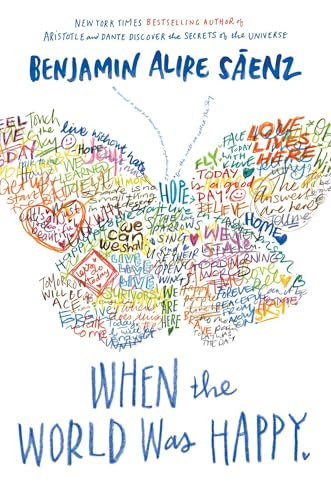
The experience of reading this book made a lot more sense once I realized it was written by an older person at the end of his life (RIP, Benjamin Alire Sáenz.)
 And I’m not saying that there’s an age range in which you can or cannot write a book for a certain audience. This wasn’t even the first Young Adult novel I’ve recently read that seemed to draaaaaaaaag (and the other was written by someone much younger than this author.) But the reliance on philosophy vs characterization, as well as a certain lack of immediacy in the narrative, had me questioning why this was written for the YA market, where readers are generally assumed to have shorter attention spans. Sure the main characters are teenagers, but they’re young people written by someone focused more on message than on actual viscerality. Even tho When The World Was Happy is written in the first person, all the emotions feel at a remove, as if this was meant more as a parable than an otherwise realistic chronicle.
That chronicle is ostensibly of the life of CheChe, a gay teenager entering his junior year of high school in El Paso, Texas. He has a twin sister Emma, a mom who’s their school librarian and a dad who’s an artist and lecturer at the University of Texas El Paso. Their life is nerd heaven. CheChe knows he’s both lucky and privileged, and revels in his idyllic existence. He’s well-aware that there’s a lot of prejudice against both Mexican Americans and gay people, but takes comfort in the fact that he’s surrounded by love, acceptance, and the peace and happiness that come from both.
Then a pair of dipshits from Idaho head south with their guns and decide to shoot up Che Che’s school, in order to kill as many “Mexicans” as they can manage. Numerous people die. CheChe loses his leg but his family is otherwise physically intact. Their trauma, however, forms the rest of the book, as CheChe tries to figure out how to go on with his life and his rage and his sadness and his pain.
I’m being so honest with you when I tell you that the author’s afterword felt way more interesting and moving to me than anything else in this book. Sure, his experience of losing his niece isn’t as topical as the school shooting depicted here, but it felt more real and, despite having happened over thirty years ago, more immediate than the gauzey experiences of CheChe and his family. Perhaps the author was trying to showcase CheChe’s numbness in the aftermath, but the tone all felt very same-y and mildly detached from reality, with little to differentiate the narrator’s affect from the parts of the book set before the shooting.
Also, I loathe the inclusion of song lyrics in prose with a boiling passion. While the original lyrics included here definitely scanned better than the vast majority of lyrics used for this purpose, it was off-putting that they weren’t formatted as poetry. Instead the lines were run-ons divided with “/”, making them unnecessarily tedious to read.
I’m sure there are going to be a lot of readers who enjoy this kind of writing — and the messages here of listening to and loving your children, anti-bigotry, pro-gun control and pro-art are all definitely excellent — but the execution was not for me. It also felt weird that these messages seemed aimed primarily at adults who need to learn how to care about kids, their own and others, as actual human beings. Are YA readers meant to internalize these messages for when they start creating their own families? Or is this a stealth attempt to reach the mainly adult audience that actually reads these books? Still, a worthwhile novel for anyone who needs reasons to believe that a better world is possible.
When The World Was Happy by Benjamin Alire Sáenz was published October 13 2026 by Simon & Schuster Books for Young Readers and is available from all good booksellers, including

 Al Singh
 Doug Merrill
 Doreen Sheridan
 Emily Lauer
 John Pitzel
 Lars N. Goldschlager
 Laura Eilers
 Professor X
 Robert Maedgen
 Sylvere Ap Leanan
 The Shire