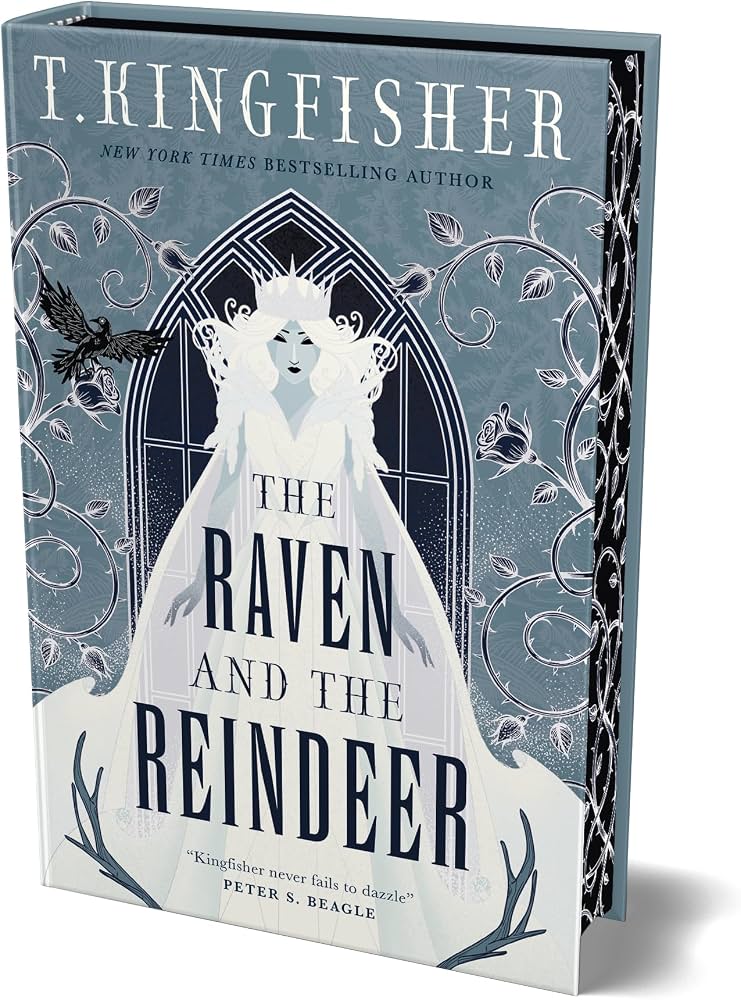
I’m glad that T. Kingfisher, a.k.a. Ursula Vernon, is having a publishing moment because I missed The Raven and the Reindeer entirely when it first came out in 2016. It’s a re-telling of Hans Christian Andersen’s “The Snow Queen” that is irreverent, tension-filled, funny, scary, and more than a little weird. That’s fitting, though, because as Kingfisher says in her afterword, Andersen “was a weird dude. … His idea of a happy ending is that everybody dies attended by angels.” She’s no fangirl, finding his work “mawkish, sentimental, and frequently utterly unreadable, and yet there’s … something. I can’t put my finger on it. … He has a line directly to the lizard brain parts that react to fairy tales. Some people do.” (p. 267)
Kingfisher takes the bones of “The Snow Queen” and does her own thing with it. She begins in a small town in the north, though not in the far north north. A baby boy is born “with frost in his eyes and frost in his heart.” (p. 7) His name is Kay. A few days later, a baby girl is born across the street. “They named her Gerta. She was chubby and good-natured and slept easily through the night.” (p. 8) Their grandmothers were friends. Kay and Gerta grew up together, playmates when they were small children. When the snow piled high, there was a link between their upstairs rooms so that even in the deepest winter they could visit each other.
Gerta would have said that Kay was her best and truest friend, that they could tell each other anything and they would take on the world together.
Kay would have said Gerta was the neighbor girl. “She’s all right. I guess.”
In fact, he did say this, on a number of occasions.
There are not many stories about this sort of thing. There ought to be more. Perhaps if there were, the Gertas of the world would learn to recognize it.
Perhaps not. It is hard to see a story when you are standing in the middle of it. (p. 8)
As they grow into young adulthood, Kay continues to love the cold, and Gerta continues to love Kay. Sometimes he seems to love her too — Gerta wonders again and again what it meant that he kissed her one time — but mostly he loves the cold, its sharpness, the quiet it brings, the feeling that you might be the only person in the world. Soon enough, a blizzard blows up, a hundred-year storm according to Gerta’s grandmother, who adds that the Snow Queen rides that night.
“Who’s the Snow Queen?” asked Kay.
“The queen of all this,” said Gerta’s grandmother. “The mistress of ice. She has a palace as far north as north. She rides in a sleigh made of ice and pulled by great white bears who used to be men.” (Gerta’s grandmother knew how a story ought to be told, even if she wasn’t always sure how much yarn went into a sock.)
Kay raised an eyebrow and sipped his hot cider.
“How did they turn into bears?” asked Gerta.
“The Snow Queen enchanted them,” said her grandmother. “She’s Circe’s cold cousin, always turning men into other beasts. Not pigs, though. She likes bears and seals and wolves and all the creatures of ice.”
“Sounds rotten of her,” said Gerta.
“Oh, I daresay she had her reasons,” said her grandmother, who could think of a few men that would have been much improved by spending time as an enchanted seal. (pp. 17–18)
The Snow Queen did indeed ride through the town that night, though Gerta thought it might all have been a dream. One thing that her grandmother didn’t know was that the Snow Queen’s gaze could freeze hearts. “Gerta felt young and weak and disgustingly mortal. She was a stinking, bleating creature, a heifer-calf with mick tangled in her tail. She did not deserve to share the same air with the magnificent Snow Queen.” (p. 23) When she woke up the next morning Kay was gone; it had not been a dream. The rest of The Raven and the Reindeer is the story of Gerta’s quest to find Kay and bring him back, whether or not he wants to return.
It takes her a while to find the courage to speak to her grandmother about the night of Kay and the Snow Queen, but her grandmother believes her story and sends her on her way with food, the sharp kitchen knife, and a blessing. There are hurdles, missteps and distractions, and winter is starting to come around again before Gerta is properly underway to seek the Snow Queen’s palace north of north. One day, she gives some food to a raven and discovers that it can talk. The raven, proud bearer of the name the Sound of Mouse Bones Crunching Under the Hooves of God, says that “ravens have spoken since Odin brought us to sit on his shoulders. … It is not our fault that humans are usually to cloddish to understand.” (p. 65)
The raven is one of the real pleasures of the book — the title billing is well earned — and gets in almost all of the best lines. Here’s a sample from their second day together, just after Gerta has heard the raven’s full name.
“May I call you Mousebones?” asked Gerta. “[The full name is] a lot to say all at once.”
It was hard for a creature with a beak to scowl, but the raven managed, mostly with the skin around its eyes. “I suppose,” it said. “If you must.”
“Mine’s Gerta,” said Gerta.
“There’s your problem right there,” said Mousebones. “Much too short and not enough in it. I don’t know how you expect to become anything more than you are with a name like that.” …
“Hugin and Munin,” she said, looking straight ahead at the road, “the ravens who sit on Odin’s shoulders, have names five letters long. Same as Gerta. They manage.”
“Aurk! Aurk! Aurk!” laughed the raven. “Oh, aurk! Not bad for a fledgling human, not bad. Who told you that?”
“My grandmother,” said Gerta. “She told me lots of stories. Fairy tales, mostly, but some about the old gods, too.”
Her grandmother had been a good Christian, as everyone in Gerta’s village was, but she loved a good story and so Gerta had grown up on tales of Thor and Loki and Sampson and Martin Luther all tangled together like rumpled knitting” (pp. 67–68)
Having worked out the first part of terms of address, they soon turn to another part.
“Mousebones?”
“Aurk?”
“Are you a he-raven or a she-raven?”
“I am a raven,” said Mousebones, “and the rest is none of your business, as we’ll not be having eggs together.”
“Sorry,” said Gerta. “I just … it’s awkward thinking of you as ‘it.'”
“Oh no, a human feeling awkward. How terrible.” …
Gerta mumbled something. She had thought that it would be less embarrassing to talk to a bird than a human, but apparently not.
She put her head down and walked very fast.
After a dozen fenceposts had gone by, Mousebones said “Sorry. You’re only a fledgling and out of the next a bit too soon, aren’t you?”
Gerta shrugged. The raven sank its talons into her pack and flapped to keep balance.
“The other human girl I know isn’t much older than you, but she came out of the egg with all her pinfeathers. I’m being rude.” Mousebones picked up a lock of hair in its beak and preened it down, which felt even stranger than its beak on her ear had.
“Thanks,” said Gerta, almost inaudibly. She wondered who the other girl Mousebones knew was—had she handled a talking raven better?
“You may call me he,” said Mousebones, “for ‘it’ is an ugly word. I may feel differently later, but I will inform you first.” He groomed another bit of her hair. “Are we well, Gerta?”
It had an air of ritual about it, even with the informality of the words.
“We’re well, Mousebones,” she answered.
“Good.” (pp. 69–71)
North and north they go, with winter settling in and sometimes taking charge. One night there is a snowstorm, and Gerta glimpses the Snow Queen. Who sees her as well with a gaze that leaves her feeling
“Dirty,” she said finally, feeling even more wretched for not being able to describe it. “Mortal. Awful, compared to her.”
“Aur-k,” said Mousebones. “Compared to her, I’m a raven. And ravens do not bow to gods or men or giants.” (p. 79)
But Mousebones has spotted a stand of bushes where they can make a little shelter from the storm “And then we’ll roost together, so we don’t freeze to death, and I will be on my very best behavior and won’t pluck out even one eye.” Gerta observes that “He sounded as if he were making a great sacrifice, and Gerta choked out a laugh. The cold inside her thawed a tiny bit.” (p. 80) Laughter is one of the things that the Snow Queen does not understand, a warmth that can keep her chill at bay.
As Gerta and the raven continue their northerly course, the surrounding culture becomes more Finnish, and eventually Sami. Following adventures and misadventures, understandings and misunderstandings, the other human girl that Mousebones joins them. Her name also has five letters: Janna. They are receiving help from a woman named Livli, and Gerta is forcefully reminded of just how far she has come, how far into an unfamiliar story she has wandered.
She shook out the [magical reindeer] hide, like a cloak. The inside was faintly pink. “Scrub it down with handfuls of snow,” [said Livli]. “It won’t last forever, but the cold will keeping it from rotting out while you need it. When it’s done, give it to Jábmiidáhkka.” …
“I’m sorry,” [Gerta] said. I don’t know what that means.
Mousebones, perched on the top of the house, cawed once. “The Mother of the Dead,” he said.
“What the raven said. Bury it,” Liveli said. “Under stone or under earth.”
“I’m sorry,” said Gerta, feeling that she had failed somehow. “I didn’t know—”
Livli patted her arm. “No reason you should, I suppose. You’ve got your own gods to deal with. But reindeer belong to our gods, and our gods belong to them”
“I thought you were Lutheran,” said Janna.
“I am. Doesn’t mean I’m stupid, girl. Luther lived a long ways away. Jábmiidáhkka lives under my feet. And I’ve never heard that Luther had much to do with reindeer, which was clearly a failing in an otherwise upright man.” (p. 189)
And so the theologian takes his place amidst a very different pantheon.
Luther has very little to do with the final confrontation. Of course there’s a confrontation because fairy-tale journeys have a destination, even if those are impossible to see from the beginning, and impossible to reach without help along the way. Help comes from unexpected directions, because that’s part of the fairytale, too, even if Hans Christian Andersen was a weirdo. Because this is a T. Kingfisher fairytale and not an Andersen one, the happy ending does not involve everyone dying whilst attended by angels. When Kingfisher wrote near the beginning of The Raven and the Reindeer that there should be more stories in which the Kays are indifferent to the Gertas of the world, she did something about it by writing one, and showing what a happy ending might look like for many different kinds of people. Including people who happen to be ravens.

 Al Singh
 Doug Merrill
 Doreen Sheridan
 Emily Lauer
 John Pitzel
 Lars N. Goldschlager
 Laura Eilers
 Professor X
 Robert Maedgen
 Sylvere Ap Leanan
 The Shire