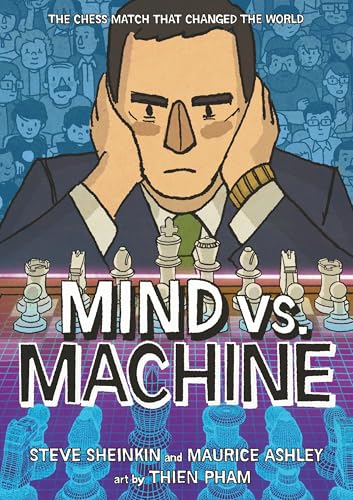
 subtitled The Chess Match That Changed the World.
I am really glad that Grandmaster Maurice Ashley was involved in the making of this book and wrote a really thoughtful Author’s Note at the end, because otherwise I would have probably Gone Off in this review. Which isn’t to say that this book is bad at all! It’s just aimed in a weird direction that felt entirely exasperating narratively, at least until Mr Ashley added his closing words.
Let’s talk about what I unreservedly loved first tho: Thien Pham’s extraordinarily expressive art! Tho his work occasionally veers towards the polygonal (the noses, lol!), his ability to evoke emotion while discussing, essentially, a series of chess matches is truly outstanding. The panels going over Garry Kasparov’s facial expressions while he was playing against Deep Blue actually increased my heart rate in sympathy.
This non-fiction graphic novel is about that much ballyhooed series of matches in 1997 between the reigning World Champion and the chess-playing computer built by the team at IBM. Narrative structure is provided by Mr Ashley himself, who tells the story to kids at a park while they all play chess together. Mr Ashley was one of the commentators for the six-match tournament, broadcasting live from the ground floor of the building where Garry and the computer team were going head-to-head. He provides a ton of eyewitness insight into what happened, grounding the story in a very human perspective.
The reporting is good, with lots of time given to both Garry’s background and the aims of the individual members of the team who were the driving forces behind Deep Blue. The suspense is terrific, in no small part due to Mr Pham’s illustrations. But, as someone who is exposed daily to the nonsense of what exactly constitutes Artificial Intelligence and what it’s going to “do” to us, I felt a growing irritation with the faint wash of scaremongering as to the idea of AI being either “smarter” or “better” than humanity.
Maybe it’s because I’ve never really rated chess as a measurement of pure human intelligence. It’s a game of tactics and strategy and probabilities, yes. And you do have to be reasonably intelligent to play it, much less excel at it. But it’s ultimately a game of mathematics, with controllable setups and consequences — exactly the things that computers excel at too. The further the book progressed, the more exasperated I got at the idea that a calculator beating a human in a mathematical process somehow meant that technology was superior to humanity. Were we as a species this weird when we created machines that could outpace and outlast us physically, like vehicles do, too?
I imagine that my ire is partially fueled by the fact that this book’s publication date has accidentally coincided with a morass of contemporary controversy. Would I be quite so annoyed by it if weirdos weren’t busy equating chatbots with real people and prophesying how sentient AI will destroy us all? Probably not, as those ideas certainly weren’t being bandied about with any seriousness when this book was first germinated five years ago.
Mr Ashley’s note at the end underscores the fact that (spoiler alert) computers being able to regularly beat people at chess nowadays doesn’t make the game of chess any less enjoyable. Because, as I keep having to say, Chess. Is. A. Game. And yes, you can absolutely imagine me saying that with the same exasperation as Ben Affleck in Jay And Silent Bob Strike Back saying, “Fictional. Characters.” Nowadays, people compete against computers in order to have fun and improve their own skills, because computers have been tools all along. Computers and AI are not our adversaries: they are — as I fully realize I am saying ad nauseum — tools that we have collectively built to help us do the things that we cannot more easily do ourselves. And sometimes those “things” include crime and exploitation! People are claiming that AI is stealing our creative work or our jobs, but the truth is that AI is being used by OTHER PEOPLE to commit these crimes, people who then choose to deflect responsibility by blaming the technology itself.
Anyway, this graphic novel was entertaining and informative but I beg y’all, don’t believe the hype that pits mind vs machine. To its credit, this book does highlight the very human faces behind Deep Blue. And with Mr Ashley’s concluding words, I hope that readers of this book will choose reason over hysteria (God bless sensible young people,) in understanding that insofar as humans create and take credit for technology, we’re also wholly responsible for it.
Mind Vs Machine by Steve Sheinkin, Maurice Ashley & Thien Pham was published September 8 2026 by Roaring Brook Press and is available from all good booksellers, including

 Al Singh
 Doug Merrill
 Doreen Sheridan
 Emily Lauer
 John Pitzel
 Lars N. Goldschlager
 Laura Eilers
 Professor X
 Robert Maedgen
 Sylvere Ap Leanan
 The Shire