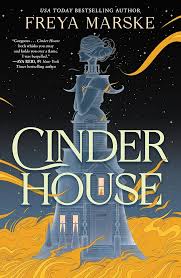
I should have caught on much faster than I did that this novella is a retelling of Cinderella. I mean, “Cinder” is right there in the title, and the story’s very first word is “Ella,” as in “Ella’s father died of the poison in their tea.” Ella drank less tea and might have survived, except that the whole house gave a shudder when its master died, and that was exactly the moment when Ella, weak and dizzy from the poison, stood at the top of the stairs. She fell and cracked her skull on the seventh step.
People who picked up on the retelling faster than I did — or who read any description of the book at all — may have wondered how a dead girl is supposed to dance with a prince. Therein, of course, lies the tale. Ella’s stepmother, who poisoned the tea, is sufficiently wicked for any fairy tale. Marske makes her motivation understandable by showing her as a shrewd businesswoman who is terrified of falling back into the poverty from which she rose, but she seems to take murder in stride so that while she is understandably wicked, wicked she remains. Marske also suggests that Ella’s mother did not die a natural death, and so perhaps these two fairy-tale parents were well matched in their wickedness. At any rate Marske does not show any scenes of the marriage prior to the fatal tea-time; she is interested in examining and upending only certain parts of the Cinderella story, and what the parents got up to is not one of them.
The step-sisters are not yet as wicked as their mother, although one of them clearly has ambitions. Ella, for her part, is surprised to be a ghost, though returning to consciousness and manifesting take a bit of time. As Marske explains
The house had wanted to apologise for its part in her death, Ella figured. It wanted to give her more existence, if not more life.
By the time of the funeral, the ghost that had been Ella had only just got the hang of consciousness; appearance would be beyond her for some weeks yet. She was too much the house to be Ella as well. Some unpeeling was yet to happen. Her awareness drifted from floorboard to windowpane to candlesticks to the wide pottery platter with its red border and its painted pattern of pears and rosemary… (p. 10)
Marske does not attempt to explain the magic of this house and, by implication, certain others, which I like. One of the pleasures of the story is Ella’s peculiar state, partly coterminous with the house, partly herself as she remembers. Her houseness never extends to anything as explicit as words; it is more in the realm of feeling, itches when things are dusty, contentment when the hearth is warm, irritation when objects are not in their proper places. Unfortunately, this gives her step-sisters leverage. Step-mother Patrice and step-sisters Danica and Greta own the house, and with it Ella, who quickly discovered that she was bound to the house. They make her into the family’s general servant, and the step-sisters are not shy about enforcing their will by hurting Ella with minor damage to the house. Marske uses their petty bullying effectively to set them up as secondary villains of the story.
Ella can interact with objects but not physically with people, and while the house’s owners can see and converse with her, nobody else can. She is bound to the grounds, no wandering ghost she. She later discovers something of a loophole that enables her to wander the city, she also discovers the hard deadline of midnight. Little by little, Marske puts the elements of the classic Cinderella tale into place. In her acknowledgments, she writes, “This is also a story about chronic illness and disability. It didn’t begin that way, but that’s what it became.” (p. 234) Ella longs for more human contact. Visits by delivery people are highlights of the days when they occur, though she cannot converse with them. She can manifest enough to write letters, and in this way she strikes up a friendship with a scholar of sorcery in the kingdom next door. Marske shows readers the limited life of someone confined to home, and how they yearn for the normality they once knew.
That epistolary friendship is one of the places where I thought that Cinder House‘s role of a retelling was a bit awkward, especially later in the story when Marske reveals more about the scholar’s background. The ease with which Ella receives answers from a high-ranking person seemed out of place with the realistic social story that Marske was telling, and lacked the dream-like inevitability of the workings of a fairy tale. Sometimes the in-betweenness of parts of the tale charmed me — the people Ella sees at the ballet and who some of them turn out to be — but at others, such as parts of the prince’s behavior on the three nights of the fateful ball, I thought that the machinery of the story showed through too readily.
The ball and the events around it emphasize the twists that Marske has applied to the original tale, and they make it much more exciting than the matter of getting away at midnight and then searching for the owner of the crucial shoes. The ending is a strong resolution that depends on both Ella’s nature as a ghost and the characters of people close to the prince. The happily ever after is unconventional — and honestly parts of it squicked me out — but mostly in keeping with the setting and characters as Marske has set them up. I liked that she plays more freely with the fairy tale, I liked how Ella’s ghostliness worked, and I particularly liked the prince, who is more than just an unattainable cipher.
+++
Cinder House is the third of this year’s finalists for Best Novella that I have read. It is the second I have written about, though of course I did not know that What Stalks the Deep would be a finalist when I read it.

 Al Singh
 Doug Merrill
 Doreen Sheridan
 Emily Lauer
 John Pitzel
 Lars N. Goldschlager
 Laura Eilers
 Professor X
 Robert Maedgen
 Sylvere Ap Leanan
 The Shire
3 pings
[…] finalists for Best Novella that I have read, and the third I have written about. The other two are Cinder House and What Stalks the […]
[…] Doug, I knew that this would be a variation on Cinderella from the very first page, steeped as I am in […]
[…] contrast to Cinder House, The Summer War is not a classic fairy tale re-told in a more modern idiom but a re-working of […]