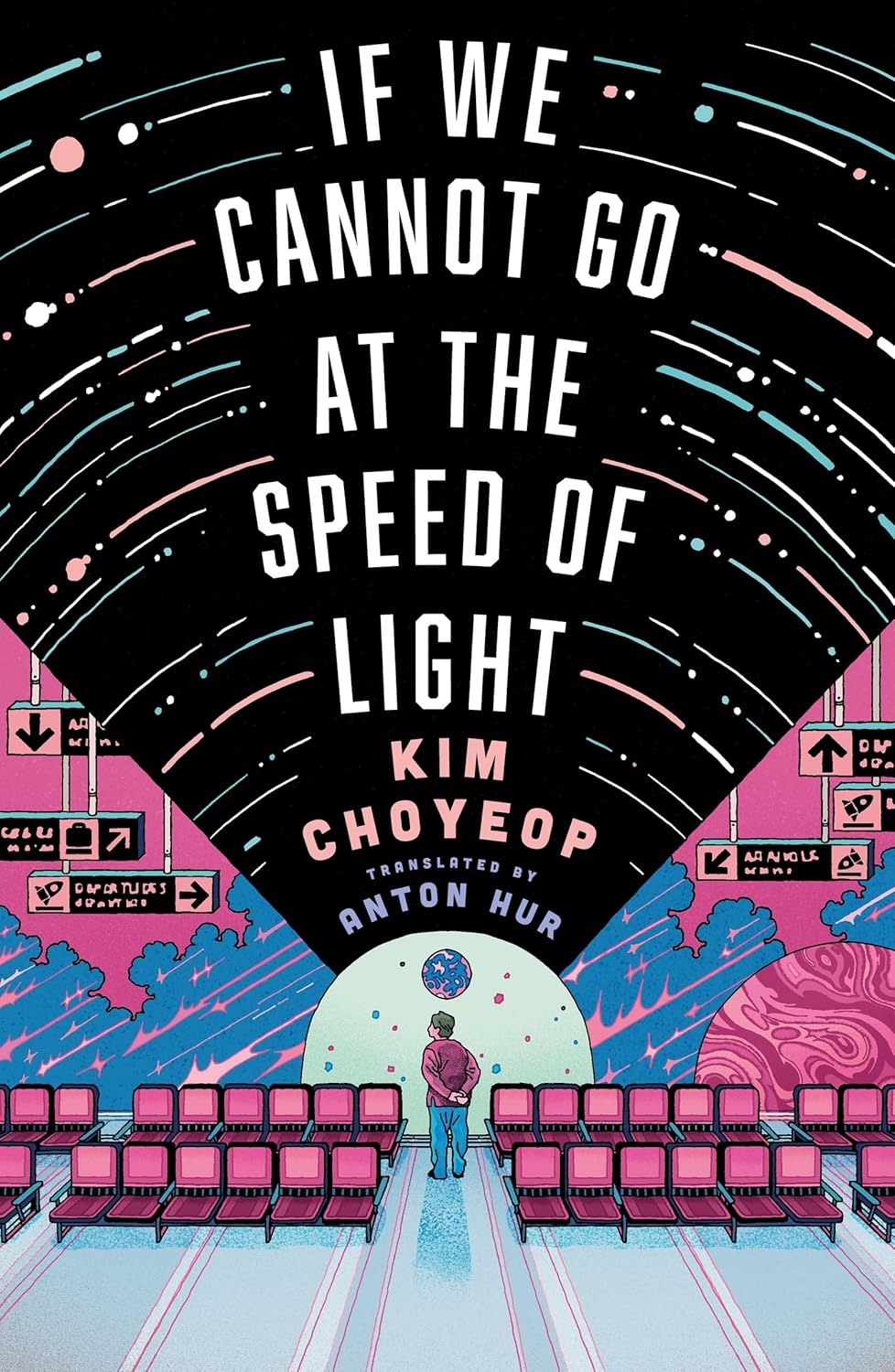
 translated from the original Korean by Anton Hur.
The only odd thing about this otherwise terrific collection of short stories, to me, is the fact that they led with the two weakest stories in the bunch instead of any of the strongest. Sure there are only seven stories in this collection, and perhaps other folks will have different opinions, but the leap in quality once you get past the first two is extraordinary.
Maybe I’m just jaded, but I spent the entirety of the opener, Symbiosis Theory, half-convinced that it was thinly-veiled Scientology propaganda. My brain kept popping up that one History Channel guy meme, only he was saying “Thetans!” instead of “Aliens!” (which I always hear in the same delivery as “The Aristocrats!”, lol.) The second story, Spectrum, is somewhat better but also feels like it relies too much on the idea of extraterrestrials being unknowable but super cool, so don’t ask too many questions about the story, just trust me, bro. And by me, ofc, I mean the author. Which, sure, why else would I be reading your book, but that trust comes with the trade-off that you’re about to tell me something interesting, which the first story wasn’t and the second one… well, at least it had promise.
Fortunately, things improve vastly once we get to the title story. If We Cannot Go At The Speed Of Light talks about the ways in which technology leaves people behind, and the choices we have to make in hopes of giving people a chance, however quixotic they may be. The Materiality Of Emotions is a weird but thoughtful little piece on the human propensity for literal objectification. Archival Loss has a woman attempting to access the uploaded personality of her mother, while Pilgrims talks about a young person who burns to understand why some people never return to their idyllic village. Finally, you have My Space Hero, where an astronaut-in-training learns the truth about the aunt she idolizes.
Writing out this review, it becomes clear that I actually really preferred it when Kim Cho-yeop focuses more on the human than the alien. Her writing about the technologies that form a core part of the last five stories is so much more interesting and believable than the hand-wavy narrative black holes that are her extraterrestrials. Spectrum also felt more interesting to me than Symbiosis Theory because it’s ultimately the story of Grandmother grappling with her conscience after living on another planet. Symbiosis Theory, otoh, is just “wow, look at this mysterious thing that makes people both happy and sad.” No, I will not be wowed by a short story that’s just a long-form definition of sehnsucht. Hilariously, that may just be my practical American-ness speaking, given the noted cultural differences between nationalities (in this case with the German) when dealing with the concept.
The bulk of the stories otherwise felt immensely understandable and enjoyable to me as a Malaysian American. I may not have related to everyone’s choices and actions but I could certainly understand why they made them (this should perhaps be the subject of another essay on why I prefer not to grapple with the entirely unknowable, especially as a plot device, when enjoying fiction.)
I really appreciated Ms Kim’s Acknowledgments section at the end, because in addition to thanking the people who helped her bring this book to publication, she also talks about the inspirations behind each story. It’s a fascinating peek into her thought processes that only makes me more eager to read her coming work. Just, hopefully, with fewer alien macguffins and more humans having complex relationships with and exacerbated by future technology.
If We Cannot Go At The Speed Of Light by Kim Cho-yeop was published April 28 2026 by S&S/Saga Press and is available from all good booksellers, including

 Al Singh
 Doug Merrill
 Doreen Sheridan
 Emily Lauer
 John Pitzel
 Lars N. Goldschlager
 Laura Eilers
 Professor X
 Robert Maedgen
 Sylvere Ap Leanan
 The Shire
3 comments
Were the stories published anywhere else first? (I can’t tell from the excerpts that I could find online.) Even if not, maybe they’re in chronological order, so you’re seeing her improvement from story to story. If I were the editor, I don’t know that I would make that particular choice, but it at least seems plausible.
Author
That is an excellent question! She doesn’t include a chronology for the stories, but definitely discusses them in a different order in her afterword. The last story was specifically written for this collection but the story that propelled her to fame, Lost On Premises, is not included here. So your guess is as good as mine!
I agree that I too have a different take as an editor when considering a short story collection but also maybe I just have a different opinion of the strengths of the stories vs most other people. Reddit seems to love Symbiosis Theory a lot. Idk if that has anything to do with it being the least Korean-feeling of the stories, imo.
nod-of-agreement dot gif