Among this year’s Hugo finalists in the four headline fiction categories — short story, novelette, novella and novel — no author has more than one nomination. I don’t think I have a particular view about this distribution. On the one hand, it’s neat when a writer has a banner year and gathers up two or even three nominations across categories. On the other, a wide range of authors who are finalists is a sign that there is a lot of talent within the genre, and that people are getting recognized for good work. This year is also a mix of people who have been Hugo finalists before, and people enjoying the thrill of their first nomination. If my brief research is correct, this is the first Hugo nomination for Scott Lynch, H.H. Pak and Cameron Reed, though they are enjoying very different publication careers. Pak’s first published story came in 2024, while Reed’s first novel was published under a different name in 1996. Lynch’s first novel, The Lies of Locke Lamorra, was published in 2006, won several awards (though not the Hugo) and is still in print and selling twenty years later. Martha Wells, Sarah Pinsker and Catherynne M. Valente each have numerous Hugo nominations and wins in their illustrious careers. Novelette has been a special friend to Pinsker, with nominations in the category in 2018, 2020, 2024, 2025 and a win in 2021. The variety of authors and the mix of new and experienced strikes me as a sign of the field’s health.
Here are brief notes on this year’s finalists in the category of Best Novelette, in ascending order of my preference.
Why, more than 70 years later, are science fiction editors still publishing “The Cold Equations”? For all that there is some contemporary window dressing in “Never Eaten Vegetables” by H.H. Pak, this novelette is still the story of a spaceship sent out with margins that are too thin to cope with contingencies, and innocent parties must pay the price. Only in this case, there’s not even the plausible naughtiness of stowing away on a spaceship because the victims are embryos and babies sent out on something like a generation ship. The ship is full of equipment and AIs that keep the embryos in stasis until they arrive at their destination, whereupon further robots and AIs will care for the babies and children until they are adults, whereupon they will be expected to reproduce at a prodigious rate for a generation or two in order to start a self-sustaining colony. This didn’t make a lick of sense to me, nevermind that the author tries to make it make some kind of economic sense by positing a Corporation in the background that somehow envisions the whole thing turning vast profits. I guess I should have remembered that the Darien Company once swallowed a fifth of all the money in Scotland with a harebrained scheme to plant a colony on the Isthmus of Panama, so corporate colonization has a long and mostly grim history, but it is largely one of abject failure, and Pak posits this Corporation as an ongoing successful concern. There’s also superluminary communication, but only when it’s convenient for the plot. “Never Eaten Vegetables” also considers roles and dialog among AIs that are sentient, but in a strangely limited way. It takes up, but does not do much with, the topic of growing up in an extremely small town that you can never leave, filled with people who are all the same age. Pressure to reproduce on a massive scale — six children before age forty is mentioned — without showing what effect that has on people. Thematically, there is a lot going on in the novelette, but Pak only handles most themes glancingly. Readers who remember the backstory of Aliens will not be surprised by the revelation of why things went wrong on the original mission, though that only emphasizes that the mission itself, a ship containing many thousands of embryos that are expected to become people, does not have sufficient capacity to cope with contingencies. Pak, like Tom Godwin, put a thumb on the scales to tell a tale of unnecessary woe.
In “The Girl That My Mother is Leaving Me For” Cameron Reed also features a world dominated by vast and unsympathetic corporations, though at least in this story they have names: Griffin, and then later Vega. The story begins interestingly, with a first sentence that echoes the arresting title and a first paragraph that sets up the rivalry. “The girl that my mother is leaving me for has hair as rich and glossy as a horse chestnut. Her skin is ivory and her eyes are emerald green. Her belly is slightly round, and that’s what matters.” The named but otherwise undescribed corporations hold all the power in the world, with their members — it’s hard to say employees because Reed does not show any signs of corporate life outside the towers that house the organizations — living richly but precariously. The narrator expects to be consigned to probable starvation in the slums and camps outside the towers, now that her mother has decided to go in a different direction. It transpires that her mother is the CEO of Griffin, and that she plans for someone to birth a clone for an heir and then replicate the circumstances that she grew up in, so as to replicate herself for the next-generation CEO. The story claims that the current CEO is the grand-daughter of Griffin’s founder and that this cloning-and-rearing business worked for two generations in a row. It’s a good thing that the story is not really about replicating an absolute corporate monarch because that part of it does not stand up to the slightest scrutiny about how people work, how power works, how organizations work, how long businesses typically last, and probably much else besides. What remains is a reasonably sweet story about how the narrator Mira, her planned replacement, fall for each other. Then Vega invades their tower in an attempted hostile takeover and the two escape with little more than their native wits. The whole chase sequence felt to me like the characters were being set up to follow the narrative of the early lives of Griffin CEO clones, but at least Reed does not tip their hand about that part. I was kinda charmed by the two of them and resolved not to think too hard about anything else.
“Kaiju Agonistes” by Scott Lynch takes its title, I presume, from Gary Wills’ 1970 book Nixon Agonistes and indeed features Richard Nixon as a character in its later sequences. The story’s proposition is that the galaxy is patrolled by reasonably benevolent long-lasting life forms that keep an eye (or equivalent) out for planets that are developing life and want to keep that life from eventually destroying itself and/or neighboring life forms. The realities of time and travel at sub-light speeds being what they are, these “old thinkers” do not stick around but when they see that the conditions somewhere are ripe for intelligent life to arise, they leave behind a “watchseed.” They visit Earth, plonk one down, and move on. “Two hundred thousand solar orbits, more or less, pass quietly. Then the watchseed wakes up with the unmistakable taste of an atomic weapon in its mouth.” Lynch sets up his premise with admirable economy and gets on with his story, which is that Godzilla is meant to warn humanity of the dangers of nuclear annihilation. This is crossed with something like a Prime Directive, so that the kaiju at first only communicates indirectly, in order not to tell the humans immediately that there is other intelligent life in the universe and has been for a very long time. Most of the story takes place in the centers of political power in the 1950s and then 1960s, with scenes in the Kremlin and the White House as Lynch sketches out an alternative history with one kaiju and humanity resolutely failing to take the hint. It’s meant as a light-hearted romp through history, and bits of it are not bad in that regard, but “Mr President!” this and “Comrade Secretary!” that amidst unsubtle attempts at power moves does not hold my interest very well these days. The Heath and Pompidou sketches fall particularly flat. The ending was silly, and I am not sure it was silly enough to convert the whole story into an enjoyable farce, of if it still wanted to hold on to a bit of political plausibility, and so it landed a bit awkwardly in the middle.
“When He Calls Your Name” is Catherynne M. Valente’s version of and homage to the classic country song “Jolene.” Charlie has been the only man for the story’s first-person narrator, ever since she spotted him across a classroom in middle school in the rural-ish community where they both grew up. She says she has a talent for wanting what she has, and she and Charlie make do in a disorganized life. He “was so allergic to opportunity he once quit a job the same day they promoted him” (p. 9) but was apparently always happy with her. “I managed the bakery section down at the big chain grocery store in town; Charlie bounced around (and around and around) until one day he turned up home with a bottle of wine from the middle shelves instead of the bottom, his electrician’s license, and a bear hug.” (p. 9) This is a story that knows how people work, knows a thing or two about how hard it can be to get by, and how many folks count themselves lucky to keep a roof over their heads and food on their table. But then one day Jolene shows up in line at the bank, flaming locks of auburn hair, ivory skin and eyes of emerald green, just like Dolly Parton wrote. Valente gives it her own spin, “and when I say emerald, what I mean isn’t real emeralds, whose green in the jewelers’ glass cabinets always seems a bit pale and sad and swampwatery. I mean the color you think of in your head when the word emerald unfurls up there.” (p. 12) Nor is Jolene just any customer: “My brain said to my gut there wasn’t any place on this sad green all-alive earth where a woman like that belonged. She didn’t look like a country girl, unless that country had nine damn rings. But she wasn’t really a city girl either, despite her fine clothes and fine way of talking and standing and laughing and being. Not unless that city was Uruk. Or Troy. Or Jericho.” (p. 13) Charlie’s volition is not really a part of this story. Of course he wants her, and of course he runs to her as soon as he can. But the pleasures involved are not strictly carnal, as Valente reveals in the course of her tale. Jolene is, as people say in the country, something else; but in this case, she really is something else, something the narrator coyly refuses to name, except that she knows that Jolene cannot enter the house uninvited. So she ties up Charlie, knowing that Jolene will, must, come for him. The rest of the story is their confrontation, and I like to think that Dolly would be proud. (Beyoncé, on the other hand, would go about things rather differently.)
“The Millay Illusion” by Sarah Pinsker takes up life in a traveling theatrical troupe in early twentieth-century America, when people flocked to theaters to see variety acts, comedians to illusionists, daredevils to dramatists, and the occasional bit of freak show. The troupers traveled by train if they were fortunate, and stayed in hotels if bookings were good. The first-person narrator is the youngest performer in Albertini’s Astonishing Traveling Show, a comedian and naive mentalist to get the crowd going. A little gender-bending is a minor aside, though of course it is also another nod to things in the theater not always being what they seem: “My name was Lottie for all of my early life, and Julius for the duration of my travels, because when my father put me on the steamship alone he said it would be safest for me to make the ocean journey as a boy. ‘And a boy you’ll stay for the show,’ declared Uncle Albert on my first day in his care. ‘Not Julius. Johnny Chess, to get them thinking you’re smart, but not smarter than them.'” (p. 3) (Uncle Albert is there, though Admiral Halsey is not.) And then one day Susanna shows up, and things start to change. Susanna is an exceptionally skilled illusionist, an art that at the time women were not supposed to practice. Pinsker shows Susanna and Lottie growing up, both friends and rivals; the jealousy of some other performers; Susanna’s great desire to be seen as an artist in her own right. It’s a terrific story that only shows what it needs to, and also a reflection on the art of creating illusions, of guiding the audience to get to where the performer wants them to be. Or where the author wants them to be.
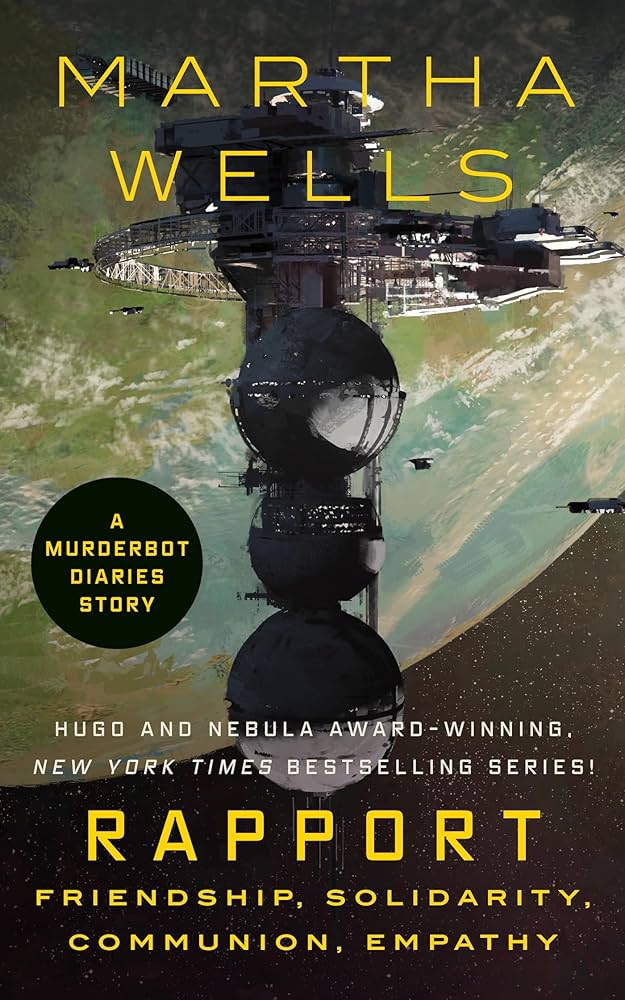
“Oh,” I said, when I reached the end of “Rapport: Friendship, Solidarity, Communiion, Empathy” by Martha Wells. I hadn’t expected that to be the end because the ticker showed that there were still a few pages left. I even went beck to the original publication to check, and yes, that was the end. I thought for a moment, and decided yes, that was where the end belonged. Some parts of the plot that Wells set in motion for “Rapport” were left unresolved, but that was fine, better than fine even, because their unfinished state emphasized what the story was really about, which was right there in the title. “Rapport” is tagged as “A Murderbot Diaries story,” but the first-person SecUnit does not appear, let alone narrate. Outside sources identify “Rapport” as 2.1 in the overall continuity, which is to say between Artificial Condition and Rogue Protocol. If I had read the main stories in anything like publication order, I might have a firmer grasp of where this story fit in the overall continuity, and that might have given me a little extra enjoyment. As it was, I came to “Rapport” with only a vague notion of the characters, and that worked just fine too, Wells filled in enough to bring readers on board. And on board is where the team of people from Preservation Station are trying to get, a pre–Corporation Rim structure attached to a more recent structure. New team members are part of a group from the Perihelion, and of course things do not go as expected. More troubling, Perihelion is acting out of sorts. The ship is not likely to cause problems directly, but it might unnerve the team members which could have the same effect. The station also turns out to be in turmoil when they arrive, which means there are far more guards out and about than they had reckoned with in their planning. Wells makes the story precisely about how the characters deal with each other, and with the unexpected. She does not try to make the story be about everything under the sun, or try to solve large human (and non-human) problems. “Rapport” is about precisely these people, in precisely this situation, and any larger meanings readers may choose to take away are up to them. That precision, that discipline, and that openness are what make “Rapport,” in my view, the best of this year’s nominated novelettes.
+++
Doreen’s comments on this year’s finalists for Best Novelette are here. We read the same stories and came to rather different conclusions.
This is the ninth bit of writing about Hugo finalists that I have done since they were announced. Prior to the announcement, I had read and reviewed What Stalks the Deep (Best Novella) and The Incandescent (Best Novel). Hugo voting will close on August 8, and winners will be announced at LAcon V on the evening (Pacific time) of August 30.

 Al Singh
 Doug Merrill
 Doreen Sheridan
 Emily Lauer
 John Pitzel
 Lars N. Goldschlager
 Laura Eilers
 Professor X
 Robert Maedgen
 Sylvere Ap Leanan
 The Shire