I was feeling very intellectually chipper last week and decided to get a head start on some of my Hugo 2026 Awards reading, beginning with a nominated novella from a podcaster I adore.
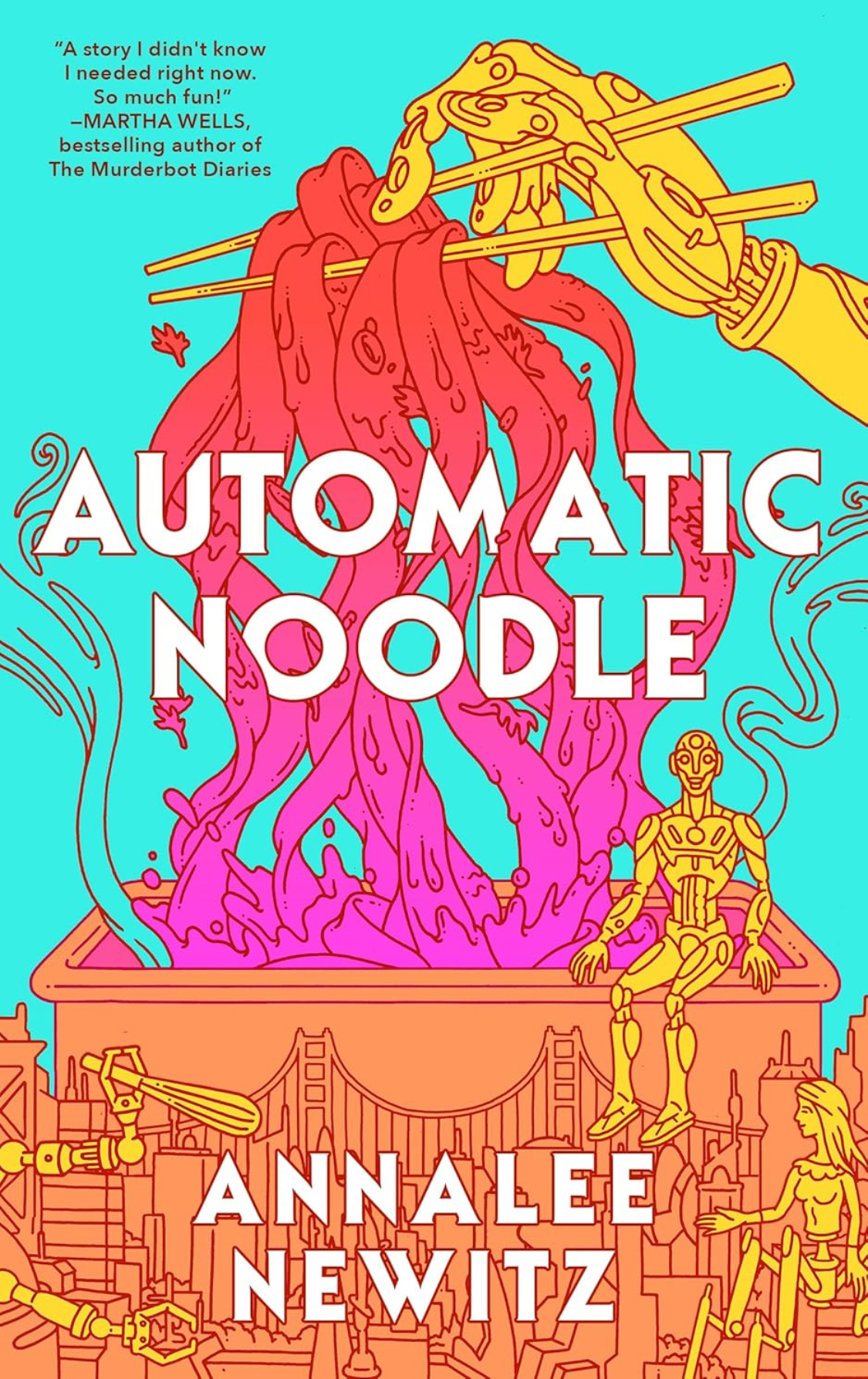 Automatic Noodle is the story of a restaurant’s robot employees in a California that has successfully seceded, at some cost, from the United States. As the book opens, all the store’s robots have been deactivated. Flooding reawakens the emergency protocols of the manager, who was formerly a soldier in the war. As he tries to figure out what’s happening, he awakens the rest of his staff. Soon, they discover that the restaurant chain that owned them decided to close their location and shut them down in the process. Unwilling to disband, they decide to take over running the restaurant for themselves, meeting all of their challenges head-on in a heartwarming story of the American dream, more or less.
It’s clear that this is meant to be an allegory for immigration and civil rights. Trouble is, you have to buy in first to the (unfortunately inconsistent) depiction here of Artificial Intelligence being so far advanced as to have granted robots enough sentience that they’ve developed free will and earned a limited form of citizenship. Perhaps this story would have landed better in a time frame where generative AI isn’t busy dismantling the livelihoods of millions worldwide, solely for the purpose of enriching the already wealthy. It’s just hard for me as a reader (and a member of an ethnic minority, and someone whose career was made precarious by gen AI) to mentally traverse robotics’ uncanny valley and accept the humanity of created objects that are also somehow fully autonomous of their investors.
That, I feel, is the crucial flaw of this novella. Mx Newitz writes from the perspective that sentience is a given and robots can be people too. Given the near future setting and the very human tendency to anthropomorphize, well, everything — I mean, seriously, have you read some of the interviews with people who’ve developed AI psychosis? — I am unconvinced. And so little effort is put into the argument for sentience here that my skepticism remains unshaken. This book would’ve been better off talking about animals making that evolutionary breakthrough: I’m 100% convinced that that will happen before glorified chatbots deserve any such consideration (it also struck me as funny that vegetarianism did not get any form of evangelical treatment in this book.) A further-future setting may also have helped as in Martha Wells’ Murderbot, which is entirely convincing in a way that these characters are not.
But I think that the worst thing about AN is that it felt weirdly othering of those of us still neck deep in the battle for civil rights and against prejudice. Technophiles sometimes fall into the trap of exalting the development of technology over maintaining and improving the wellbeing of people who are actually already here. I know that I sound like I’m on the verge of nativism but for real, I want less money spent on state violence anywhere and more on improving people’s health and education outcomes worldwide. While human minority characters do show up in this book, and primarily as allies, AN feels overall like a blueprint for solving a problem that doesn’t exist instead of looking at ones that actually do. That said, the most consuming challenge in a book about robots trying to gain acceptance in their community and earn enough money to survive… is to figure out who’s review bombing them? Come on.
I’m sure other people are going to love this — it’s got strong cozy, found family vibes that I enjoyed too — but it was so heavy-handed and lowkey insulting in its equating of minorities with AI, that I just could not. Perhaps oddly, I did find the expressions of queer joy to be compelling, but I also feel that love is love no matter what body parts you prefer.
Ugh, this is a messy review of a messy book that I felt demanded a lot more rigor in order to get me fully on board. As a pro-immigration, pro-equal rights writer who’s becoming increasingly depressed by the state of this nation, I wanted to love this book and empathize, but found the allegory here to be more equivocating than evocative. It felt like a good faith effort that unfortunately springs from a problematic starting point. This will not rank highly on my Hugo slate for Best Novella.
Automatic Noodle by Annalee Newitz was published August 5 2025 by Tordotcom and is available from all good booksellers, including

 Al Singh
 Doug Merrill
 Doreen Sheridan
 Emily Lauer
 John Pitzel
 Lars N. Goldschlager
 Laura Eilers
 Professor X
 Robert Maedgen
 Sylvere Ap Leanan
 The Shire
1 ping
[…] liked Automatic Noodle more than I did; her review is here. This was the sixth of the Hugo finalists for Best Novella that I read, and the third that I have […]