Watership Down is a seminal book in the life of most young readers, and one I remember with great fondness from my own childhood. Re-reading it as an adult produced a slightly different, admittedly lesser experience, that I talked about briefly here. So how, I wondered, would experiencing it as a graphic novel change my perspective on the book again, if at all?
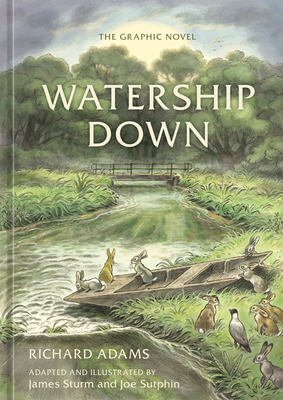 Turns out that adapting the book to a graphic format is a shockingly good way of bringing me back to the magic of my initial childhood reading experience, untarnished by a more adult absorption in the text’s every word. I can’t be the only adult who goes back to read a favorite tome from their youth only to be confounded by how many more words there are in it than remembered? Or perhaps I am merely an impatient first-time reader, gobbling up words by the yard in pursuit of story instead of savoring each passage in its fulness, as I’m more likely to do on a re-read. It is also fairly rare for me to remember words on a page: instead, the books that linger in my memory remain there as vivid pictures and the feelings they evoke. Bigwig, for example, will always be a bad ass, both objectively and in my mind, tho darned if I can remember a single word he’s ever said.
So this reinterpretation, if you will, helped refocus my memories of the book and underscore things I probably hadn’t appreciated on my last re-read as an adult. A large part of this comes ofc from the creators’ decision to illustrate so much of the proceedings. That old saw of a picture being worth a thousand words helps in condensing Richard Adams’ initial prose to its most important parts, displaying the most impactful scenes in a way that suits (my perhaps idiosyncratic memory of) the material. I was definitely far more affected by sadness upon reading this than I had been my last go-round, tho less due to Bigwig this time than to the trials that befell Hazel.

 Al Singh
 Doug Merrill
 Doreen Sheridan
 Emily Lauer
 John Pitzel
 Lars N. Goldschlager
 Laura Eilers
 Professor X
 Robert Maedgen
 Sylvere Ap Leanan
 The Shire