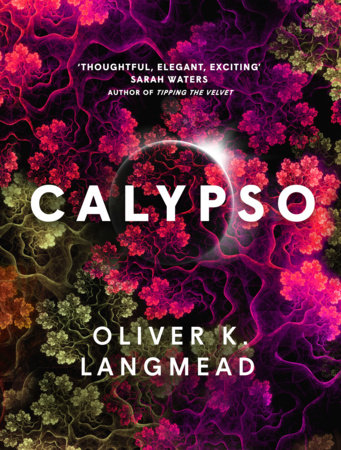
Calypso by Oliver K Langmead

My kingdom for pdfs properly formatted for Kindle!

That gripe aside, wow, was I finally glad to be able to read Oliver K Langmead’s novel in verse. And I get it, the pdf was meant to preserve the gorgeous art and design of the book, which it definitely does. It just took way longer to read on my Kindle than it should have because the print was so tiny!

Anyway, the poetry inside is divided into narratives centering four different people: Rochelle, the engineer and moral center; Sigmund, the architect and visionary; Catherine, the biologist and creator, and the Herald, the storyteller and historian. All four are on the colony/generation ship Calypso, where the first three went into extended cryosleep on their way to a brand new planet, in a universe where terraforming has already turned Mars and Venus into habitable environments for humanity. The new planet the four are headed to, however, is light years beyond our solar system.

Rochelle, especially, feels guilt for leaving her children behind. It’s never really explained why she felt compelled to join this expedition to begin with, which I thought was rather odd. It’s obvious why Sigmund and Catherine went, and the Herald had no choice, being the descendant of generations of crew who’ve ensured that the sleeping technicians and colonists are taken care of on their long trek through the stars. Things, ofc, do not quite go to plan, as Rochelle wakes to find a ship entirely different from what she expected.
Continue reading

Permanent link to this article: https://www.thefrumiousconsortium.net/2025/07/21/calypso-by-oliver-k-langmead/

Hugo Awards 2025: Best Short Story

Officially, I’m taking a break from reading for the Hugo Awards this year. I’ve found participating in the Hugo process as a reader and voter wonderfully rewarding, not least because it has introduced me to authors I would have completely missed otherwise, but I’m also a conscientious voter, and that means I try to read enough of each work in the categories I vote in to give it a fair shake. That adds up to a significant share of my annual reading page — I am not one of the people who can read upwards of 200 books a year — and this year I felt it would be more of a chore than a joy. I chose to take a year off even before the finalists were announced, so it’s no reflection on the finalists. In fact, the publishers may come out ahead on me this year, since there are several finalists I want to read and will obviously not be receiving in the Hugo reader’s packet.

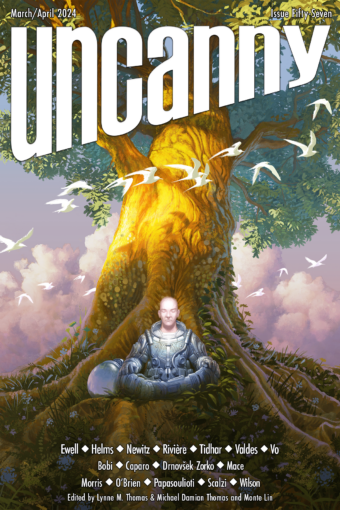
Uncanny Issue 57, which contains "Stitched to the Skin Like Family Is" by Nghi Vo

But then I read Doreen’s post, and I thought that looking in on one category, with manageable reading, would be a fun thing to do even in an off year. In theory, I like formal experiments — yay! stretch what it is that a story can do, push limits on what’s considered a story — but I am coming to realize that I almost never like an experiment better than a really well-told narrative. This year’s short story finalists had four experimental stories, and it’s not surprising that I preferred the two narratives. Here are some short thoughts on each, in ascending order of my preference.

Five Views of the Planet Tartarus” by Rachael K. Jones offers a bare-bones account of horrific punishment in a spacefaring society that can afford the resources to mete out eternal orbital confinement as the penalty for treason. The story pulls names from Greek mythology — Tartarus, of course, and also a Sibylline Court — but the setting and society are not even sketched, just gestured toward. Speaking of Sibyls, the story is more of a dream or a vision than a tale. Jones says so with the story’s title, so a reader should not expect anything else. I found the work more of an evocation of elements that I already knew; I don’t know if the set-up could support a story rather than a set of views, but in any event that’s not what Jones chose to write. It’s a horrific vision with a kick at the end, but there isn’t anything else.

Continue reading

Permanent link to this article: https://www.thefrumiousconsortium.net/2025/07/20/hugo-awards-2025-best-short-story/

Tantalizing Tales — July 2025 — Part Three

Was July this huge a month for books in previous years, dear reader, or is this another case of my time blindness? Regardless, we have some delicious reads that have either just or are freshly coming out, beginning with Tess Sharpe’s No Body No Crime, a twisty and gripping romantic thriller about enduring love, true friendship and murder (with an absolutely outstanding cover!)

Murder will either bond you or break you. For teenaged Melanie Tillman and Chloe Harper, their experience of murder was the bonding sort, both in crime and in a love affair that they both believed would last.

But time has a funny way of changing things. Nowadays Mel is single, and a working PI in her rural NorCal hometown. Chloe, meanwhile, has been missing for six years. And their victim Toby Dunne? He’s buried where no one will ever find him.

When the Harper family hires Mel to bring Chloe home to be with her dying father, Mel tracks her ex down to a boobytrapped DIY cabin in the Canadian wilderness. There she learns that what broke them apart wasn’t murder, but the fact that when they buried Toby, they also buried something that belonged to the Newells, the most powerful and politically connected family in town. The Newells are desperate to get it back, and have been hunting Chloe ruthlessly since linking her to Toby’s disappearance. Chloe, in turn, has been hiding out, hoping against hope that doing so will keep Mel safe.

Will the reunited lovers be able to figure out a way to get Chloe home safely to her dad? After losing each other once, they’ll do whatever it takes to make sure they’re never parted again.

Continue reading

Permanent link to this article: https://www.thefrumiousconsortium.net/2025/07/18/tantalizing-tales-july-2025-part-three/

Martin Cruz Smith, 1942-2025

I was digging myself out from the bottom of the 270 or so emails in my inbox when I came across this press release announcing the recent death of acclaimed and accomplished author Martin Cruz Smith:

~~~~~~~

We at Simon & Schuster are saddened by the death of Martin Cruz Smith, who passed away peacefully on Friday, July 11, surrounded by those he loved. We offer our condolences to his family and to his many loyal readers who have enjoyed his work over the last half-century.

Smith was a writer accomplished in nearly every genre—westerns, horror, historical fiction, and of course mysteries. He was a recipient of the Mystery Writers of America’s Grand Master Award as well as several international mystery prizes, and he has been acknowledged as an inspiration by many bestselling authors including Lee Child and Slow Horses novelist Mick Herron. Smith’s eleven-book series featuring Moscow detective Arkady Renko—beginning with the 1981 publishing phenomenon Gorky Park and concluding with Hotel Ukraine, just released last week—is one of the great achievements in modern suspense writing, with the Washington Post hailing it “a work of art” and the Denver Post claiming, “Along with icons like Sherlock Holmes, Philip Marlowe, and Sam Spade, Akrady Renko has become one of the finest fictional detectives to prowl the literary landscape.”

For the last three decades, Smith lived with Parkinson’s, and he innovatively incorporated the condition into the more recent Renko novels, with his protagonist facing it as courageously as the author himself. As Smith writes of Renko in Hotel Ukraine: “He could stay at home, do nothing, and surrender as his symptoms got worse…He was defined by who he was and what he could still do. Put that way, it wasn’t even a choice.”

Continue reading

Permanent link to this article: https://www.thefrumiousconsortium.net/2025/07/17/martin-cruz-smith-1942-2025/

Hugo Awards 2025: Best Short Story Nominees

I have become even more time blind than usual lately, and am woefully behind on any emails that may be reminding me of voting deadlines. Nevertheless, I’m glad that I’m finally getting a chance to look at this year’s Hugo nominees, beginning, as is tradition, with Best Short Story!

And, as is tradition, let’s start with my favorite of the bunch then work our way downwards. I read each nominee in alphabetical order by title, and had a really obvious favorite until I got to the last story, Isabel J Kim’s Why Don’t We Just Kill The Kid In The Omelas Hole. That title alone is a hell of a choice. The lack of a question mark signals that this is a story that has no interest in moral hand-wringing, even if it is based on one of science fiction’s greatest thought experiments on questions of justice and conscience. It was actually that basis that made me avoid this story until I had to read it for the Hugos. Someone taking on what is arguably Ursula K LeGuin’s most famous work? Bold move, considering that it very much needs to live up to its source material in order to succeed.

Readers, I’m pleased to report that it very much does. I have an instinctive repugnance towards accelerationism, as shown by my review of yesterday’s graphic novel, but Ms Kim uses it here in fascinating, thought-provoking ways. When people start killing the kid in the Omelas hole, greater discussions are spurred as to culpability, transparency and the morality of utilitarianism. Most strikingly, this is done both in Omelas and in the “outside” world, reminding readers once again that we too are active participants in this conversation with Ms LeGuin’s text as it continues to apply to our everyday lives. It’s an incredible bit of literary sleight of hand from Ms Kim that, frankly, deserves to win all the awards.

Continue reading

Permanent link to this article: https://www.thefrumiousconsortium.net/2025/07/16/hugo-awards-2025-best-short-story-nominees/

Hourglass by Barbara Mazzi

So it’s weird sometimes, when I’m trying to review the first book in a series where a large part of the plot revolves around a mystery. There’s a very delicate balance that authors have to hit in order to make the book feel both satisfying for the reader and like we really need to read more. I’m hoping that in the process of writing this review, I’ll be able to figure out why I felt both dissatisfied with the stopping point but curious enough to want a second book, even if that curiosity is not a burning desire.

Hourglass tells the story of a post-apocalyptic world where the seas have gone dry. Instead, the vast sands left behind have been mined to produce an even more curious sort of sand, that can imbue longevity to a select few known as the Ancient Ones (it is never stated what the terms of this selection are.) These life-extending sands are collected in the massive but delicately engineered hourglass of the book’s title. Engineers and technicians, including a young woman named Twenty, toil to keep the hourglass working correctly. If they do their job well, then perhaps they too will be rewarded with extra years by the sand.

One of the few highlights of Twenty’s life of endless labor are her visits with Martel, the privileged daughter of one of the Ancient Ones. Martel is adept at sneaking her way into the hourglass, which makes it easier for her and Twenty to spend stolen moments together. But one day, Martel does something reckless with the hourglass’ workings. Perhaps she does it out of nerves: her mother is returning to see her after an absence of five years, after all. Or perhaps she has a far more destructive intent. Regardless, her choices set off a chain of events that will change her and Twenty’s lives — and the lives of countless others — for good.

Continue reading

Permanent link to this article: https://www.thefrumiousconsortium.net/2025/07/15/hourglass-by-barbara-mazzi/

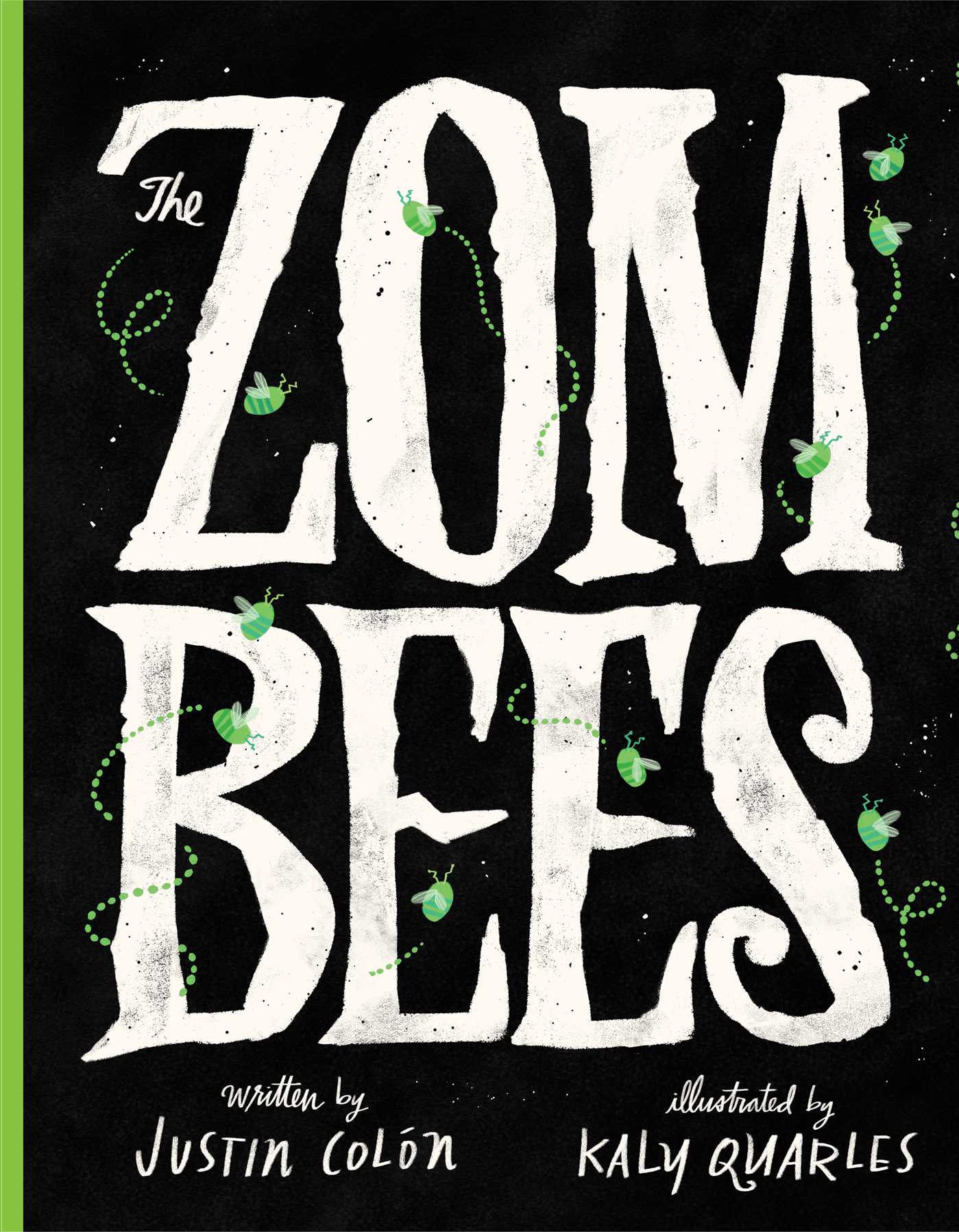
The Zombees by Justin Colón & Kaly Quarles

Aside: this is the second zombie-related book I’ve read in a row, how odd for the middle of July!

It’s Halloween and the normally quiet graveyard by Honey Hills is abuzz. Literally, as strange creatures begin to rise from the tombs and wend their winding way through town. Could these flying apparitions be… bees? But bees aren’t that sickly shade of green, nor do they have that strange, lingering smell.

As terrified trick-or-treaters run through the streets searching for safe haven from the zombees coming at them, the big smokers are called in to protect them. Who will survive this night of mischief and mayhem? And will the townsfolk be able to get to the bottom of this zombee outbreak and put a stop to it before anyone gets hurt?

Given that this is a kid’s book, the answer is yes, and in the most heartwarming, relatable way possible. The way that the book makes the idea of zombie bees feel age-appropriate for young readers developing their vocabularies is well suited for its target audience, with just enough scares to give them a thrill but not enough to induce outright fear.

Continue reading

Permanent link to this article: https://www.thefrumiousconsortium.net/2025/07/14/the-zombees-by-justin-colon-kaly-quarles/

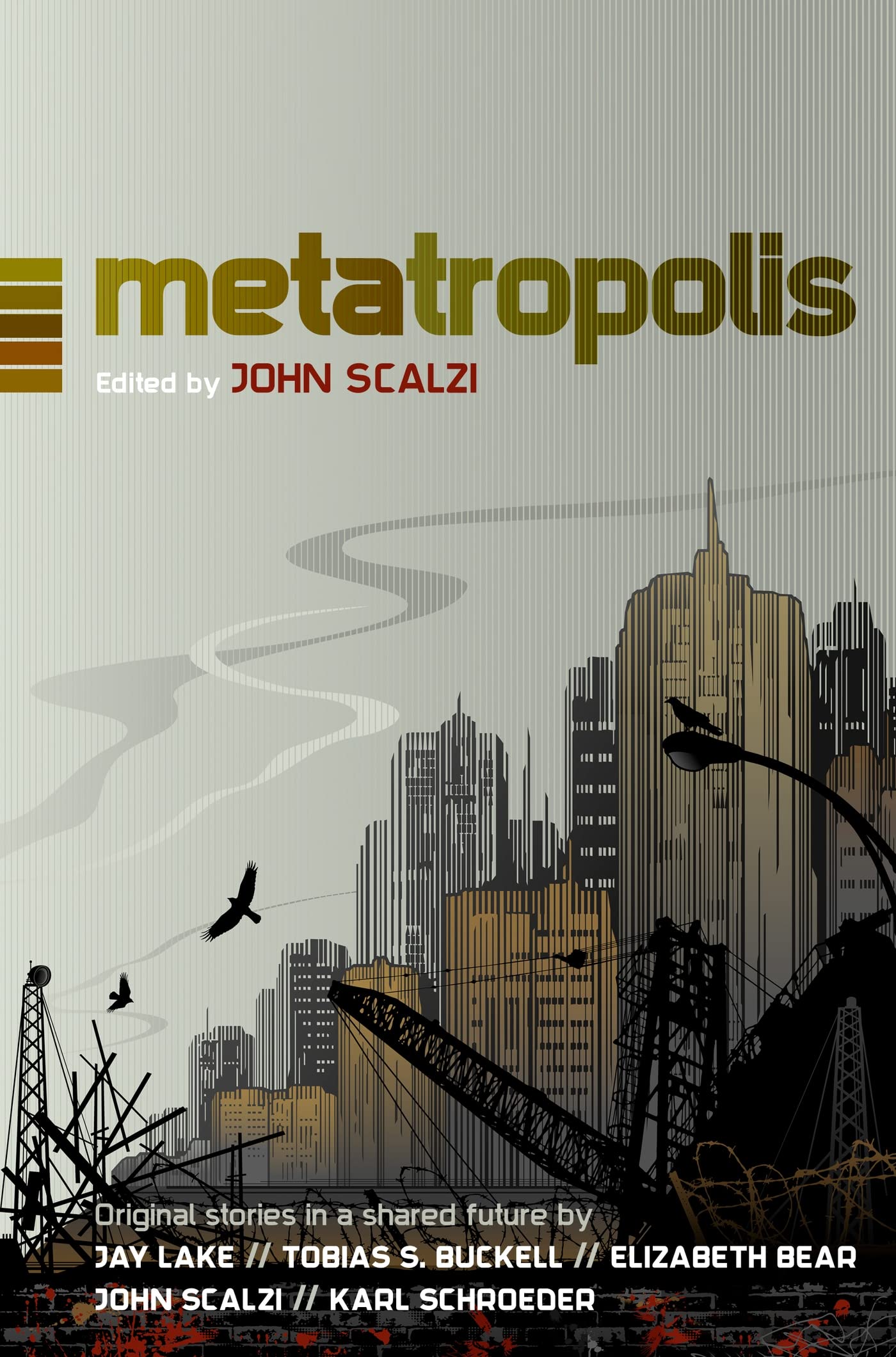
METAtropolis edited by John Scalzi

METAtropolis brings together five stories set in a nearish-future United States that’s mostly come undone amid climate catastrophes and other less-specified degradations. The anthology began as an audio-only collection. John Scalzi put it together, and worked with the other authors — Jay Lake, Tobias S. Buckell, Elizabeth Bear, and Karl Schroeder — to create a shared setting for their tales. Scalzi notes in his introduction that Medea: Harlan’s World, edited by Harlan Ellison, was something of a model, although I suspect that the worldbuilding for METAtropolis was more collaborative.

METAtropolis, edited by John Scalzi

The audio anthology grew in two different directions. Three more all-audio collections followed in 2010, 2013 and 2014, with editorship passing to Jay Lake. The second, METAtropolis: Cascadia, won an Audie in 2012 for Original Work. Meanwhile, the first collection went into print, first as a limited edition from Subterranean Press in 2009, then a hardback from Tor in 2010, and then the trade paperback edition that I own was published in 2013. Five years of public and publisher interest in an anthology is unusually good. In the case of METAtropolis, I think it comes from three factors. First, and probably least important, there are people like me who are avid readers but haven’t really made room in their lives for audiobooks. I’m happy that I can enjoy the fiction on pages, even belatedly. (I haven’t yet picked up Scalzi’s series of audio-first novellas, but I am glad they are available in other formats.) Second, the overall idea is a neat one, and shared-world anthologies or series in fantasy and science fiction have a fun history. While METAtropolis did not grow into a large-scale project like Wild Cards or 1632, three sequels is perfectly respectable. Third, and probably most important, the authors were all well-known within the field, and each brought some of their fans, and their continued success led to more and more people discovering the anthology. By the time I picked up an autographed copy in a Chicago airport in 2015, the collection had a solid history.

Continue reading

Permanent link to this article: https://www.thefrumiousconsortium.net/2025/07/12/metatropolis-edited-by-john-scalzi/

Tantalizing Tales — July 2025 — Part Two

Hey, I’m on Jeopardy! today. I had a really great time (as you can probably tell if you watch what is, in my entirely biased opinion, one of the best regular season episodes you’ll ever see) but it’s super cut into my reading time, unsurprisingly.

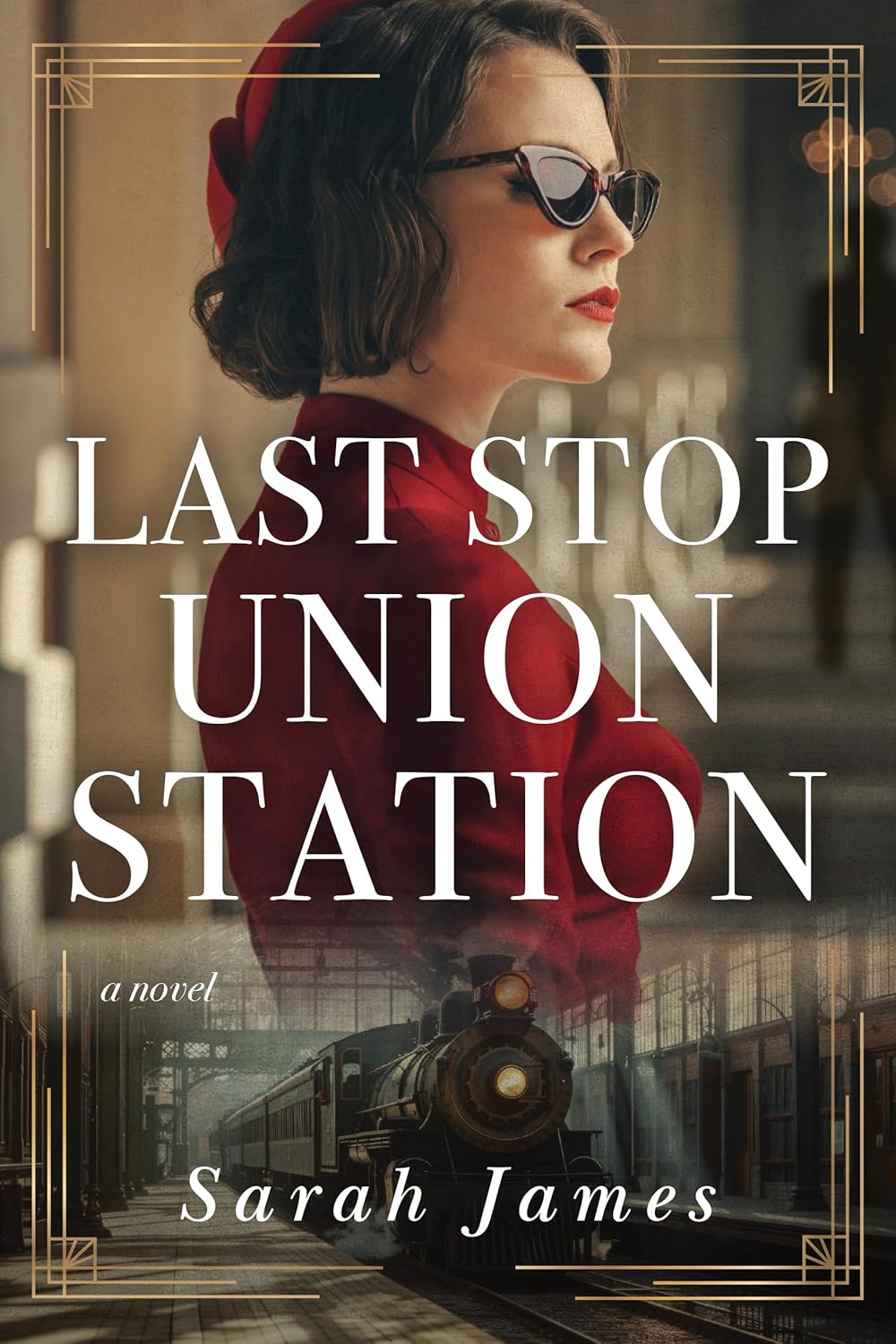
So I wanted to make sure in this round-up column to highlight the latest queer historical mystery from an author who wrote one of my favorite books of 2023, Last Night At The Hollywood Canteen. I won’t be able to get to it in the timely manner it deserves, but I’m so excited that Sarah James has returned with Last Stop Union Station.

The 1942 Hollywood Victory Caravan was a real train full of stars like Bing Crosby, Bob Hope and Joan Bennett, who volunteered to sell war bonds for the troops overseas. Ms James uncorks a bubbly cast of has-beens and up-and-coming stars aboard her version of this celebrity tour, where a finely timed publicity stunt becomes the scene of an affair, a blackmail scheme, a murder cover-up and a Nazi conspirator playground — just another day in the dog-eat-dog world of Old Hollywood!

The iconic and “difficult to work with” actress Jacqueline Love is shoved onto the Hollywood Victory Caravan in order to perform a facelift on her sagging career. While Jackie is schmoozing the press and glowering at the younger, more successful version of herself, one of her fellow stars dies mysteriously, forcing the crew to lock down in Chicago. Unable to storm off this set, Jackie suspects foul play, so recruits a desk-duty female police officer hungry for her big break to help her solve this murder mystery. In the spirit of old Hollywood drama, their investigation reveals dark secrets and hidden agendas, including a homegrown Nazi scheme that forces Jackie to decide between country and career.

Continue reading

Permanent link to this article: https://www.thefrumiousconsortium.net/2025/07/11/tantalizing-tales-july-2025-part-two/

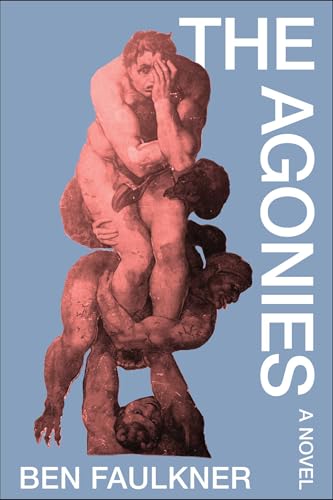
The Agonies by Ben Faulkner

In all earnestness, the teenaged narrator of this affecting novel desperately needs sports. A sport, any sport: even a sedentary bookworm like myself can recognize that the kid has too much energy and too few healthy outlets.

The kid in question is Armie Bernal, the son of two semi-famous writers who divorced when he was in the single digits. Mom stayed in New York City while he followed his dad to Baltimore. Dad is, frankly, too self-absorbed to be a good parent. Armie decides that he doesn’t want to talk to his mom any more and sinks into a cesspool of online reactionaries and contrarians. At some point, he uses his dad’s credit card to source a whole bunch of different drugs from shady sources on the Internet (see, again: bad parenting.) Unsurprisingly, a psychotic break ensues. In the aftermath, Armie tries to make sense of his life by writing this book.

There is, oddly, “an act of terrifying violence” promised as the climax of this story. It never manifests, unless the last page is meant to be a veiled metaphor told from Dill’s point of view. If so, it’s so vague as to lack any impact. I actually hope it isn’t, as the novel functions quite well without it.

And what is that function? To showcase the rambling, often incoherent but deeply believed thought processes of a disaffected young man in the 2010-20s. The Agonies well deserves its comparisons to Camus’ The Stranger (which I loved) and Salinger’s Catcher In The Rye (which I despised,) updating the disconnect felt by the protagonists of those classics to better gel with the challenges kids face today. And there are so many challenges facing our kids right now. From gun violence to online radicalization to the excesses of late-stage capitalism, our current era is a hard time for smart, sensitive kids to make sense of. I felt tremendous sympathy for Armie, even as I was appalled at the utter lack of guidance he was given.

Continue reading

Permanent link to this article: https://www.thefrumiousconsortium.net/2025/07/10/the-agonies-by-ben-faulkner/