As a relatively uninformed reader of The Odyssey — one trip through it unaccompanied while traveling across Central Europe in the mid-1990s; I don’t even remember which translation I read, only that I was mesmerized — I was happy to read all of Emily Wilson’s introductory material before embarking on the poem itself. What is known about Homer, and the poetic tradition from which the two Homeric epics emerged? What are contemporary discussions concerned with when they take on the intersection of archeology, linguistics and literature that The Odyssey presents? I was glad to have her set the scene and sketch the surroundings, and to state up front what her main decisions about translating the epic would be: all in iambic pentameter, as the natural meter of English epic verse, and the same number of lines as Homer’s Odyssey. This was all in 2022, well before this summer’s movie version was even a gleam in Christopher Nolan’s scriptwriting eye. Her Iliad was also the first one that I found I could read. I had bounced off of several others through the years, and I read hers in about three weeks.
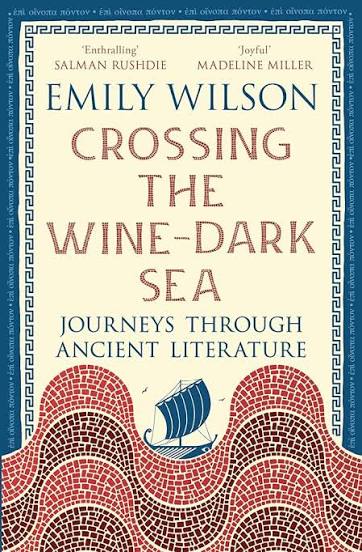
All of which piqued my interest in Crossing the Wine-Dark Sea, a collection of essays about translating and classical literature. The book contains 13 essays — seven of which were published elsewhere, as far as I can tell — along with an introduction, an afterword, and suggestions for further reading. Wilson writes in her introduction that all were thoroughly revised and reworked for this publication. I do wish that Wilson and her publisher had included the information about original publication with the essays themselves, instead of burying them on the copyright page, because when she writes something like “Stoicism is having a moment” (p. 132), I would like to know when in the twenty-year period of writing that moment was had, or whether I should presume it includes the 2026 moment of publication. The fine print reveals that “Chill Out with the Stoics” was first published in The New Republic in 2010. The essay’s second sentence mentions a book that was published in 2016, so its inclusion was clearly part of the revision process, and the moment has apparently lasted more than a decade and a half, which seems to me a bit long for a moment, but maybe a classicist sees things differently.
The other thing that annoyed me about Crossing the Wine-Dark Sea is a writing tic that is by no means limited to Wilson. Indeed, it is so common that I wonder whether she sees it at all, or whether she sails smoothly past without noticing. This pet peeve of mine is the unmarked “we.” We see. We read. We notice. We observe. Our hero. Our knowledge. In our day. As we’ve seen. Wilson writes numerous times that words matter — and why would she make her career as a translator if she did not believe that words mattered — but she does not seem to have paused to think about who “we” are in the many times such a construction appears in her book. For all the times that she insists on the importance of nuance, of careful attention to small details of usage that reveal important aspects of characters, of writers, of the classical world more generally, she glides right past considering this detail in her own work. As I said, it’s an extremely common construction in essay writing, but Wilson’s subject matter made it stand out all the more for me.
The essays themselves are full of interesting perspectives, from detailed consideration of how to deal with the loss of Sappho’s books and their fragmentary rediscovery through an examination of how Demosthenes’ rhetoric backfired in important senses, and onward to how non-experts have engaged constructively with re-creating Greek works of literature in different contexts. One example of the last is her essay about Christopher Logue’s War Music. Logue himself (1926–2011) seems to have been a bit of a crazy man, and War Music carries the subtitle “An Account of Homer’s Iliad,” so it’s not a translation per se, but something of a re-creation. Wilson calls it “Logue’s master-heist of Homer” and she adds that it “is combined with many miniature thefts from other poets, and the loot in his commonplace book provides some of the most resonant gnomic utterances.” (p. 158) In Logue’s hands, Homer meets Eliot meets Byron and then Paul McCartney appears. “When it works — which is surprisingly often, though by no means always — the multiple layers of quotation create a layered awareness of many moments in time, many pens and typewriters and computers, creating a single, truly epic story.” (pp. 158–59) Wilson’s range of interests, and her insistence on the multiplicity of translation and interpretation, are some of the best aspects of Crossing the Wine-Dark Sea. She can, when she wants, engage with unusual approaches, and she can marshal many examples to bring new light to a topic.
Her most substantial essay, comprising nearly a quarter of the book, is on translating The Odyssey. She stakes out her ground immediately:
Mistakes are possible in translation, as every language instructor knows. But there is never a single ‘correct’ translation of a specific word, phrase, sentence or passage. There are a wide variety of responsible ways to create an equivalent, just as there are many ways to play a single score of music, many ways to paint the same landscape, and many ways to direct a play or deliver a speech. (p. 197)
(I will cheekily add that there are also plenty of irresponsible ways, and when the author of the original text tries to insist on one of those, you get a problem that classicists are generally spared. Ask me how I know.)
Wilson segues from her general thesis into a discussion on how views on the appropriateness of different modes of translation into English have changed over time. The earliest translations of the Homeric epics into English put them into the poetic idiom of the day, rhyming couplets. More recent efforts have included a prose translation that Wilson writes is still fairly widely read, “perhaps largely because it is out of copyright and therefore available for free online.” (p. 199) Commerce and economics were topics in earlier essays in which Wilson considers the contexts of Greek writing and drama; the modern era needs its economic context too. Robert Fitzgerald’s translation is “largely iambic” while Richard Lattimore’s “uses long, unmetrical lines” (p. 199) She then goes through numerous examples of how different translators approach the same passages, showing what people take out, what they add in, how they try to capture nuances, how to bring multiple meanings from the Greek into a single set of English phrases. The details and Wilson’s willingness to consider multiple examples of many different passages made this fascinating reading for me. I was both intrigued and slightly dismayed to read that she is still tinkering with her Odyssey. On the one hand, I can see the virtue in thinking it’s always possible to improve; on the other, the Odyssey that went out into the world is just a work in progress. Ah well.
In view of recent controversies about Wilson and Christopher Nolan’s movie, her essay on Edith Hamilton and the popularization of the classics is particularly interesting. Wilson discusses the cultural cachet of classicism, how that intersected with both self-improvement among working people in the earlier parts of the twentieth century, and the subject’s continuing function as a gateway to the upper reaches of society, particularly in the UK. She has especially pointed words — “buffoon” is not among them, but “incompetent” and “drunkard” are — about Boris Johnson in this regard. She also notes that some of the most successful popularizers, such as Stephen Fry, Mary Beard and Natalie Haynes, were not classicists at all. “Each of these figures — Fry, Haynes and Beard — are like [Edith] Hamilton in that they have gained popular success by fusing a schtick about classics with something much more nebulous and hard to achieve: a popular persona.” (p. 192) Indeed.

 Al Singh
 Doug Merrill
 Doreen Sheridan
 Emily Lauer
 John Pitzel
 Lars N. Goldschlager
 Laura Eilers
 Professor X
 Robert Maedgen
 Sylvere Ap Leanan
 The Shire
3 comments
Excellent review, as always. Would it be correct to observe that she seems unreasonably cranky about non-academics finding success in popularizing the classics for the masses, from Edith Hamilton to the present day?
Author
Thanks! And yes, I would agree with that. I think she has also made that “much more nebulous and hard to achieve” thing, a popular persona, but I am not sure that she realizes it. (Or had realized it when she sent this book to the publisher.)
I didn’t weigh in on any of the film review business because I haven’t read them, but I strongly suspect she’s brought the norms of academia and/or British literary jousting into a realm that does not share those norms.
Thing is, I’ve read a lot of professional movie reviews, and even the scathing ones engage with what the movie is trying to do, and judge it by primarily based on whether or not it’s succeeded. Her broadside was so Comic Book Guy, critiquing it less as a movie and more as an offense to her beloved canon text, that I genuinely think she just doesn’t understand the point, much less value, of adaptations, which your review affirmed to me.