In Tyll, Daniel Kehlmann explores the German folklore figure Til Eulenspiegel. In common legends, Eulenspiegel is known for playing practical jokes on his contemporaries, exposing their foibles and hypocrisies. The first printed collection of Eulenspiegel stories dates to 1510, and it places his life as taking place in the early 1400s. Early printings were mostly illustrations with a few lines of text; many of Til’s pranks were scatological. Tradition holds that he was born in Kneitlingen (in Lower Saxony) and died of the plague in Mölln (between Hamburg and Lübeck). There is some evidence that there was an actual Til Eulenspiegel, including records of a Till van Kneitlingen who was jailed for a year in the city of Brunswick on charges of highway robbery. He is not one of your harmless jokers or Robin Hood folk heroes.
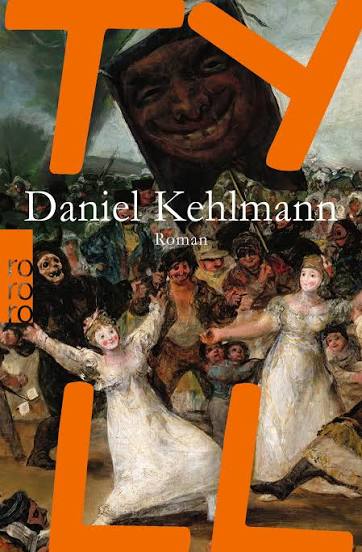
Kehlmann transposes Til to the era of the Thirty Years War (1618–1648) and takes Tyll Ulenspiegel as the spelling of the character’s name. In Kehlmann’s telling, Tyll is a skilled acrobat and juggler, a good singer, dancer and storyteller, and finally something of a magician. He’s also a harbinger, as the first of the novel’s eight sections makes clear. Tyll begins with a first-person narrator telling readers how hard her walled town with 105 houses had prayed to keep the war away. They had prayed to the Almighty and to the Good Virgin, of course, and also to the lord of the forest and to the little people of midnight, to St. Gerwin, to Peter the Gatekeeper of Heaven, to St. John the Evangelist, and just to be sure to Old Mela who rides across the heavens with her followers on the raw nights when the demons are allowed to roam free. They prayed to the horned ones of the old days and to Bishop Martin, and of course to St. Moritz. The narrator does not say how long the war has been going, but the does say that the tax farmers came twice per year “and always seemed surprised that we were still there.” (p. 7, all translations mine)
Tyll Ullenspiegel is also already well known by the start of the novel. When Tyll and his small troupe — a young woman, an older woman and an older man — trundle into town and set up their wagon, people are quick to say “Tyll is here!” “Tyll has come!” “Look, Tyll is there!” (p. 8) and everyone knows who they’re talking about. The town is self-sufficient but sleepy, and Tyll’s group brings some welcome entertainment. They play a tragedy, then they play a comedy, and between the two so much time has passed that the cows are starting to complain that they haven’t been milked, and many other chores have been left undone. Tyll sing songs that made fun of the Winter King, whose election in Prague had started the war, and others that made fun of the Kaiser, praying away in his cold rooms in Vienna. The songs lead to a dance with the young woman from the troupe, and the two of them hold the crowd spellbound with their skill and lightness. After the players pass the hat for money, the show continues with a rope that has suddenly appeared between the church tower and the town hall, which Tyll soon alights on and runs up and down effortlessly. From there, he eggs the crowd into a game of thrown shoes, but when he tells them to recover their shoes, the game descends into a brawl. Some people can’t recognize their own shoes or decide to improve their footwear at a neighbor’s cost. Hidden feuds come out into the open, slips turn into kicks and punches, and people give free rein to their violent urges. By the time the townspeople return to their senses, Tyll’s wagon — when did he come down from the rope anyway? how did they pack up so fast? — can barely be seen on its way out of town. One man died with a knife of unknown origin in his back, another was left lame, and many lost a tooth or several. A year later, war comes to the town leaving almost no survivors.
The second section goes back to Tyll’s boyhood and goes a long way toward explaining why he is the way that he is, while leaving important parts uncertain. Was his father really dabbling in magic, or was he just unusually single-minded and scientifically inclined, and happened to come to the attention of the witchfinders? Did his mother’s knowledge of folk charms and useful plants extend into the uncanny? What really happened the night that Tyll was left in the forest to guard the donkey and grain when his mother’s waters broke prematurely and she tried to get back to their farm before nightfall? Kehlmann shows readers a world steeped in superstition, but also one in which those superstitions might be right. Learnéd travelers debate the correspondences with dragons’ parts that might be effective treatments. Soldiers believe in charms’ effectiveness enough to make sure they loot them from the corpses of the dead. After reading about how Tyll’s childhood ended, I understood more about him, but that still did not make him less of an asshole.
Honestly, that aspect almost kept me from reading Tyll to the end. I’ve read enough of German history to know how horrible the Thirty Years War was, how thorough the devastation. If you’re ever wondering why something in a German region is the way that it is, “Because of the Thirty Years War” is always a good guess. In the spring of 2025 I was visiting friends who live in northern Bavaria, a mixed Protestant and Catholic area. They live in a place I’ll call Little Town, and about half a kilometer up the main road toward Thuringia there’s a smaller settlement called Upper Little Town. That’s where the Protestants all went when they lost a local battle, and more than 350 years later there’s still a firm division. I kept going for reasons. First, reading in German is a skill that’s good for me to practice, and reading a well-written novel all the way through — Tyll deserves its accolades in that regard — is a good way to do that. Second, my copy was a present from one of my kids, and she was also reading along. It was her current Kindle book, so from time to time we got to discuss, and that was great!
For someone who has had fewer encounters with the Thirty Years War, Tyll brings its chaos and brutality into clear focus. Tyll himself is also a bit of a Forrest Gump of the war. For a time attaches himself to Frederick of the Palatinate, whose election as King of Bohemia was the spark that set off the powder-keg of Central Europe. By that time Frederick’s court has been reduced to about half a dozen attendants, and Tyll’s role is court jester, keeping the king humble by cleverly insulting him. Kehlmann also shows Tyll in less exalted company. In the next to last section, Tyll’s antics have caught up with him, and he is press-ganged into a group of sappers, counter-tunneling against the Swedes who are besieging the city where he had gotten caught. In between, the funniest section is “The Great Art of Light and Shadow,” in which traveling scholars avoid the war (and plague) while ostensibly searching for northern Germany’s last dragon. The one upmanship and jockeying for position are drily hilarious, and they show that scholarship has never been fully disinterested.
I’ll give the last words to C.V. Wedgwood, who wrote a history of the Thirty Years War not long before WWII, and added a preface after that war:
Many of my generation who grew up under the shadow of the First World War had a sincere, if mistaken, conviction that all wars were unnecessary and useless. I no longer think that all wars are unnecessary; but some are, and I still think the Thirty Years War was one of these. It need not have happened and it settled nothing worth settling. … Several statesmen of genius outside German from time to time dominate the course of the war; no statesman of genius inside Germany appeared to put a stop to it. The dismal course of the conflict, dragging on from one decade to the next and from one deadlock to the next, seems to me an object lesson on the dangers and disasters which can arise when men of narrow hearts and little minds are in high places.
Tyll dramatizes the history, shows life in an enchanted but demon-haunted world, and speculates on what wartime might have been like on many different levels.
+++
An English translation of Tyll by Ross Benjamin was published in 2020. It was shortlisted for that year’s Booker International Prize.

 Al Singh
 Doug Merrill
 Doreen Sheridan
 Emily Lauer
 John Pitzel
 Lars N. Goldschlager
 Laura Eilers
 Professor X
 Robert Maedgen
 Sylvere Ap Leanan
 The Shire