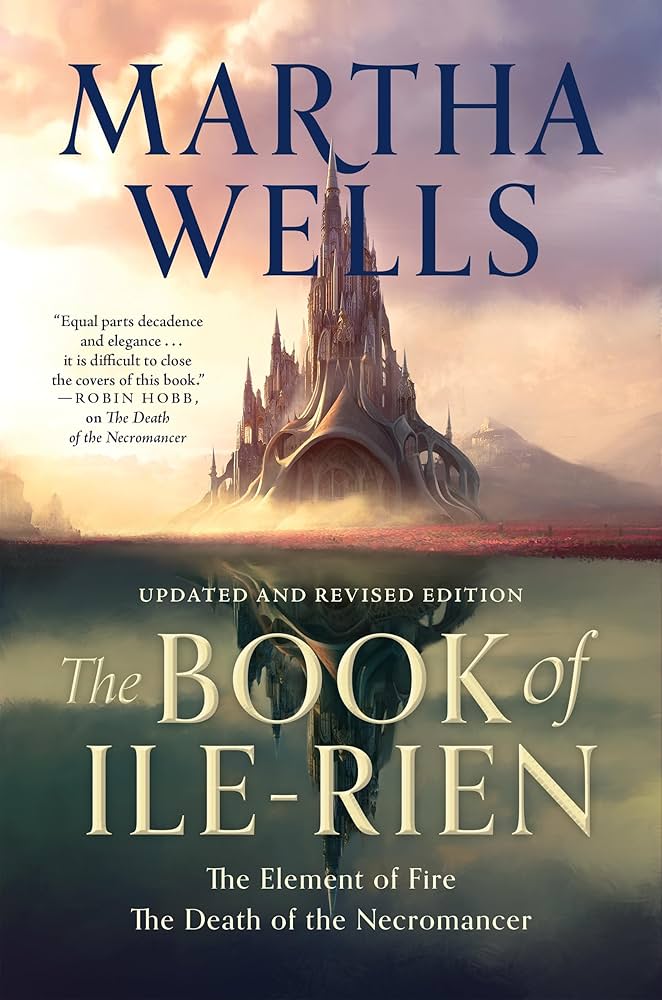
Come for the opening heist in a magician’s home, stay for the burgeoning civil war and Martha Wells’ willingness to keep changing the story. The Element of Fire was her first novel, originally published in 1993. (The current edition was revised in 2022, though her author’s note does not say anything about the extent of her revisions.) Ile-Rien is a kingdom in a moderately magical world; it still has castles and strongholds, though both magic and cannon can make short work of them. Guns are a new and not entirely reliable technology. None of that is immediately apparent.
Captain Thomas Boniface is leading a break-in at a sorcerer’s mansion, to rescue yet another sorcerer. Thomas, his lieutenant Gideon, and the various other Queen’s guards stationed outside the mansion have brought the new court magician, Dr Braun, with them, but he can offer little help.
“You can’t give us any hint of what we’re to find in there?” Thomas said … Braun’s expression was both distressed and obstinate. “He is too strong or … he might have the help of some creature of the Fay.”
“God protect us,” [a Queen’s guard] muttered, and uneasily studied the cloudy darkness above. (p. 6)
That is another complication. There is not just Ile-Rien and its rival kingdoms, there is a whole other world of Faerie, a world that plays by its own rules but takes an interest in the mostly human world of Ile-Rien. In fact, the current young king has an older half-sister, product of an illicit liaison between the late king and the almost equally late Fay Queen of Air and Darkness. The human Dowager Queen, Ravenna, was always a force to be reckoned with; it was her prowess and leadership that saved the kingdom in a desperate war against one of its neighbors. She has effectively wielded power ever since, though she is generally careful to observe the forms so that her son Roland is seen to rule even if all the court knows who is really paramount.
Wells puts many more elements than just fire into the novel’s main action. The king’s favorite, his best friend since childhood, comes from an old family and would not mind supplanting Ravenna as the power behind the throne. Or perhaps more. There is an official church that has the structure of Christianity — cathedrals, monastic orders, bishops — without any specified content, except that in Ile-Rien the church tolerates magic whereas in the kingdom’s nearest enemy Bisra, it persecutes magic with great vigor. Both the sorcerer rescued in the opening sequence and his captor have recent ties to Bisra, ties that could lead to more danger for Ile-Rien. To make the situation even more volatile, Kade, the king’s illegitimate half-sister, appears in the midst of the court. Is she there to claim an inheritance? Is she there to make amends with Roland for abandoning him at a crucial childhood juncture? What does she have in mind? Even she is not sure. Thomas, as befits the Captain of the Queen’s guard, is the long-time lover of the Queen Dowager. He’s devoted, but he is also conscious that he is forever just a pawn on the board of royalty, the great families, and the magicians.
The raid turns out to have been the falling pebble that sets an avalanche in motion, and things get complicated fast, as the first dialogue between the royal princess of uncertain status and the Queen Dowager shows.
Ravenna looked up and said, “How lovely to see you again, dear child.”
Kade curtsied in what had to be an intentionally graceless fashion. “I’m sure it’s just as lovely for you as it is for me, Stepmother.”
“I’m not your stepmother, dear,” Ravenna reminded her calmly. “Your mother did not bother with the travesty of marriage with your father, and it would hardly have served the purpose if she had, because he was already my husband at the time. You know this, but it seems to please you to hear me repeat it.”
In a whisper plainly audible to the rest of the room, [the king’s favorite] Denzil said to Roland, “Cousin, this is all too dull.”
Ravenna snapped, “Roland, send him away. This is private.”
Roland glared, “I could ask you to send your paramour away too, Mother.”
In the ensuing moment of silence, Kade snorted in amusement.
Thomas glanced briefly heavenward. Denzil looked at Roland in irritation as the implication in the unfortunate phrasing of the King’s retort sunk in.
Realizing what he had said and reddening faintly, Roland continued defiantly, “This is a family matter and he is the only one of my family who is truly fond of me.”
“What a sad thought,” Kade added helpfully. “Sad, but true.”
Roland stared at her, meeting her eyes for the first time since she had entered the room. “What do you want here?”
Kade ignored the question. She looked to Ravenna, who had gone back to her embroidery. After a moment the Dowager Queen said, “And how is your dear mother, child” as if her prepared greeting had never been interrupted.
Ravenna’s expression was as polite as a judge passing sentence; Kade looked ironic and amused. “She’s in Hell,” she said.
Ravenna’s brows lifted. “Wistful thinking, certainly.”
“Oh no, she really is,” Kade assured her. “We saw her go. She lost a wager.”
“My condolences,” Ravenna said dryly, as the rest of the room digested that. Kade had just reminded them all of her strangeness, and Ravenna had taken the point. “Now tell us why you’ve come here in this unseemly fashion, as an actress of all things, bringing an enemy with you and disturbing our peace.” (pp. 75–76)
There’s more plotting going on than any of the participants in the dialog realize, and they already think there is quite a lot. Wells keeps it all balanced, and not obvious to the reader. When the surprises are sprung, it turns out that the hints were there all along, only people were too caught up in their own motivations to have noticed.
The vaguely French names along with the mix of deadly court intrigue and swashbuckling call The Three Musketeers to mind, but the intrusions of magic and Faerie — which are related but far from congruent — take The Element of Fire into a stranger country. Though there are other books set in Ile-Rien, The Element of Fire is effectively a standalone, and none of the characters is structurally guaranteed to make it through to the final page. I was surprised about how willing Wells was to change the type of story that she was telling, from adventurous heist to court intrigue to deadly political drama and back to personal tales of love and redemption. It never felt like too much, and it never felt predictable, both great virtues in a fantasy novel. The Element of Fire builds toward a conclusion that’s fitting, and appropriate to all of the characters, even if not all of them are there to greet it. The sudden ending also leaves questions open, but I am not at all sure that the The Death of the Necromancer, which forms the second half of The Book of Ile-Rien will answer them directly. There are many stories to tell in that kingdom.
+++
The Element of Fire is more readily available as part of the omnibus volume, The Book of Ile-Rien.

 Al Singh
 Doug Merrill
 Doreen Sheridan
 Emily Lauer
 John Pitzel
 Lars N. Goldschlager
 Laura Eilers
 Professor X
 Robert Maedgen
 Sylvere Ap Leanan
 The Shire