The 2026 Hugo Award for Best Related Work — which isn’t called the Hugo Award for Everything Else but at this stage in its evolution maybe should be — hews closer to its bookish roots this time around. Four of six finalists are books, or at least very book-like, with a podcast and a spreadsheet rounding out the list. This inverts the 2025 shares, which had two books, three reports in various formats and a Bingo Reading Challenge.
I expect the back and forth to continue, as it speaks to a fundamental tension in the category: Will the non-fiction books for which the category was originally created get crowded out by more topical, more controversial and more glancingly engageable works? Hugo nominators and voters are having a multi-year conversation about what they, we, consider deserving of the field’s top honors. Inevitably, there will be proposals to split the category into book and non-book categories. Unless books somehow wind up getting crowded out year after year, I hope that the present inelegant compromise will be maintained. Category proliferation is a one-way ratchet, and as much as I have rolled my eyes at some nominations (and ranked them below No Award), establishing Best Related Non-Book Work would likely be the source of much more.
This year seems to have struck a good balance, though my views will become obvious as I make a few notes about each finalist in ascending order of preference.
“Ragnarök vs the Long Night” is an episode of the History of Westeros Podcast, released in August 2025. I presume that the whole project is close enough to a professional podcast that it was ineligible in the Fancast category. The episode concerns connections between apocalypses, especially from Nordic mythology, and “The Long Night,” the third episode of the final season of Game of Thrones, originally broadcast in May 2019, and the first episode that I didn’t watch. The production of the podcast, which I encountered as a YouTube video, is high quality, and obviously a labor of love. It’s also two and a half hours long about a show I had fallen out of love with and stopped watching at precisely the episode the hosts discuss in great detail. There’s obviously an appreciative audience for this sort of thing. I’m just not part of it.
The Hugo Spreadsheet of Doom is an ongoing project to crowdsource recommendations for the next year’s Hugo Awards. Each year produces a spreadsheet of the numerous categories with people and works listed as potential nominees. People who use the spreadsheet work to place the works in their proper categories and to make non-definitive determinations about eligibility. Contributors note, for example, whether someone mentioned as a potential nominee for new writer might have had eligible sales in past years, or whether a republished work has been substantially re-done so that it is eligible for the coming year’s awards. It appears to be done in an open spirit of voluntarism, recognizing how large and diverse fantasy and science fiction have become, and how difficult it can be for deserving works to become known enough to be nominated for the Hugo Awards. It’s a real contribution to the community, and I’m glad that it exists.
Last War in Albion: “The Cuddled Little Vice (Sandman)” is an excerpt from Elizabeth Sandifer’s larger work, which is “a multi-volume history of the magical war between Alan Moore and Grant Morrison.” Sandifer explains a bit more in her introduction.
This has puzzled several readers, who raise the admittedly reasonable objection that there is no magical war between Alan Moore and Grant Morrison. It’s just an ordinary rivalry: two comics writers who don’t like each other because of the narcissism of small differences. But Moore and Morrison both believe in magic and have made that belief central to their careers. Last War in Albion proceeds by taking this belief at face value and evaluating the history of their careers in light of it. The result is a sort of heightened, mythic reality in which banal comics industry feuds become aesthetic battles for the soul of the 21st century—literary criticism done as epic fantasy. This fact hopefully provides context for some of the essay’s odder claims.
One of those claims is that the writing, production and publication of Watchmen brought about the end of the Cold War. This revelation will no doubt come as something of a surprise to people like Adam Michnik and Lech Walesa, among others. Apart from the magical framework, “The Cuddled Little Vice” is an extended look at Neil Gaiman’s career and work in comics, particularly Sandman, which Sandifer examines in great detail. She has the deep knowledge of comics to be able to do things like say when a particular storyline was extended to delay publication of its later parts because an earlier publication date would have created overlap with other books DC was publishing at the same time. Sandifer then considers how those mechanical changes affected the artistic aspects of Sandman. It’s interesting, particularly when everything else has fallen away and all that today’s readers are left with is the finished, collected work. It’s one thing to know that Dickens and Dostoevsky wrote in weekly installments; it would be quite another to learn that the Grand Inquisitor only exists because the newspaper editors wanted Dostoevsky to hold off on the main story until most readers returned from their summer vacations.
Sandifer looks at Sandman through commercial, mythical, biographical, craft and other lenses. For me, it was both reminder and demonstration of how groundbreaking the book had been. To take one of the simplest point, it had an ending. DC owned the characters and the concepts, and would have been perfectly within their rights to keep going when Gaiman left the book. He just built such a close identification between himself and Sandman, and stated his preference for an ending so often and so publicly, that DC made the commercial decision that keeping Gaiman Sandman in print would be more profitable than continuing to publish non-Gaiman Sandman. It was unprecedented at the time, and remains vanishingly rare more than 30 years later.
The level of detail is one of Sandifer’s virtues, but it was also often more than I was interested in, and I don’t regret skimming. One of Sandifer’s overarching arguments is that Gaiman’s career was an attempt to escape his family’s Scientology. “There is no plausible way that Gaiman, as the only son of the most prominent Scientologist in the UK, was not severely abused throughout his childhood for the simple reason that Scientology is one of the most comprehensively abusive organizations ever to exist, and David Gaiman devoted his life perpetuating that abuse.” (p. 13) She ties that background to many episodes in Sandman, both locating the basis for horror, and the personality that gives rise to it. Late in the work, she details some of the accusations against Gaiman, and they are harrowing. Finally, she considers Gaiman’s career as an extended magical working, in line with her overall project of Last War in Albion. It’s a very Faustian bargain, one that is both foreshadowed and shown implicitly in Sandman. The point of view of taking magical workings as actual fact makes for very odd reading, though it is a small part of the text.
Colourfields: Writing About Writing About Science Fiction by Paul Kincaid collects, over the course of its roughly 700 pages of main text, essays Kincaid has written about science fiction, its history, whether it can be considered in any useful way a single thing, several aspects of science fiction such as utopias or science fiction in a pre-historic setting, and finally considerations of not quite a dozen authors from H.G. Wells to Margaret Atwood. I’m glad the book exists, I’m glad that there’s a publisher — Briardene Books — specializing in non-fiction about science fiction and fantasy to bring books like this into being. (Briardene is also the publisher of Abigail Nussbaum’s 2025 Hugo finalist in Best Related Work, Track Changes, and of Niall Harrison’s 2024 Hugo finalist in Best Related Work, All These Worlds.) I enjoyed dipping into Kincaid’s considerations here and there, particularly the essays about individual authors, where I could generally compare Kincaid’s reactions and views to my own. I have not read the whole book, so maybe I missed the essays about more recent work, but a lot of what’s in Colourfields I would say is mainly of historical interest. There seemed to be a lot about origins and definitions of science fiction, about Gernsbeckian versus more humanistic, about the British New Wave versus more technophiliac science fiction of the 1950s. It was in parts interesting, but these conflicts and generational changes are now nearly sixty years in the past. There’s a keynote address Kincaid gave in 2024, but it’s about Billion Year Spree, and was given for the 50th anniversary of that book’s publication. There’s value in a longer perspective, but now, more than a quarter of a century past the year 2000, I hoped for newer subject matter, and I often found my attention wandering.
Susana M. Morris’ Positive Obsession: The Life and Times of Octavia E. Butler does what it says on the tin. It’s a book-length biography of the author of Kindred, Parable of the Sower and other works that are widely recognized as classics. As Morris writes in an introductory note, “As a pioneering Black woman in science fiction, she carved out space where none existed before, creating worlds that continue to resonate with startling relevance decades later.” (p. 26) Butler has been a formative author and model for Morris; she writes that she “was inspired to call this book Positive Obsession because Octavia called her deep, unmitigated desire to write and share her work a ‘positive obsession.’” (p. 44) I gather that Butler has also been a positive obsession for Morris, and this comes through positively in all the parts of the book that I read. I appreciated Morris’ willingness to weave her personal relationship with Butler’s work into her biographical narrative, it brought the author and her work closer and showed me her influence more clearly than dry pronouncements about her importance. Though Morris writes that she wants to place Butler within the larger context of American life and culture, and not just her role within science fiction, there were times when I wanted even more context. Butler’s mother, for example, was born in Louisiana in 1914 and moved to California before her daughter was born. That’s a classic tale of the Great Migration, and I would have liked a bit more family history to place Butler within a major aspect of American history. On the whole, I found Positive Obsession interesting and engaging, a positive product of Morris’ own obsession.
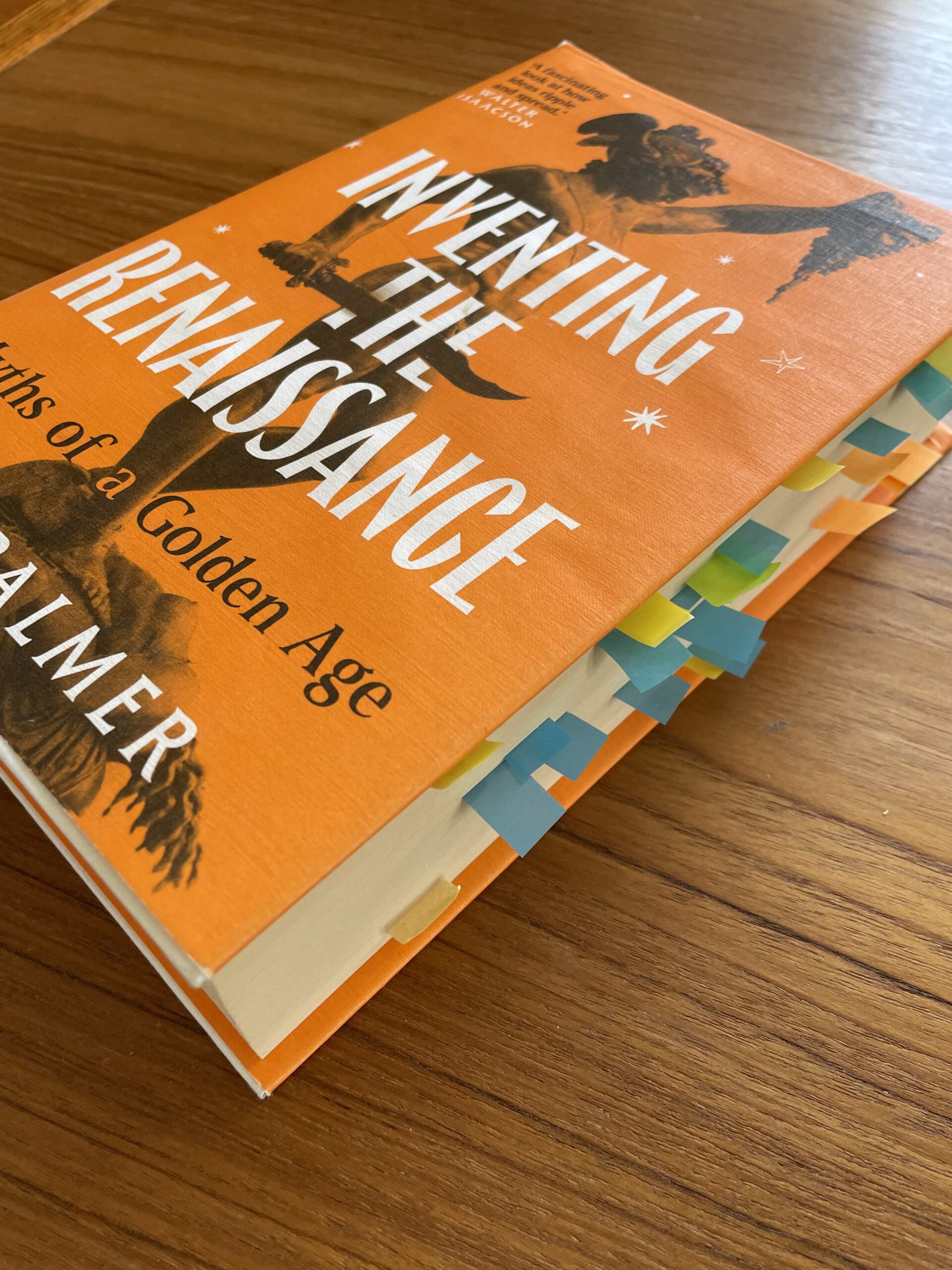
The key word in the title of Ada Palmer’s Inventing the Renaissance is the first one: inventing. History happens day by day every day, but looking back and giving it form, giving it a shape, is what historians do. The Renaissance is an idea, and over 650 pages of primary text Palmer explores how that idea was created, refined and spread, and how the idea has changed over time, up to and including the present day as historians and interested lay people continue to examine the Renaissance. Those questions also include whether a thing called the Renaissance happened at all. Palmer is chattier and more direct than most writers of history. She often talks about “the history lab,” by which she means the various settings in which historians gather evidence, discuss their findings, and engage in the ongoing work of interpreting the past. Here are two early examples.
I want to show you historians at work. But how can I invite you to question, judge, and distrust historians without inviting you to distrust me too? So you’ll see Ada Palmer in these pages: my jokes, my anecdotes, my favorites and grudges, and I’ll trust you to judge me as you would any friend telling a story, an act of fun, nerdy enthusiasm, sharing the fruits of my labor of love. I hope dropping my own veil will help as I then pull the veil from my fellow historians who, over centuries, for good and ill, mythmade the Renaissance. And hopefully hereafter, when you pick up other histories whose careful authors stay concealed behind their veils, you’ll see the hidden human underneath a little better. (p. xxi)
If you’re looking for the giant scholarly footnote listing fifty books on Machiavelli, this isn’t that kind of book. In the coming chapters, as appropriate in a public-facing history, endnotes will credit individual scholars at the moment I draw on each, and will recommend further reading on each topic, giving preference to books in print, books easily accessible via e-book editions and modest cover prices, and books with the kind of approachable prose one might read for pleasure. Comprehensive reviews of scholarship can be found in the sources I cite. (p. 1)
(Speaking of scholarship, I was personally pleased to see Medieval Ethiopian Kingship turn up in Palmer’s notes. One of the recurring themes of Inventing the Renaissance is how interconnected Europe of the period was, with Constantinople a key source of sources, ruling families intermarrying, ideas crossing long distances, and all shores of the Mediterranean playing a role while more distant shores gradually come to shape European developments.)
Inventing the Renaissance is about how history is made, but of course it is also about the Renaissance, and more specifically about how over time it has been contrasted with the Middle Ages and held up as a Golden Age. Which is funny for a number of reasons that Palmer explores, not least because the period that different fields consider the Renaissance is a matter that varies by literal centuries. The first third of the book considers the invention of the Renaissance as an ongoing search for the characteristic (Palmer calls it the “X Factor” for the purposes of her narrative) that separated the Renaissance from the Middle Ages and made it the precursor of modernity. Along the way she takes aim at the thesis that the Renaissance was a Golden Age, making the argument that it was far more a case of “Desperate Times and Desperate Measures,” as she titles the book’s Part II.
The middle third of the book is a collection of fifteen portraits of figures from the Italian Renaissance, concluding with three chapters and a coda concerning Machiavelli, Palmer’s closest candidate for the Renaissance man. She chooses the subjects of her portraits to illustrate various aspects of the Renaissance, including the accidents of history that have made some people almost universally known, Michelangelo, while others who were near the peak of their societies have come to languish in relative obscurity, Josquin des Prez. (He was a composer so well known in his lifetime that other composers put his name on their works in hopes of bringing in more money. He is also one of the few superstars of the day who rose from genuinely humble origins.) The section is not intended as a comprehensive survey or even as a “greatest hits” collection; instead, these are people whose interesting lives reveal aspects of Palmer’s arguments about the Renaissance. I wish I had realized going in that this is really the heart of the book. I spent too long thinking, ok, these are interesting examples but when will Palmer get back to the overview. She’s arguing inductively, providing examples that will make greater sense of the theses when she returns to them in the book’s final third.
Shortly after this year’s Hugo finalists were announced, I came across the argument on a podcast transcript that Inventing the Renaissance should not be on the ballot because it was about history, not about science fiction. Leaving aside the very problematic assertion that Hugo administrators should set aside nominators’ preferences (I suspect that when the nominating statistics come out, Palmer’s book will rank high among the finalists) there is the point made by one of the podcasters that 2024’s winner in this category, A City on Mars, is not about science fiction either. History and worldbuilding are both immensely important to science fiction and fantasy. How many novels in the genre are re-workings of Earth history? How is worldbuilding — the interpretation of events, people and objects to make a narrative — handled in the case of the planet humans know best? These are core aspects of science fiction and fantasy, and Palmer’s book is a full-length and multi-layered examination of all of them. Not only does Inventing the Renaissance belong in Best Related Work, it deserves to win the 2026 Hugo.

 Al Singh
 Doug Merrill
 Doreen Sheridan
 Emily Lauer
 John Pitzel
 Lars N. Goldschlager
 Laura Eilers
 Professor X
 Robert Maedgen
 Sylvere Ap Leanan
 The Shire