
I continue to be genuinely pleased and impressed by the consistently high quality of this children’s graphic novel series, that speaks just as meaningfully to any adult with an interest in popular (and sometimes not-so-popular) history as to any curious child.
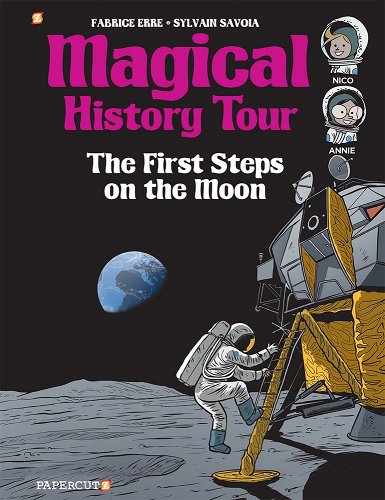 The tenth installment of the Magical History Tour has Annie and Nico discussing spaceflight, with a focus on moon landings. It’s a very of-the-moment topic even despite the events discussed within the book’s pages having occurred over half a century ago: with the United States’ Artemis program currently in more or less full swing, interests are running high in space exploration once more. And while the recently delayed Artemis 1 was meant to be an uncrewed mission, our intrepid sibling narrators discuss the more interesting, at least to me, topic of all the crewed missions to have left earth for, orbited and landed on the moon.
The book begins with Nico on his trampoline, and Annie jokingly cautioning him not to launch himself to the moon. This leads to their discussion of the history of space travel, from the fanciful/prescient pop culture fantasies of the early 20th century to the actual rocket science developed by German engineers during World War II. The end of that conflict saw the United States and Russia scooping up German scientists as part of the nascent Cold War, with the space race beginning in earnest once the Soviets sent Sputnik I into orbit. After cosmonaut Yuri Gagarin became the first man to orbit the earth, US President John F Kennedy vowed to send and safely return a man to and from the moon by 1970. Mission accomplished, as this book details, tho President Kennedy was no longer alive when that historic moment finally came.








 Al Singh
 Doug Merrill
 Doreen Sheridan
 Emily Lauer
 John Pitzel
 Lars N. Goldschlager
 Laura Eilers
 Professor X
 Robert Maedgen
 Sylvere Ap Leanan
 The Shire