
Oh, boy, am I the worst person to send a speculative fiction mystery to when the mystery is, at best, mid. And that’s the thing: these mysteries could be so good, and have so much to say about the human condition as we hurtle into infinity, if the ideas were at all fleshed out and given room to breathe.
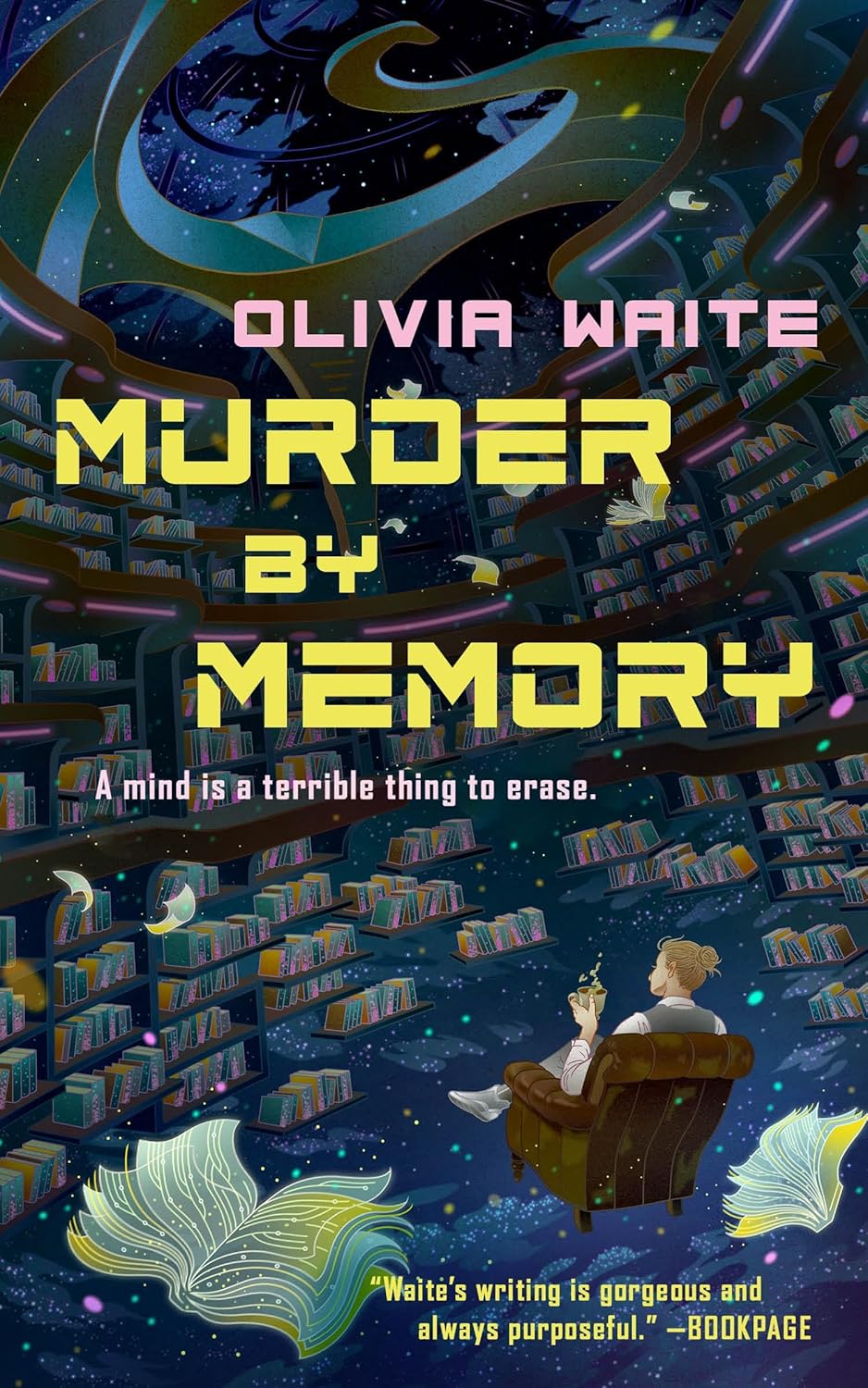 Which is a bit ironic given that being fleshed out is one of the core technologies at the heart of these novellas. The basic premise is that instead of generation ships carrying humanity to new life on a distant planet, the inhabitants have the ability instead to write their memories and personalities into digital books stored in the ship’s Library. These can then be re-downloaded into newly created bodies based on each individual’s own genetic codes when their old ones expire, whether from natural causes or otherwise. The people aboard the HMS Fairweather have thus been alive for centuries.
Ship’s detective Dorothy Gentleman had elected not to be immediately reborn after her latest death, and has essentially been hibernating for the past two years. She’s thus startled, as Murder By Memory begins, to find herself rudely awakened, and not in a body corresponding to her own. Instead, she wakes up in an elevator, her personality and memory abruptly thrust upon another’s in an emergency action that the ship’s computer Ferry has deemed absolutely necessary.
It seems that while the ship is weathering a magnetic storm, some of the books in the Library have been damaged beyond repair, including Dorothy’s. Given her importance to the ship, Ferry shunted her consciousness into the first available body, knowing it would be able to sort everything out later. But another emergency has come up: there’s been a murder aboard the Fairweather. And who better than the newly reanimated ship’s detective to solve it?









 Al Singh
 Doug Merrill
 Doreen Sheridan
 Emily Lauer
 John Pitzel
 Lars N. Goldschlager
 Laura Eilers
 Professor X
 Robert Maedgen
 Sylvere Ap Leanan
 The Shire