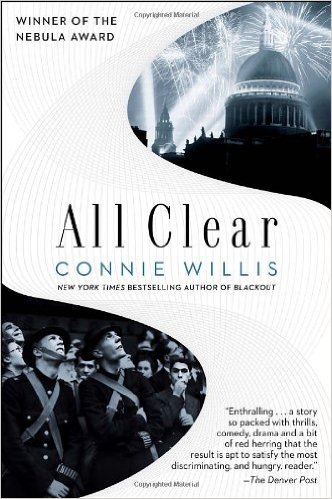
All Clear, which picks up right where Blackout left off and comprises the second part of an 1100-page story, would have been a brilliant book at about half or two-thirds of its 640-page length. The ending has emotional power; it resolves the main question running through the books and ties up the characters’ individual tales satisfyingly, but it’s a long way to get there. I like big books and I cannot lie, but even though I have just finished All Clear this afternoon I would be hard pressed to say what the characters were getting up to in the first 300 or so pages.
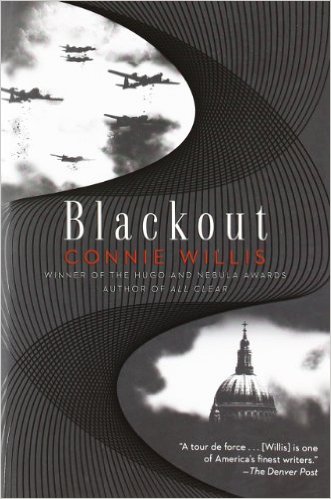
The three historians from the future who were separated through most of Blackout have found each other by the time All Clear begins. They are still cut off from 2060s Oxford, and they cannot understand why. Worse, a historian cannot visit the same day in the past twice, and so at least one of them who had a previous research assignment later in the war is facing a deadline in a very literal sense. Time is no longer on their side. They also convince themselves that the reason the drops are not opening and allowing them to return to the future is that they have somehow altered the course of history, and the Oxford that they knew in the future has ceased to exist. In the first parts of the novel, the historians react to their reunion and their joint predicament largely by retreating into their circle of three and cutting off most contact with the contemporaries with whom they had forged bonds in the previous book. That struck me as both bad behavior on their part and inconsistent with the way they had been portrayed up to that point. It also seemed an odd authorial choice, as interesting characters were mostly set aside for a series of wild goose chases. Another odd choice was to have the historians at least partly come to the conclusion that the continuum of history itself is trying to kill them and many of the people around them, in an attempt to prevent the historians from altering events. But when characters in a novel started talking about history taking specific actions, it was impossible for me not to see the hand of the author, and my suspension of disbelief started to fall apart.
It’s possible that Willis wanted readers to experience the length of wartime Britain in some way as the people of the period did, and that’s why the first half of the book felt like an uncertain slog, full of bombs and raids and destruction. It’s possible that her material just got away from her, as happens to the best of authors from time to time.
 Al Singh
 Doug Merrill
 Doreen Sheridan
 Emily Lauer
 John Pitzel
 Lars N. Goldschlager
 Laura Eilers
 Professor X
 Robert Maedgen
 Sylvere Ap Leanan
 The Shire