The premise of Naomi Novik’s Temeraire novels is simple: Patrick O’Brian with dragons instead of ships. What’s not to like? The first three or four books are pretty much a lark. The history is alternate – dragons! – but not too alternate, because otherwise there wouldn’t be any Royal Aerial Corps, nor any wicked Napoleon to fight. It doesn’t pay to think about the premise too hard. The notion that the presence of dragons in human history would lead to precisely the same configuration of events that allowed a young Corsican to be Emperor of France and would-be conqueror of Europe collapses as soon as it is plainly stated, so I will take it for granted and run with it. Which is precisely what Novik does, with panache.
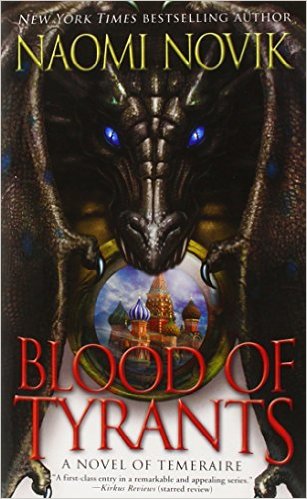
The dragons in Novik’s world are sentient, and some are large enough to carry a crew of dozens of humans into aerial combat. The British, from whose point of view she tells the first few novels, regard dragons as beasts whose abilities to fight and talk make them useful but also dangerous. They are treated poorly, kept away from most human settlements, and strictly regimented by the Aerial Corps. The Corps itself is the most disreputable of Britain’s armed forces, the more so because dragons sometimes bond with women, accepting no one else as their captain.
In the first book, circumstances align to forge an unbreakable bond between a hatchling, soon to name himself Temeraire, and Capt. William Laurence, a Royal Navy officer of noble birth and high social standing. That volume, and the ones that follow mix exploration — Laurence is learning the strange customs of the aviators at the same time the readers are — and adventure. Part of the fun is watching how Novik arranges events so that dragons’ involvement in major battles of the Napoleonic wars changes the main line of history not a whit, something of an anti-butterfly effect. It’s a neat trick, when deftly done, and Novik is reasonably deft. Temeraire and Laurence are also a fun pair to spend time with; they’re not quite Aubrey and Maturin, but that is an awfully high bar to clear. It’s also fun to see their stock in the service rise, as Laurence becomes less of a stiff-upper-lip Navy man and more of a freethinking aviator, while Temeraire’s abilities grow far past expectations.
Precisely those developments, however, lead the series into more treacherous waters. Temeraire is too powerful for the balance of forces in Europe to stay the same, even after a similarly powerful dragon turns up as an ally of Napoleon. It’s as if Patrick O’Brian’s hero had discovered he was captain of a dreadnought in the middle of the age of sail. The stories are no longer yarns of adventure, but Novik is not yet ready to change European history. Her solution is to send her protagonists around the world (the Napoleonic wars had a global scope), but that brings in another difficulty: history outside of Europe is much more alternate. Africa, for instance, has a very different political setup than was known in our timeline. In South America, the Spanish never conquered the Inca, and a possible alliance between Napoleon and the Inca Empress drives the plot of one of the later books. These differences prompt more thinking about the premise of the series, which can’t really stand up to the scrutiny.


 Al Singh
 Doug Merrill
 Doreen Sheridan
 Emily Lauer
 John Pitzel
 Lars N. Goldschlager
 Laura Eilers
 Professor X
 Robert Maedgen
 Sylvere Ap Leanan
 The Shire