
I picked up A Parish Chronicle because I had never read anything by Halldór Laxness, and this looked short enough to be a low-investment place to start. Mission accomplished, then, for the publisher Vintage Classics, who issued the book as part of their “Brief Encounters” series, which they flag as “Short books. Timeless stories.” Other authors in the series include Margaret Atwood, Jane Austen, J.G. Ballard, Roberto Bolaño, Mikhail Bulgakov and Italo Calvino, and that’s just from the first three letters of the alphabet. The works chosen for these authors are also not the obvious ones, by and large. It’s nice to be in the target audience: people who might like to take a flyer on a big literary name without committing to one of the major works. Joyce but not Ulysses; Toni Morrison but not Beloved (though that one is fewer than 400 pages); Melville but not Moby-Dick. Thus with Laxness, I didn’t have to dive in at the deep end with 500+ pages of Independent People; I could sample the 112 page of A Parish Chronicle.
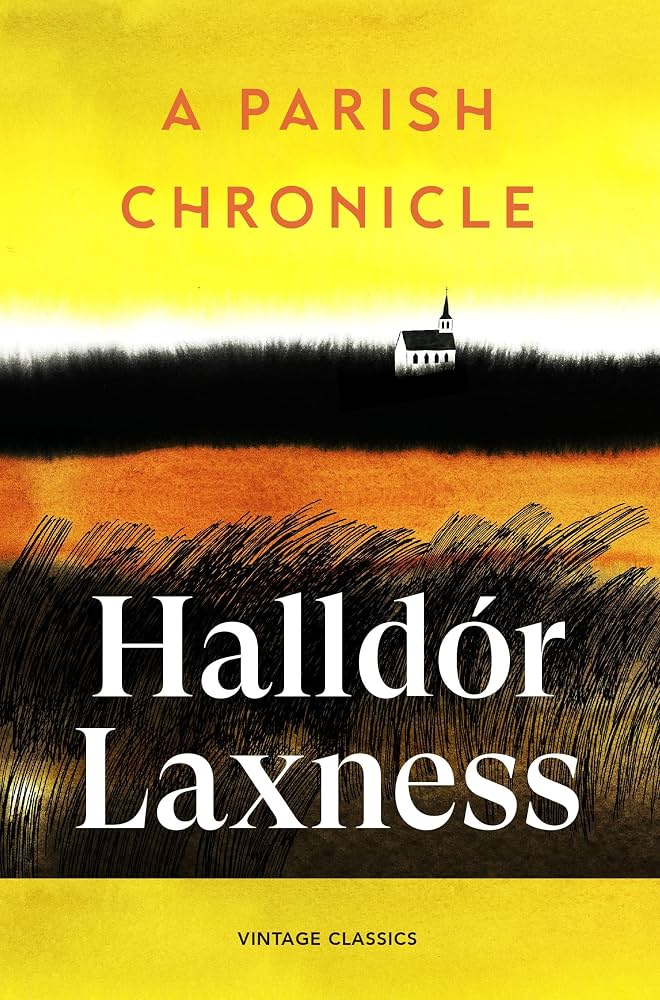
The parish in question is Mosfell, which Laxness portrays as an out of the way place in western Iceland, somewhat on the way from Reykjavik to the northern coast. It may have been such in the mid-1800s when the bulk of A Parish Chronicle takes place, but in fact it is all of 12 kilometers east of the capital. Travellers occasionally pass through, bringing news of weather and sheep from other places, those two topics being the main items of interest in and around Mosfell. The locality was the site of the burial mound belonging to Egill Skallagrímsson, a saga poet. When Christianity came to the country, his remains were exhumed and brought to a church. Whether his bones — reputed to be inhumanly large — are still located somewhere in or near the church is difficult to say.
If you look at Mosfell now, you would think that the church had been there on the hill, its steeple silhouetted against the clouds, since ancient times. This, however, is not the case. Again and again this church disappeared from the hill. Over and over, it was thoroughly erased from the pages of history and omitted from the laws of God and man, failed to appear in written documents, was neglected in oral tradition. (p. 2)
By the time the Reformation rolled around, the church had disappeared and been re-built at least twice, the land had passed into private hand, and though Lutheranism brought a new church, no one could remember to which saints Mosfell had been dedicated, relics were lost, as was Egill Skallagrímsson’s head. Laxness, through a chronicler who appears occasionally in the text writing about himself, limits his interest to a narrower period. “Here, the story will be told of how the church was dismantled and razed to the ground for the third time in the latter part of the 19th century.” (p. 3) The Danish king apparently first ordered its removal, and the consolidation of several parishes in the area, in 1774. Part of the story of A Parish Chronicle is slowness and indolence. Iceland is not a priority for the King of Denmark, and Mosfell is not particularly a priority for anyone except the few dozen people who live on the dispersed farms of the parish. They have no inclination to tear down their traditional church, and certainly no desire to become a subordinate part of another parish, and there the matter rests for many sheep-shearing seasons and years.
Eventually an ecclesiastical dean bestirs himself to put the orders into practice, and this causes what passes for a hubbub in the community. Meetings are held; letters are written; people appear to be in favor of contradictory proposals. Some hope for an intervention in their favor by a more senior authority. Some cause a ruckus that then peters out. Meanwhile a serving girl gets lost in a snowstorm but is later found. People who have known each other all their lives exchange few words; traditions persist. Days grow longer, hay is made, days grow shorter, snow returns.
Eventually, as the chronicler stated, the church is razed to the ground. The bell and the chalice, along with a few additional precious items are nowhere to be found. It goes without saying that Egill Skallagrímsson’s remains remain lost. More years pass, and the technological age gradually makes its presence known in Mosfell, mostly through the striking good luck of an orphan who was passing through the area. He was invited in for the night by a family that never invited anyone in, and he stayed for 20 years, becoming an adopted son and an unlikely vehicle of a new era. Short chapters make up this short book — there are 23 all told — and Laxness’ chronicler leaves much unsaid, and the rest unexcitedly related. Some parts are almost funny, and might be more so if a reader stopped to think about them longer. The characters are peculiar in the way of people who have lived amongst themselves for a long time, not remarking on their oddness because it seems self-evident to them. I can see that Laxness is a formidable artist who can conjure lives with just a few words, and who can make improbable tales seem obvious by telling them so straightforwardly, but on the whole I found A Parish Chronicle drier work than I wanted to spend a whole lot of time with. Good to discover that from a shorter book.
+++
A Parish Chronicle was originally published in 1970. This edition is a new and able translation from 2026 by Philip Roughton.

 Al Singh
 Doug Merrill
 Doreen Sheridan
 Emily Lauer
 John Pitzel
 Lars N. Goldschlager
 Laura Eilers
 Professor X
 Robert Maedgen
 Sylvere Ap Leanan
 The Shire