This year’s list of Hugo Award finalists in the category of Best Graphic Story of Comic is unusual in that for the first time since 2016 neither Saga nor Monstress is among them. The balance between one-offs and continuing characters/series is a little more usual, with three volumes from each. The ongoing series are a little unusual, in that one is the start of a new continuity, one is part of a long-running webcomic, and only one — the Wonder Woman book — features a familiar character from a traditional comics publisher. The three stand-alones are a children’s book that is almost entirely art, a graphic novel, and an adaptation of a beloved fantasy classic. I vastly preferred the stand-alone works, as will become clear from these notes on the finalists, in ascending order of my preference.
The Power Fantasy Volume 1: The Superpowers starts a story about superpowered beings in the post-WWII era, a story that will presumably run for a considerable number of additional issues. Doreen reviewed it here, and liked it much more than I did. I did not make it to the end of volume 1. A psionic massacre in the White House and, I think, across the US government is where I noped out. Under Trump 2.0, friends have had careers destroyed; the personal intervention of Elon Musk and his DOGE boys sparked gratuitous waste on an epic scale, and will cause many, many thousands of needless deaths. Friends who have stayed in public service have had their work made needlessly more difficult, just to stroke the overweening egos of rotten men. Others I was once close to but have not kept up with may have had their careers destroyed simply because it was their time to rotate back to the States instead of staying in the field. One friend was personally hounded out of an ambassadorial posting in a war zone because she would not tell egregious and easily disproven lies on Trump’s behalf. Though it was not a literal massacre like the one depicted in the book, it was close enough that I did not want to read more, not least because the prologue and couple dozen pages that served as an introduction did not have me invested enough in the characters to go along on a ride of cosmic destruction. The art was striking, but it did not induce me to care what happened to those people.
The creators of A Girl and Her Fed were excited enough about their Hugo nomination that they put together a one-page introduction specifically for the readers’ packet. Their enthusiasm was a delight! I learned that the work that’s a finalist is part of a webcomic that has been running for more than 20 years. The story’s third act, which wrapped up in October 2025, runs to 469 pages, of which the last 60 or so are part of the packet. I did make it to the end of this one, but I spent much of it lost, lost, lost. This story also featured a lot of scenes in the White House, and a lot of death in the intimate circles of the American president. I get it, the president stands in for maximal power, and for comics that want to reach for that archetype the White House is a go-to location. But gah, I bounced right off; I couldn’t suspend my disbelief, even for a comic. There’s obviously a dedicated fandom for A Girl and Her Fed and good luck to them, but between coming in to the story so far along, not getting attached to any of the characters, and finding the politics simplistic at the very best, I did not become a convert.
Absolute Wonder Woman Vol. 1: The Last Amazon combines a retelling of Wonder Woman’s origin with a present-day supernatural threat to Gateway City (the in-world stand-in for San Francisco) and, presumably, the world as a whole. In this version, Apollo brings Diana to Circe, who then raises her alone. Apollo forbids Circe to say the word “Amazon,” thus denying Diana knowledge of her heritage. The story alternates between Diana’s childhood and a desperate situation in the present day, as supernatural creatures emerge from a gigantic tetrahedral structure that has suddenly appeared suspended in the air just off the coast of Gateway City. The military is predictably pompous and ineffective; Diana is equally predictably in charge and up to the task, even though she wields a cleaver-looking weapon as tall as she is, which would seem awkward. In the end, it takes magic, cleverness and sacrifice to save the world above from the monstrous menace. Just after the victory, though, the hand of Hades reaches up from the underworld to pull Diana down to his throne room, beginning the second story collected in this volume. What follows is a riddle game of sorts, and also something of a grand tour of Greek mythology. I’m not sure how many retellings of Wonder Woman’s origin I have seen or read; this one was, I think, unusual in not having a society of Amazons but only Circe. I don’t know whether this is a change in DC’s overall continuity regarding the character, or whether it’s just a way of looking at her for these stories. Nor am I really sure what was in it for a reader not already deeply invested in Wonder Woman. It’s very likely that I am simply outside the target audience — after more than 40 years of reading explosive apocalypses in comic format, I’m not really seeing anything new in this one, especially as there was so little build-up.
In The Invisible Parade, young Cala wakes on the first day of November to a chill wind blowing branches against her window. There is a big party planned for that night — everyone in her household, everyone in town — is getting ready for it, but Cala does not feel like going, so soon after her beloved grandfather died. Cala is wearing a black one-piece with a skeleton’s bones showing in white. The red scarf wrapped around her neck is a big one, sometimes billowing outward like a cape. It is the Day of the Dead in the unspecified part of Mexico where the story takes place. Everyone is preparing for the grave visits and festivities of the night, but Cala is just sad. All of the art in this gorgeous book is two-page spreads that capture the mood, sometimes with a tableau, sometimes with Cala in motion against a background or interacting with another character. The text is brief, allowing a reader to sink into the gorgeous pictures. At the cemetery, Cala gets separated from her family and comes face to face with some of the terrors that she had barely allowed herself to name. She wins through in the end, of course, and finds her way back to her family, wiser for the experience. Though the story is simple, the effect is lasting, like the best children’s tales always are.
Thank goodness for The Space Cat for ensuring that not all of this year’s finalists were tales of woe and epic conflict. It starts with the words, “Hi. My name is Pumpernickel Pickle Periwinkle Chukwu Okorafor. You can call me Periwinkle.” He’s the eponymous cat, narrating this tale of an American cat transported to Nigeria with his people: “the Nnedi” and her teenage daughter. He has huge ears, extremely short hair and large blue eyes that give him one of his names. He’s a happy and playful cat by day, and by night he enters the liminal space he has made into a lair, and in there he has built a spaceship that he uses to go exploring. And to race, especially against another cat he calls Orange Meow. The first race in the book ends in embarrassment when Periwinkle’s new battery, which looks very much like a Duracell, runs out of charge faster than he expects. Orange Meow zips past him, blowing a big cat raspberry as she goes. There’s more exuberant storytelling as Periwinkle relates not only his first days with the Okorafors but also the great hot sauce incident and how owlie gets what he deserves. Adventures really start when the Nnedi’s publisher sets them up for a year in Nigeria to write her next book. There are space aliens, there are Nigerian folk prejudices about cats, there are the other animals that Periwinkle gets to know while in the cargo hold on the way to Lagos, there are local cats, and of course there is more space racing. The story is fast-paced, pitch-perfect and hilarious. I’m grinning all over again looking through The Space Cat to write these notes. There’s a happy ending, of course, and one last fun twist at the end. Space Cat is a hoot, in the best way possible.
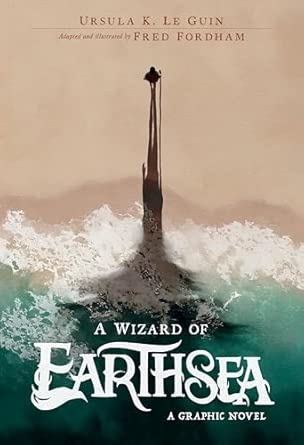
A Wizard of Earthsea was a formative book for me as a young reader, and the rest of the trilogy my introduction to Le Guin though I did not read any more of her work until many years later. On the other hand, I have not read A Wizard of Earthsea this century, and possibly for a decade more than that. That combination may have made me an ideal reader for Fred Fordham’s adaptation into a graphic novel. I remembered the outlines of the story, and how it felt, but I had forgotten nearly all of the details. Fordham’s art is simply gorgeous. His watercolor palette captures the climates and moods of the islands of Earthsea, from the close interiors of Sparrowhawk’s village on Gont to the wizard’s school on Roke to the menacing dragon of Pendor, and much more. The two-page spreads of the sea struck me particularly, showing how small even a powerful wizard is, as compared to the sea and the world. Fordham has replaced many of Le Guin’s words with his art, but he has kept the sense, the spirit, the most important dialogues. This one is a keeper, a classic, and in my view the best of this year’s nominees for Graphic Story or Comic.
+++
This is the fifth bit of Hugo-related writing that I have done since I started addressing the finalists in a concentrated way. I wrote about What Stalks the Deep (Best Novella finalist) and The Incandescent (Best Novel finalist) prior to knowing that they would be Hugo finalists. I have also already voted in categories where I do not expect to have anything particular to say, and I will be refraining from voting in categories that I don’t really partake of (Best Fancast) or that irritate me for idiosyncratic reasons (Best Semiprozine). Emily, Doreen and I had a chat about this year’s finalists not long after they were announced, and I expect that we will have a follow-up after the winners are announced in late August.

 Al Singh
 Doug Merrill
 Doreen Sheridan
 Emily Lauer
 John Pitzel
 Lars N. Goldschlager
 Laura Eilers
 Professor X
 Robert Maedgen
 Sylvere Ap Leanan
 The Shire
5 comments
Skip to comment form
Genuinely impressed that you read all of them so quickly! I’ll probably hit this category up once I’m done with Novelette and Novella.
Author
Thanks!
The Wizard of Earthsea adaptation hit perfectly at just the right time, and then Space Cat was such a joy. The two non-superhero stories were both short, even though I didn’t much care for Girl and Her Fed. I skimmed a good bit of the Wonder Woman, and I bailed early on in Power Fantasy. You gave it a good and fair review back in April. I guess what I’m saying is that it all went faster that I had expected. Now to see what I have to say about the short stories. Reading after that will probably be Novelette and Poem; I’ve read all the novellas and voted, but I have yet to write them up. My top vote in that category wasn’t what I thought it would be going in!
Random thought: I wonder what Hugo-like ranked choice voting would do to the Oscars.
Doug! I feel like I have found part of my tribe. I had similar feedback on all the graphic novels. I genuinely wish I had not wasted my time with “Power Fantasy,” “Wonder Woman,” or “A Girl and her Fed.” I was confused about why Cala’s story was nominated (ghosts?) but loved The Space Cat so much and your desciption of ‘cat raspberries’ is exactly what my Orange Meow does.
Author
Welcome! And thanks for reading! Thanks also for the pointer back to your blog; I’ve already enjoyed reading some of the recent items.
I think The Invisible Parade got nominated because it’s gorgeous. Picacio is also well known among Hugo nominators (19 nominations and three wins, according to his website), so it seems a natural that a single work would make it to the list of finalists.
Doreen and I continue the discussion on this category a bit over at her review of The Space Cat.
Thanks! This is my first year participating in WorldCon; I knew nothing about it six or seven months ago. I signed up and I’m still looking for a place to stay in Anaheim within walking distance of the convention center which isn’t exorbitant before charging a daily parking fee (EEP!)
I agree – “The Invisible Parade” is gorgeous. I didn’t look up the artist to see his connection to the Hugos. There was just SO MUCH CONTENT in the nominee packet. I’ll check out Doreen’s review next!