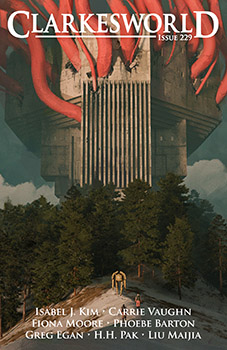
Getting a much earlier start with this year’s slate of Hugo nominees than I did last year’s, go me! And, as with last year’s short story slate, my favorite comes from Isabel J Kim, with her diabolical Wire Mother.
 Perhaps diabolical isn’t the best description, but after reading the bland obviousness of most of the other nominees, it was nice to get into a story that’s messy and mean and thoroughly believable.
Our prickly young heroine Cassie has been diagnosed with Emotional Contagion Deficit, a condition where she has trouble bonding with digital people. This includes her digital mother Amy, to the chagrin of her fully biological father. As Cassie sometimes wants to tells him, while he could build Amy to love him and the things he loves, he couldn’t build Cassie to do the same, so stop trying to make them bond already.
I really don’t want to say too much else about this story because it’s full of sharp surprises, but I very much appreciated the skepticism with which Ms Kim addresses the idea of AI personhood under circumstances which are essentially a realistic extrapolation from where we are as a society today, both technologically and emotionally. I also appreciated how she underscores the complexity of the matter, in the persons of both Rina and Oliver. WM is both a clever interrogation of the happy clappy idea that chatbots are actually people and a warning against the trouble inherent in conflating the two.
My runner up is Tia Tashiro’s Missing Helen, which does an excellent job of subverting both form and expectations as a woman learns that her ex-husband is set to marry her own clone. As a teenager, Helen sold her genome in much the same way that young women today are able to sell their eggs. She was legally prohibited from contacting the child that resulted, so didn’t talk about it much as she grew up, met and married Mark, then eventually signed their divorce papers. Learning that he’s not only going to remarry but is going to wed her clone sets off a chain of quietly devastating but also illuminating events.
There were relationship bits that had me baffled until the twist, tho I still don’t understand why Mark would stick to the story that he’d never really seen or understood Helen’s neediness until after they’d married. That aside, this was an emotionally satisfying read with cleverly envisioned technology and a well-executed literary trick that I very much appreciated.
In third place is Effie Seiberg’s Laser Eyes Ain’t Everything, a pointedly satirical look at a world where superpowers are real. The narrator is already using a wheelchair when a freak accident gives her the ability to shoot lasers from her eyes. She’s excited to join her local union of super-abled, until she realizes that they have no accommodations for her as a wheelchair user. In her efforts to be accepted, she decides to track down the elusive super-villain Doctor Croc by herself, and finds a lot more than she bargained for.
I loved the idea of this story but the execution felt very unpolished, particularly in the dialog. It feels as if the author pulled back a little too much from the sardonic edge of satire and landed on earnest After School Special messaging instead. It’s a good story that feels like it could have been great. I guess it works for the purpose of getting people to care about accommodations without feeling attacked tho.
I’m honestly still having trouble sorting out how I feel about the last three stories. I think I’ll put Samantha Mills’ 10 Visions For The Future; Or, Self-Care For The End Of Days in fourth, even tho I’m twitching a little at the pretentious punctuation of the title alone. I usually love the listicle as short story (sorry, Doug!) but this one, detailing ten different and usually outlandish ways in which the world could end, didn’t feel like it offered anything that hasn’t already been said before. Surprise, our current existence is just one hellscape among others! It’s a perfectly fine, run-of-the-mill story that I feel like I’ve read dozens of times before.
Thomas Ha’s In My Country is a thinly veiled parable of our authoritarian hellscape as yet another dystopia, distinguishable from all the others we’ve read about since 1984 only by some of its details. If this short story opens somebody’s eyes to the insidious ways in which people are controlled by oppressive governments and their propaganda arms, then good. It’s a perfectly fine, run-of-the-mill story that I feel like I’ve read dozens of times before (and yes, I c&ped that from the last paragraph.)
Finally, we have JR Dawson’s Six People To Revise You, a story I’m not sure how to talk about without being mean. Imagine a future where you can have yourself surgically “revised” in order to become the best version of yourself, at a steep but insurance-covered price. As part of the process, you have to get feedback from six important people in your life on what you should have improved. This is, ofc, an entirely ludicrous proposition — there’s no way that the companies pushing what’s essentially a vanity-driven therapy a la cosmetic semaglutide would allow non-medical professionals to influence the outcome like this — and serves primarily as set up for the struggling main character to be affirmed by people who actually love them instead. Even this wouldn’t be so bad if it weren’t for the fact that I agreed more with the ex-friend than with the main character. The MC is a sad sack looking for a shortcut to personal growth. The entire exercise felt like emotional masochism in search of validation.
And look, if this story makes anyone who’s struggling with their identity feel better about themselves, then that’s grand. But being the speculative equivalent of, at best, Chicken Soup For The Soul doesn’t mean this should win a Hugo.
Anyway, that was my grumpy review of this year’s slate of Best Short Story Nominees for the 2026 Hugos, and now I’m off to vote accordingly. As always, each story is linked so you can judge for yourself. And you can check out some of my actual favorite reading from this year so far below:

 Al Singh
 Doug Merrill
 Doreen Sheridan
 Emily Lauer
 John Pitzel
 Lars N. Goldschlager
 Laura Eilers
 Professor X
 Robert Maedgen
 Sylvere Ap Leanan
 The Shire