
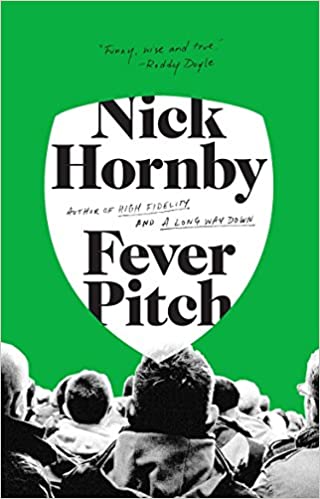
 Deeeeeep siiiiiiigh.
I know I touted this as the seminal guide to understanding the Arsenal fan — as that’s how it’s long been sold to me — but after actually reading the book, I unhesitatingly recant my endorsement. This was the most excruciating nonsense I’ve read in a long time. And here’s the thing, as someone who’s been in love with the Arsenal since 1997 — admittedly, some years after this book is set — Fever Pitch should have been right up my alley. I, too, over-identify with my beloved team and treat them like a pillar of my personality. I have suffered through many lean years in which non-Arsenal fans greeted my declaration of allegiance with either polite bafflement or outright mockery. I have gotten up at nonsense hours countless times to watch games live via satellite TV, either alone on my parents’ living room couch in Malaysia or here with my friends in the Washington DC area, well before our sports bar’s regular opening hours. I’ve traveled absurd distances both up and down the East Coast of the USA and across the Atlantic to watch my lads (and lately my ladies) play. My work and social schedules are entirely and unapologetically at the mercy of the Arsenal fixture list. So I understand the devotion that drives the often miserable conditions of being a Gooner, as we Arsenal supporters have been called long before more recent usages of the term.
Imagine then my dismay when I had to endure this absolute bollocks of a book that I was entirely predisposed to liking! The experience of reading it felt like eagerly attending a family reunion only to have to grit my teeth when an obnoxious uncle loudly insists that everyone else present — and especially the women; the misogyny in this book is through the stadium roof while also oblivious as to how it contradicts itself — can’t be real fans because we’ve never had to tough it out like he did.
Guys like this, for real, are the reason no one likes football fans or wants to be one of them.
What really annoys me about this book is that it’s less about the Arsenal and more about the witteringly unsympathetic personality of one of their fans. Honestly, you could substitute any other team (like, say, the Bosox, lololol) and it wouldn’t matter one whit. What surprises me is how popular this book has become with so many readers. Like, they understand that this guy is only fixating on the Arsenal because it happens to be his borderline-autistic special interest, right? Worse, the Arsenal is just window dressing to his incredibly dramatic worldview, where he refuses to take the initiative and be the main character of his own life, yet somehow insists that he must be the main character of other’s existences. This portrayal of the sports fan, and particularly the diehard supporter of any one particular team, as a self-centered sad sack is such a disservice to the vast majority of fans who “somehow” manage to balance lifelong commitments with normal everyday lives. I was genuinely appalled at the bullshit he gave an Arsenal-supporting partner about potentially having to share a season ticket should they have children, picking a fight with her until she agreed that he’s a better fan so would deserve to go more than she would. What an utter manchild. I hope to God this is just a bombastic snapshot of who the author was at the time and that he’s grown up significantly in the thirty-five or so years since publication.
For all that, I hope that there are parts of himself that he doesn’t lose. I would be especially thrilled if he’s dropped the nauseating idea that loving Arsenal is akin to a disability, but very much hope he still treats it as a religion. This memoir is also an interesting artifact on life as an Arsenal fan before the Wenger era. In 1996, (my Papa) Arsene Wenger came in as manager and built something truly extraordinary, embracing innovation, science, multiculturalism and character in a way that often saw his vision of club football stand alone against the malign influences of racism, xenophobia and financial doping, among others. Mikel Arteta has picked up that (e)standard and added greater levels of inclusion, tactics, belief and grit. I hope Mr Hornby has enjoyed the football of these last thirty years as much as I have, and hopefully even more than in his first thirty years of being a Gooner.
Anyway, I kinda want to write my own memoir of supporting the Arsenal now, if only because this book is very much not representative of most of the 21st century Gooners I know, including and especially myself. Hell, it’s not even representative of most modern sports fans! And for all that I deride the American adaptation of the film adaptation of this book, it certainly improves on the latter’s bizarre affirmation of the idea that liking sports is childish and should be left behind once maturity is achieved. I regret to inform those who might believe otherwise that having hobbies is healthy actually.
Perhaps times have changed and society is now more accepting of people having interests and connections outside of work, family and organized religion. Instead of stewing miserably as part of a neo-feudal-capitalist world, where the focus and energy of the consumer must prioritize work first and the creation of more workers via family second, all to enrich the lives of the landowner/capitalist class, fans nowadays are allowed to like things for our own emotional benefit without being derided as selfish or immature. And while this review is not going to delve further into an examination of the evolution of the leisure class, I can certainly recognize and appreciate how Nick Hornby’s rebellion, even if unknowing, against that restrictive system with this book paved the way for greater acceptance of passion in fandom — even if he himself was a prick to other fans.
For better or worse, FP is very much a product of its time and its author’s depressive viewpoint. Honestly, I wouldn’t recommend reading this today as anything more than a historical curio. Just as sports are a constantly shifting, living thing, so too are its fans. This book is an illuminating portrait of times past that feels increasingly less relevant as times progress and people learn how to make healthier choices that successfully integrate our own desires with the mercifully more generous expectations of the modern world around us.
Fever Pitch by Nick Hornby was first published in 1992 by Gollancz and is available from all good booksellers, including

 Al Singh
 Doug Merrill
 Doreen Sheridan
 Emily Lauer
 John Pitzel
 Lars N. Goldschlager
 Laura Eilers
 Professor X
 Robert Maedgen
 Sylvere Ap Leanan
 The Shire
2 comments
This is a terrific review! Your exasperation at what a great book it could have been but wasn’t comes through so clearly.
Author
I wanted it to succeeeeeeeed! Had a great time at Book Club discussing it today tho, so it wasn’t a complete waste of time.