One of the ways that the Folly — the secret unit of London’s Metropolitan Police Service that deals with the supernatural — is integrated into regular police work is that they receive reports concerning missing children. Apparently in previous eras, rogue practitioners used to use children for some very rogue practices. And so Nightingale dispatches Peter to fictional Rushpool in not-entirely-fictional Herefordshire on the English-Welsh border to lend a hand to the local police in the disappearance of two eleven-year-old girls.
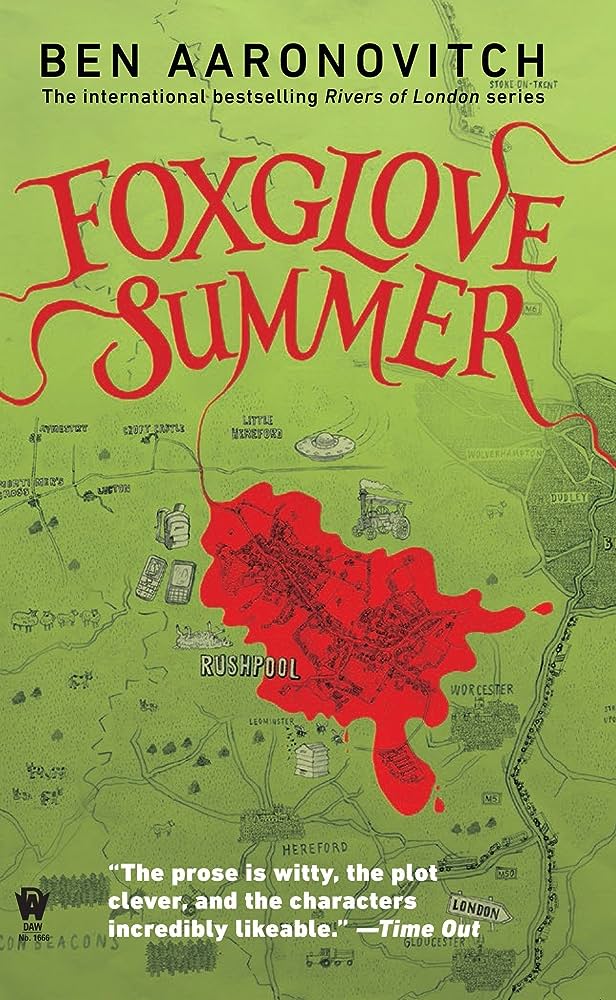
Nightingale explains:
“… It’s always been our policy to keep an eye on missing child cases and, where necessary, check to make sure that certain individuals in the proximity are not involved.”
“Certain individuals?” I asked.
“Hedge wizards and the like,” he said.
In Folly parlance a “hedge wizard” was any magical practitioner who had either picked up their skills ad hoc from outside the Folly or who had retired to seclusion in the countryside—what Nightingale called “rusticated.” (p.5)
Nightingale has someone in particular in mind.
I popped back to the Folly proper and met Nightingale in the main library where he handed me a manila folder tied up with red ribbons. Inside were about thirty pages of tissue-thin paper covered in densely typed text and what was obviously a photostat of an identity document of some sort.
“Hugh Oswald,” said Nightingale. “Fought at Antwerp and Ettersberg [the WWII clash between British and German magicians that left few alive on either side].”
“He survived Ettersberg?”
Nightingale looked away. “He made it back to England,” he said. “But he suffered from what I’m told is now called post-traumatic stress disorder. Still lives on a medical pension—took up beekeeping.”
“How strong is he?”
“Well, you wouldn’t want to test him,” said Nightingale. “But I suspect he’s out of practice.”
“And if I suspect something?”
“Keep it to yourself, make a discreet withdrawal and telephone me at the first opportunity,” he said. (pp. 6–7)




 Al Singh
 Doug Merrill
 Doreen Sheridan
 Emily Lauer
 John Pitzel
 Lars N. Goldschlager
 Laura Eilers
 Professor X
 Robert Maedgen
 Sylvere Ap Leanan
 The Shire