Witness In Death (In Death #10) by J. D. Robb

It’s weird, I feel like this should have been a more powerful story for me. All the plot points are there, plus it’s set in The Theatre, so this is exactly the kind of mystery I should love.

But there was something about it that was a little too overwrought, IMO. The killer’s little asides, in the form of a journal of some sort, felt jarringly out of character and not at all in step with the tragedy of the thing. And I really wanted to feel for Eve and for how this hit home and all that but… Idk, maybe if I hadn’t read it immediately after the self-pitying Conspiracy, if I’d had the sheer thriller of Loyalty as a buffer, maybe I would have liked this better. There’s a lot to be said for reading series fiction in order, after all.

Which makes the fact that I won’t have time to read more of this series before the latest comes out for review a greater pity. I rather like the sly subversiveness of the male-female relationships in re: physical attractiveness, and even if the initial coming togethers of the characters are the corniest things ever, the growth of the relationships afterwards are interesting to watch.

So many books, so little time! Would that my younger self had had this richness.

Permanent link to this article: https://www.thefrumiousconsortium.net/2016/12/24/witness-in-death-in-death-10-by-j-d-robb/

Wrapping Up

Both reading and writing have slowed significantly since November 8, and not only because of the election, though that has certainly played a major part in my slowdown. Time for some short takes, to clear the desk for the coming year.

Catch-22 by Joseph Heller. I read this in the summer, and I’ve been searching ever since for something new, or at least new-ish to say about the book. I haven’t succeeded. It’s as great as its reputation: bleakly, mordantly hilarious, with a core of humanity amidst the random and heartless horror of industrial war. The edition that I read has a preface that Heller wrote in 1994, detailing the combination of hard work, crafty promotion and good luck that built the book’s initial success and opened the door to perennial sales. I found that fascinating for its insight into how culture is produced. I wondered about the character of Milo as an anti-Semitic stereotype; I’m still not quite sure what I think on that score. A major major book.

Necessity by Jo Walton. The third in her Thessaly trilogy, in which Apollo and Athena set up a society for people to try to live in Plato’s Just City. I’m glad that I read these three as they were released, because the beginning of each successive volume is a huge spoiler for the ending of the previous book. Knowing that there are three, and knowing a little bit about each in advance will change the experience of reading the set. (Like knowing there’s Before Midnight and Before Sunset that follow Before Sunrise.) The other two did more for me, especially The Philosopher Kings. I think that’s because in this third volume Walton, of necessity, widens her focus. I preferred the tight constraints of the first two stories; I found that they gave an emotional sharpness to the events. There are some terrific moments in Necessity, especially the style of writing taken up by one point-of-view character, but I think I am more likely to return to either of the first two books.

Continue reading

Permanent link to this article: https://www.thefrumiousconsortium.net/2016/12/21/wrapping-up/

Conspiracy In Death (In Death #8) by J. D. Robb

Undoubtedly the weakest of the first nine books. I’m v glad I read this only after the ninth, as I would have strongly suspected the dreaded 8th-book slump and written off the rest of the series (well, excepting for the fact that I’m being paid to review the ninth, so would have read that anyway.)

The world-building is terrific as always but the intuitive leap that breaks the case made no Goddamn sense, and then there’s all the masochistic bullshit Eve puts herself through against the orders of doctors and her bosses. It’s one thing to understand her reactive stubbornness against her husband, Roarke, when he’s likely talking out of his ass half the time (and oooooh, that one scene where she goes to him looking for comfort and he’s a total asshole to her instead, on purpose, and I’m supposed to believe that this makes their relationship stronger instead of cracking a big fucking gap between them is toooootal bullshit) but to flay herself open despite the advice of experts in the field made me question all her judgment forever. Luckily, the next book, Loyalty In Death, does a much better job of having her not suck, so there’s that. Also? There’s absolutely nothing in this book that you have to read to make any sense of the next one, so I’d highly recommend skipping it.

Permanent link to this article: https://www.thefrumiousconsortium.net/2016/12/18/conspiracy-in-death-in-death-8-by-j-d-robb/

Holiday In Death (In Death #7) by J. D. Robb

Another solid installment to the series. Loved the Christmas murder angle, even if I thought it was obvious, the way it usually is in Law & Order episodes, whodunnit. I also really enjoyed the exploration into Eve’s psyche: it’s nice that she’s kind of a horrible person but is working really hard at not being one (even if I thought that she was way out of line with Peabody, not necessarily when she yelled at her for Peabody’s dating choices but because of how rude she was when Peabody was, rightly, offended and stand-offish after. You can’t order someone to be your friend, Eve.) It also continues to wow me that anyone thinks Roarke is anything like a real person. I’m almost at the point where I’m thinking Roarke is a hallucination on Eve’s part, and that she really just happened to inherit a huge amount of money and this is her way of dealing with both her inheritance and her repressed sexual urges. Certainly a safer way of dealing with such than the perps in these books do!

Permanent link to this article: https://www.thefrumiousconsortium.net/2016/12/09/holiday-in-death-in-death-7-by-j-d-robb/

Naked In Death (In Death #1) by J. D. Robb

(Hunh, I thought I’d posted this when I’d originally reviewed it. Apologies.)

There is so much about this book to like, from the fully realized near-future setting to the compelling, scandalous murder mystery to the damaged protagonist (and victims) to the clear moral and political stance J. D. Robb has on women’s rights and crime and violence. But. And here I’d like to take a moment to assure readers who are fans of this series that what I’m about to say isn’t a criticism of you personally. Everyone is entitled to like the characters and relationships they enjoy, and when I criticize one of those, I’m not telling you you’re a bad person with terrible taste. There is so much about this book that is awesome, and woman-positive, but there is one hugely questionable part of it, and when I talk about him (yes, him, and you already know where this is going,) I want you to realize that this isn’t a criticism of you or the good parts of the book or your enjoyment of the book at all. But I can’t not talk about something, someone so problematic.

So yes, obviously, Roarke. My criticism is two-fold, and first is the believability of his feelings as presented in this book. Guys, no one falls in love like that. No one who’s made their money out of illegal dealings, who’s been involved with that many women, who’s clawed their way to respectability, is as open with their most vulnerable feelings the way Roarke proclaims to be. I buy that tough, damaged Eve Dallas shoots herself in the foot by getting involved with him. She’s completely believable, even when she’s being unbelievably stupid. But he is not a real person. No one who’s evaded suspicion and placing trust like that their entire life would then jeopardize their sense of self by telling a cop that they love her and meaning it, not over the course of several days.

But more importantly, I was really disturbed by his manipulative, abusive behavior. It’s not okay for him to ignore her stated wishes. At the very least, it’s disrespectful, and a terrible basis for a healthy relationship. Sure, he does nice things, but he also does really crappy things, and it all looks like he’s creating an unhealthy atmosphere of unpredictability around her that depends solely on his whims. That is classic abusive behavior, which I found completely repulsive. I’m supposed to believe that he knows better than she does what’s good for her, and that’s a negation of her personhood that I find utterly distasteful. Sure, he doesn’t actually sexually or physically abuse her, but treating her like less than a grown woman who needs to make her own decisions is a belittling that makes their relationship imbalanced and, again, unhealthy.

Also, the sex in this book really wasn’t that great. I’m glad I read Book 2 first because it’s definitely better than this one, and I can only hope that the series continues to improve as it goes along. This book was published in 1995, after all, and plenty of things change in twenty years. Hopefully, the books’ awareness of what’s healthy and not in a romantic relationship is one of those things that improve for the better as this series progresses.
Permanent link to this article: https://www.thefrumiousconsortium.net/2016/12/05/naked-in-death-in-death-1-by-j-d-robb/

Fables: The Deluxe Edition, Book Two by Bill Willingham et. al.

The only problem with reading comics in their original single-issue format is that, if you’re like me and disorganized and somewhat absent-minded (and thus, the kind of person who finds Goodreads a godsend for its ability to help me keep track of what I’ve read and what I haven’t,) a lot of times, you don’t remember whether you’ve read this or that issue or arc, especially if your comic-reading heyday was also when you moved around a lot a/o had to put books in the rather dubious care of family members.

Anyway, I was at the library the other day, spending far too much time fruitlessly hunting down a book for work. To console myself at the disappointment, I decided to take a look at the graphic novels section, and found they had almost all of the Fables Deluxe Editions! Having read most of the first Fables when they came out in single issues, then later when they were collected as trade paperbacks and bookstores were my primary source of comics-reading material, I wanted to pick up where I’d left off… only I couldn’t for the life of me remember where that was. Also, my phone bricked that day, further adding to my glum mood, so I couldn’t check Goodreads on the fly. What better reasons to just go ahead and restart the series! They didn’t have Book One, but I was pretty certain I’d read at least that, so I snagged far too many of the following volumes to take home and read between, um, other books.

And it was a lot of fun, just having an hour or so to myself between work assignments last night, to sit down and read this volume through. I knew so much of the general story but had forgotten so many of the details, and even plot points. It was nice to delve back into it and be able to read it all in one sitting. It was also nice to be reading it with my tablet by my side so I could look up the more obscure references (e.g. Aucassin and Feathertop,) an advantage I certainly didn’t have when first reading this series, oh gosh, I don’t even want to think how long ago.

Anyway, I’m super glad the Montgomery County Public Library has these, because they’re a terrific way to re-experience one of the best comic series ever published. Great writing, great art (especially Mark Buckingham; I still think of him and Chris Bachalo as Team Chrucky,) and a great addition to the library of any comics aficionado who can afford the splurge.

Permanent link to this article: https://www.thefrumiousconsortium.net/2016/12/05/fables-the-deluxe-edition-book-two-by-bill-willingham-et-al/

Hag-Seed by Margaret Atwood

This was 324 pages, really? It breezed by so quickly, an under-rated quality in serious fiction, and I was so, so happy to not cringe my way through another of Margaret Atwood’s recent works. Of course, she’s not completely off the hook, but her modern-day adaptation of The Tempest, a novel about a man whose life parallels the play’s in so many wondrously meta ways, is a sure-handed examination of what is easily my favorite of Shakespeare’s plays, sans the tiresome preachiness that permeates her eco-dystopian novels. There are, of course, bits that align themselves too easily with the play but, as with its source material, Hag-Seed isn’t above a little hand-waving to reach a neat conclusion.

And I really, really liked how Ms Atwood translated the play into the prison setting. Her empathy with the prisoners and her support for their literacy and enrichment programs was clear throughout, as was her belief in the transformative powers of the arts. I did also find myself admiring the lyrics she wrote, tho I did keep wondering if those were Hamilton-inspired. The chapters where the prisoners described the play’s characters’ after-lives were also compelling.

I’m not sure if I’ll read more of the Hogarth Shakespeare series, but I’m really glad I picked up this one. It’s a beautifully layered, swift and elegant read that incorporated the source material in an effortlessly clever way.

Permanent link to this article: https://www.thefrumiousconsortium.net/2016/12/03/hag-seed-by-margaret-atwood/

The Sellout by Paul Beatty

I picked up this book hoping for a little comfort after the recent elections but found something else instead: stark truth served up as satire. The stark truth is rarely comforting but — and this is why the book merits four stars from me rather than three — in Paul Beatty’s hands, it is not bleak. And that’s a big deal, because hope and confidence in humanity, and not in government or in external forces but in ourselves and our immediate societies and the lives we immediately touch, are underrated sentiments that deserve to be spoken of and written of more often, and not just as platitudes but as calls to action to examine ourselves and see how we can be and do better.

The Sellout highlights the hypocrisies of modern American society, and in so doing leaves no sacred cow untipped. It skewers the notion of a post-racial society, of the idea that competition is discouraging and unnecessary, of the belief that any person, much less community, is somehow special simply by virtue of existing. It emphasizes that identity matters, but only as a secondary to good, moral actions, and that complexity is something to be engaged, not shied away from.

Unfortunately, the book itself is sloppy in terms of narrative, particularly towards the rather abrupt ending. I feel that the Supreme Court case was given too little shrift, even as I appreciated the accurate portrayal of Washington DC. I’m not 100% certain how I feel about this as a Booker prize winner, though I certainly enjoyed it more than last year’s a A Brief History Of Seven Killings. I wish I had time to look through the rest of the offerings on the shortlist, but I will say that The Sellout isn’t unworthy of the honor, by virtue of its searing, sharp message alone, if not necessarily in form.

It was also interesting to note the differences in the two library systems I considered borrowing this book from in digital format. The DC Public Library had 7 people each waiting for 15 copies, while Montgomery County’s had 1 person each waiting for 8 copies. I opted for the latter, of course.

Permanent link to this article: https://www.thefrumiousconsortium.net/2016/11/14/the-sellout-by-paul-beatty/

Glory In Death (In Death #2) by J. D. Robb

A solid near-future police procedural, with a fully realized setting that falls firmly on the side of feminism and social justice. It isn’t the most inspired mystery — I figured out whodunnit 56% of the way in — but the world building and the cop talk more than made up for it.

The thing that drove me nuts about this book, tho, isn’t even the romance between the heroine, Lt Eve Dallas, and her billionaire boyfriend, Roarke. They’re two damaged people (or assholes, if you’re feeling blunter) who don’t know how to deal with being in love so behave acutely terribly to one another. In that, it’s realistic, but it really irritates me that people find this awful behavior aspirational. Example of unacceptable behavior: when Eve is reluctant to move in to Roarke’s mansion, he moves all her stuff over without telling her. As a friend said, Eve should call herself on him, because that’s not okay.

The first few sex scenes were also pretty intense in a good way, but it just got kinda gross as the book progressed, to the point where I was wincing because some of the stuff described just sounded painful (and I’m a middle-aged married mother of three who definitely sowed her wild oats.) Anyway, I’m not turned off enough by Roarke to stop reading the series, because the rest of the book was pretty neat; I just hope that this relationship improves with time.

Permanent link to this article: https://www.thefrumiousconsortium.net/2016/11/08/glory-in-death-in-death-2-by-j-d-robb/

Baptism of Fire by Andrzej Sapkowski

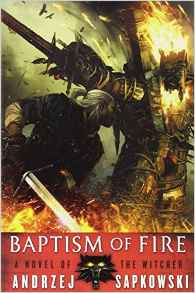
Andrzej Sapkowski’s novels of the Witcher, Geralt of Rivia, came late to the English-speaking world. Baptism of Fire, the third novel in a long narrative about Geralt, about wars overwhelming the world that he knows, and about a child of prophecy, was published in Poland in 1996. It was published in English in 2014, by which time editions had already appeared in Czech, Russian, Spanish, Lithuanian, German, French and Serbian. The series’ fifth (and presumably final) book will appear in English in 2017, nearly 20 years after its initial publication. I was introduced to Sapkowski’s writing in 2012 by a Russian friend, who was surprised that such a big-name author was practically unknown in my language. For someone like me who is used to thinking of English as the most important language for fantasy literature, it’s odd to feel so late to the party. But that may be the way of things in the 21st century. Kid Three is reading (in German) the fourth book in a fantasy series by Italian author Silvana De Mari; only one of them has appeared in English.

baptism-of-fire

Baptism of Fire is a middle book that does not seem to be aware there is such a thing as a middle-book problem. Sapkowski continues the wars that were set in motion The Time of Contempt. Geralt, a classic fantasy loner-hero finds that in a war-torn land, even a preternaturally gifted fighter is no match for big battalions. Over the course of the book, an unlikely company accretes around him. The scrapes that they get into and out of, and the interactions of the lively personalities — from the irrepressible poet Dandelion to the unlikely scholar Emiel Regis or the several dwarfs and gnomes in a merchant band — bring out the fun in their adventures. The action is both fun and tense. The non-titular characters are all in real danger over the course of the book, and Sapkowski has shown in previous books that he is willing to harm his hero as well, so there are no guarantees that anyone will escape a tight situation unscathed. The characters refuse to be weighed down by the dangers that beset them, adding humor and life even in the direst of straits.

The background, though, is far from jolly. Sapkowski was born in Poland not long after the end of World War II. He would have seen the effects of its devastation all around him, and all of the adults he knew as a young person were survivors of that terrible conflict in one of its most brutal theaters. The war through which Geralt moves draws on World War II and older conflicts in Polish history, notably the Swedish invasion known to Poles as Potop, the Deluge. Bodies of troops range back and forth across the land; one’s own side can be as bad for civilians as notional opponents; the military situation is often unclear, with uncertainty increasing the chances of sudden death. Within this maelstrom, Geralt is seeking the young woman Ciri, of whom prophecies speak. Sapkowski shows her intermittently, riding with bandits and increasingly gaining a taste for fighting and killing for their own sake. There is plenty of fire for these baptisms, but it is not clear that there is any grace at all.

Permanent link to this article: https://www.thefrumiousconsortium.net/2016/11/02/baptism-of-fire-by-andrzej-sapkowski/