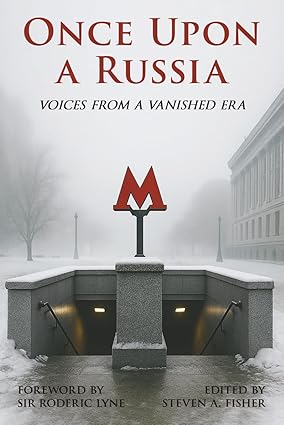
Once Upon a Russia, which carries the subtitle “Voices from a Vanished Era,” collects slightly more than 100 short essays from Westerners who lived and worked in Russia after the collapse of the Soviet Union. It’s a personal project, born of a 2024 reunion with a friend and colleague that “unfolded into hours of nostalgic storytelling, half-forgotten names, and generous pours,” as Fisher notes in his acknowledgments. (p. 237) What makes this more than just recollections among buddies is the remarkable address book that Fisher built up over sixteen years as a senior banker in Moscow and Kyiv. The ambassadors, financiers, analysts and entrepreneurs whose recollections — alongside those from people in less exalted professions — fill the book write with great openness about a historical moment that has passed.
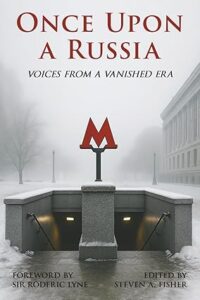
They came to Russia, they found hope, adventure, not a few found love and fortune, and they have all now left Russia. Most of them kept the love and fortune that they found there, all of them recall the adventures, but the hope, by and large, is gone. The time that the writers lost hope and left varies — some as early as 2008, some as late as the winter of 2022 when Russia launched its full-scale war of aggression against Ukraine. Some of the writers think that a time may come again when the Russia that they experienced, a Russia full of people seeking freedom and excited about the possibilities of the future, a Russia integrating with international institutions and at peace with its neighbors, a Russia that acknowledged and was beginning to welcome the diversity of its citizens, will be the face that Russia shows the world. None of them expect it to come soon.
The vignettes in Once Upon a Russia tend to follow a pattern: the writer’s initial contact with the country; the excitement, challenges, and life-changing experiences of living in Russia; the disillusionment, whether gradual or precipitous; the departure, and regret for what might have been. Some of the writers had previous experience with the Soviet Union, a few during the Brezhnev years, most during Gorbachev’s era of opening and reform. Several of them were in Moscow during Yeltsin’s confrontation with the Communist-dominated parliament and saw first-hand how people came out on the streets to defend their newly-won freedoms. Some brought with them deep knowledge of the language and country, honed by study or family connections. Others arrived with nothing more than curiosity and enthusiasm. In numerous cases, Russia was not initially welcoming, but as the contributors persevered, opened up unexpectedly. The writers built lives, they built companies, they integrated deeply in Russian life and society, mostly in Moscow but others across that vast land. Some of the diplomats returned again and again — Sir Roderic Lyne, who wrote the volume’s foreword served three times in the country and was the last head of the UK Soviet desk — before their regular rotation elsewhere. Other writers left of their own accord. Many, though, left because the advancing years of Putin’s rule made it impossible for them to stay. Harassment, confiscation, corruption — all increasing with time — led to their much-regretted departures. I didn’t count the number of who stayed until the 2022 invasion of Ukraine, but it was a noticeable share.
Continue reading
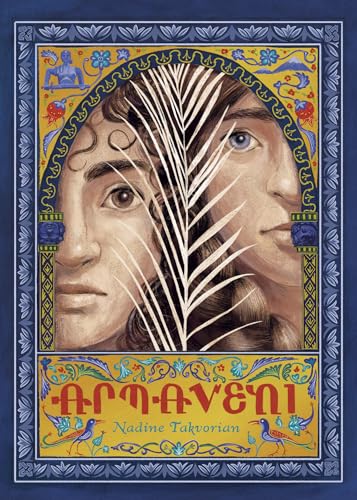 subtitled: A Graphic Novel Of The Armenian Genocide.





 Al Singh
 Doug Merrill
 Doreen Sheridan
 Emily Lauer
 John Pitzel
 Lars N. Goldschlager
 Laura Eilers
 Professor X
 Robert Maedgen
 Sylvere Ap Leanan
 The Shire