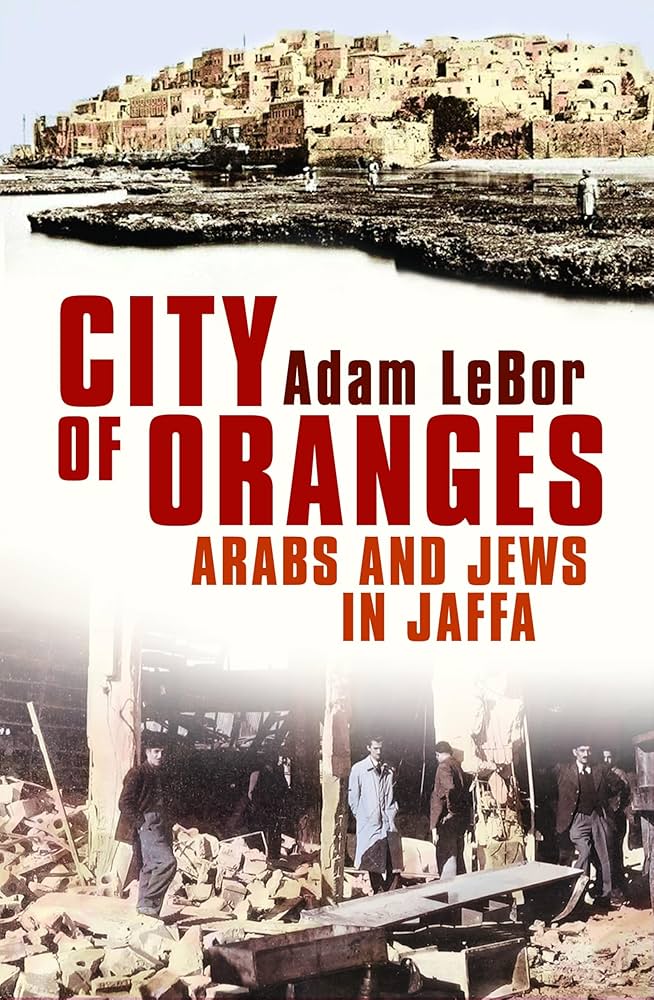
City of Oranges, which was published in 2006, must have been a difficult book to write, even in the comparatively less fraught time of the early 2000s. Adam LeBor — whom I knew a little bit many years ago in Budapest, so I will refer to him as Adam — attempts an open-minded and honest reckoning with the history of the city of Jaffa from the early 20th century to the early 21st. Inevitably, the twenty years that have passed since the book’s publication have made it a piece of history as much as a record of history, but the years have not erased the book’s value. Given the large number of people Adam interviewed in their old age, many of them have passed on by now, making their recorded recollections all the more valuable.
This is a book of people and personalities. As Adam writes in his introductory author’s note, “This book is based on hours of interviews with several generations of Jaffa families, their recollections of parents and grandparents and their memoirs, letters and personal archives, reaching back to the early twentieth century. These are their stories of their lives as they remember them. This is what they want to say, and the quotes of every interviewee have been checked back with them for accuracy.” (p. xxiii) Jaffa today is a part of the larger Tel Aviv conurbation. At the beginning of City of Oranges, it was very much the other way around. Jaffa was the political and cultural center of Palestine, which in the aftermath of the Great War was placed under a British mandate. “[Jaffa’s] oranges, especially the sweet and juicy Shamouti, were famed the world over and kept many thousands in gainful employment, including the Jewish traders who bought and sold the fruit.” (p. 2) Adam has consciously chosen to write a small-scale history, in which he can always focus on individuals. The larger currents of history are inescapable, and their ebb and flow are clearly visible in the personal stories he tell. One thing that the book really brings home is that the tides of history are never uniform; there are always exceptions; sometimes even within the same family, people will have different perspectives on the same events. Adam writes, “I hope the people featured in this book give a sense of [the Israeli-Arab conflict’s] complexity and its human dimension. They are Muslim, Christian and Jewish. They are middle class and working class. They are artisans and intellectuals, artists and businessmen. Some are left-wing, others right-wing. In short, human beings, in all their variety and contradictions.” (p. 3)
One thing that Adam has done admirably is to capture the fact that although there are two sides in the conflict, each side is far from monolithic. “On the Arab side, my starting point was to find families who had lived in Jaffa since before 1948.” (p. 3) Two families that he found are the Gedays and the Andrauses. “The Gedays can trace their roots in Jaffa for eight generations. Fakhri, born in 1927, still lives in the spacious stone house built by his ancestors in the nineteenth century, and is a fount of memories of pre-1948 Jaffa.” (p. 3) The Andraus family was similarly notable, and though Amin sent his children to Jordan when war came in 1948, he stayed in Jaffa with his aged mother, and was one of the people who signed the surrender agreement and negotiated for food, water and security for the Arab people who had remained in the city. Adam also found families who had fled, because “most of Jaffa’s Arab population did not [stay], and the experience of exile and dispossession is central to Palestinian history.” (p. 4) Some of the Arab families whose history Adam chronicles are Christian, and some are Muslim.
“For the Jewish families I also sought a mix that represented different aspects of Jewish and Israeli history: Ashkenazi, eastern European Jews who had fled the Holocaust; Sephardic and Arabic-speaking Jews; those rooted in Ottoman–era Palestine and comparatively recent arrivals.” (p. 5) The Chelouches, for example, arrived in Jaffa from north Africa in the middle of the nineteenth century. Yoram Aharoni fled Bulgaria in March 1941, the night the Nazis invaded. British authorities arrested him as soon as he arrived in mid-war Palestine. Aharoni made the world war local, joining a Jewish underground organization upon his release by the Mandate government; he spent almost six years fighting the British. Frank Meisler had been a child in Gdansk and “arrived in Britain as a schoolboy in 1939, on one of the last Kindertransports from Nazi Germany.” (pp. 5–6) Meisler chose to immigrate in the 1950s. Adam notes fissures:
It is now barely remembered that many Jewish emigrants from Arab countries and Turkey did not want to come to Israel. The educated elites of those communities relocated to France, Britain or North America. The less well–off Jews were dumped in dismal “development towns” in the middle of the desert by an uncaring and often racist Ashkenazi elite. (p. 6)
Adam finds an entry point into Jaffa’s past and present at the Abulafia bakery, a local institution that was founded in 1879 and is open around the clock. He talks with Khamis Abulafia, one of the bakery’s directors (the family also owns a restaurant, another bakery in Tel Aviv, and a property company) numerous times in the course of his research.
“… I support the Jewish people’s right to live here, but they have to understand, and to believe, that I also have that same right” [said Khamis]. I nod my agreement. This is our first meeting, but during the many weeks I spent in Jaffa I would talk with Khamis several times. For now, he is still sounding me out. The legend of Jaffa as a “special model for co-existence,” where Jews and Arabs life together in peace and mutual respect, is a bland, safe starting point. Like the shiny, renovated alleys of Old Jaffa, it has a superficial appeal. Our later discussions would be more serious, even provocative. For Khamis and I both know that Jaffa’s reality, its present and its past, is far more complex than either the tourist myth or the media coverage would lead us to believe. (p. 8)
With that introduction, Adam takes his readers back to 1921 and over the course of 25 chapters brings them up to the then-present of 2006. He shows how the families experienced political and sectarian events within the city, even as he also charts the turning generations, children growing up and then growing old. Some hold on to prosperity, some rise and fall — there is a lovely but fraught story of one family that was saved by an act of kindness from decades earlier, who then had to find the strength to risk kindness again years later when the wheel of fortune made another turn. None of it is simple, and some parts are very hard indeed. Where the kindness is personal, the violence is equally personal, and often unforgiving.
There aren’t any lessons — unless it’s that it only takes one side to make conflict — but there is a great deal of humanity and understanding.

 Al Singh
 Doug Merrill
 Doreen Sheridan
 Emily Lauer
 John Pitzel
 Lars N. Goldschlager
 Laura Eilers
 Professor X
 Robert Maedgen
 Sylvere Ap Leanan
 The Shire